Theron Couch
The 30th anniversary look at Age of Apocalypse continues (even if it’s now technically 31)…
 “Jeph Loeb and I were paired off by editorial. They’d tasked all the X-writers with reimagining their respective books’ characters in a world where Professor X never lived to create the X-Men, a dystopia where humanity was being systematically expunged, and there were very few safe places for them left in the world. Jeph imagined a version of Cable that stripped away all of his tropes; he became a boy without a past searching for purpose instead of a middle-aged man with a mission, and whose power was unfettered by the techno organic virus. Instead, he was threatened by his own destructive potential and the manipulation of secret enemies and Apocalypse himself. I was on cloud nine, I thought it was the coolest thing I’d ever heard and was feeling so lucky to be working on it.” – Steve Skroce
“I knew the book was going to do well just because it was part of this big event, but a lot of people took to Nate Grey. Whenever I’m at a con, I always meet people who loved that character and era of the X-Men. He’s got a lot of classic Marvel DNA in him: Young man, trauma survivor, and an orphan who’s been endowed with great power and has to choose how to wield it.” – Skroce
“We were surprised by the sales of X-Man. There was some discussion because it was such a hit and we were three months ahead and that ended up with us saying, ‘Can we extend it past AoA?’” – Scott Lobdell
“We found out near the end of the third issue that X-Man became an ongoing series, but I’m sure the massive success of the AoA had something to do with it. People wanted more! I think it’s still the comic I’ve done the most consecutive issues of. The hours I put in back then!” – Skroce
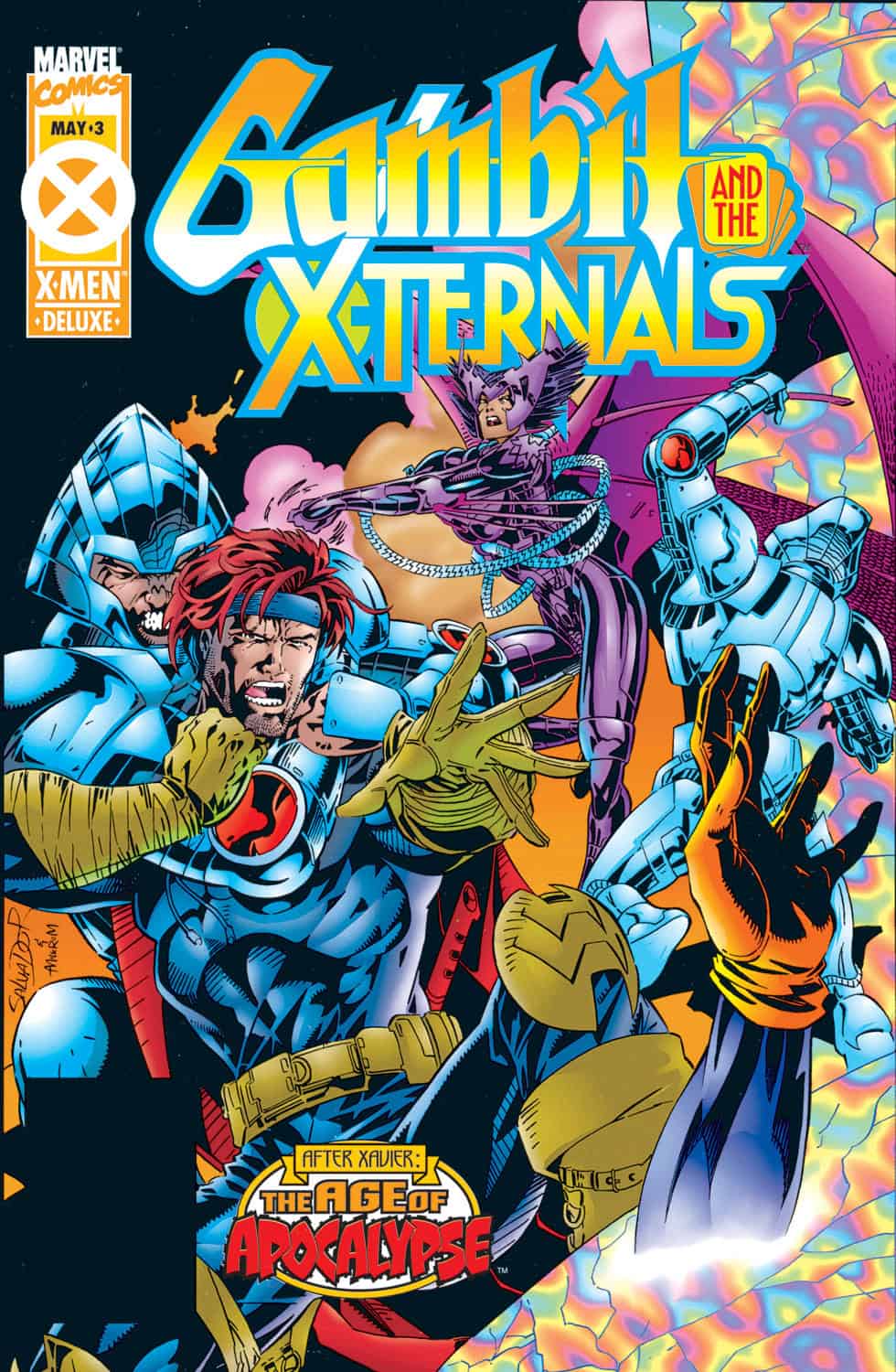 Gambit and the X-Ternals #3
W: Fabian Nicieza | P: Steve Larroca | I: Al Milgrom | C: Marie Javins, Joe Rosas, Matt Webb, Mike Thomas & Electric Crayon | L: Chris Eliopoulos
ESSENTIAL – The X-Ternals arrive at the most heavily guarded planet in the Shi’ar Imperium courtesy of Deathbird’s Starjammers. The Imperial Guard, with Rictor along for the ride, follow shortly after. Gambit is surprised to discover that the gem he’s supposed to steal is the size of a small building. As the fight between the X-Ternals, the Imperial Guard, and assorted Shi’ar forces rages, Gambit gets pulled inside the M’Kraan Crystal and encounters Jahf, the crystal’s guardian. He explains to Gambit that because Charles Xavier died in the real timeline, Jean Grey never became Phoenix and thus couldn’t repair the crystal. Once the actual reality ceased to exist as a result of this failure, it started dragging down every other one with it. Gambit is somewhat dismayed to learn that Bishop is right and this reality is a mistake. Meanwhile, outside the crystal, the universe BLINK-outs speed up and people on the planet start turning to crystal. Each BLINK is supercharging Sunspot with excess solar energy. Back inside the Crystal, Jahf tells Gambit that he doesn’t need the entire M’Kraan Crystal–a shard is just as good. But to get that piece, the Crystal demands something in return. Gambit offers his love for Rogue and gets the shard in return. Lila Cheney opens a portal back to Earth. The team departs, forced to leave an overcharged Sunspot behind.
Readers who hadn’t yet pieced together why the universe is ending get the full explanation Gambit and the X-Ternals #3. There is a bit of a contradiction in what Jahf says and how the existence of the Age of Apocalypse is explained. From Bishop and Magneto’s first encounter, this universe is treated as a mistake. Jahf confirms Gambit’s supposition that the Age of Apocalypse universe isn’t supposed to exist at all. But in the same breath, Jahf also confirms the idea that a multiverse exists. So why can’t the Age of Apocalypse exist alongside the original universe?
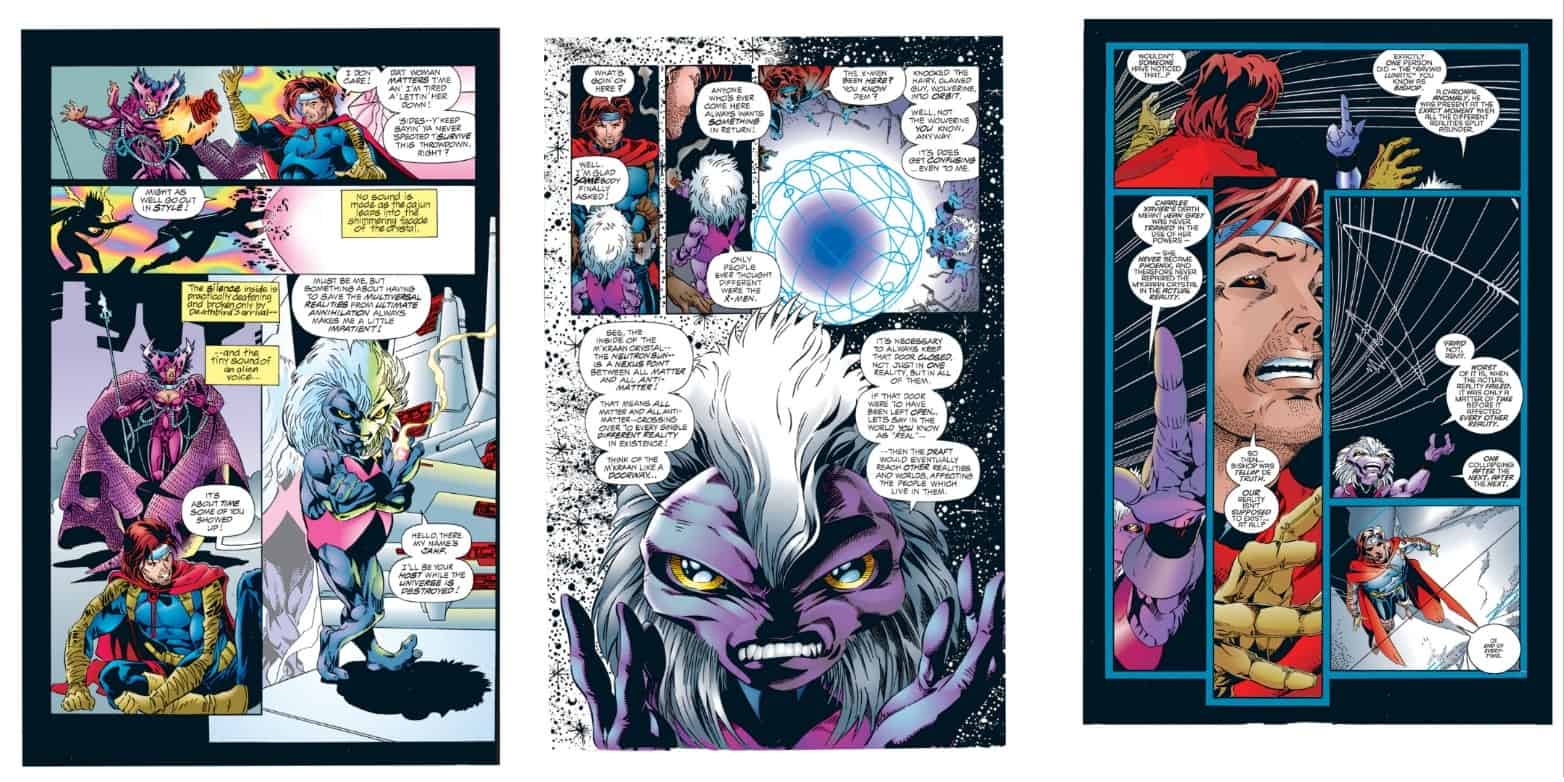 Contradiction or not, this is the first confirmation that Bishop is right–something readers knew but all the characters were taking on faith (or more that Magneto was taking on faith and everyone else was going along with Magneto). Equivalent moments, though with different responses, happen in X-Men Omega. It’s nice to see these responses. To this point the implications of what Bishop is suggesting hasn’t been met with much emotion–except, perhaps, in the case of Magneto who has become super contemplative about the whole thing. If Magneto’s plan is successful, this universe and everyone in it will cease to exist. Additionally, Nicieza’s choice to make Gambit’s response so understated, while perhaps counterintuitive, works very well.
Gambit’s stronger emotional response is best saved for Jahf’s explanation that he has to give the crystal something in trade for a shard and the realization of what the only thing he has left to offer is.
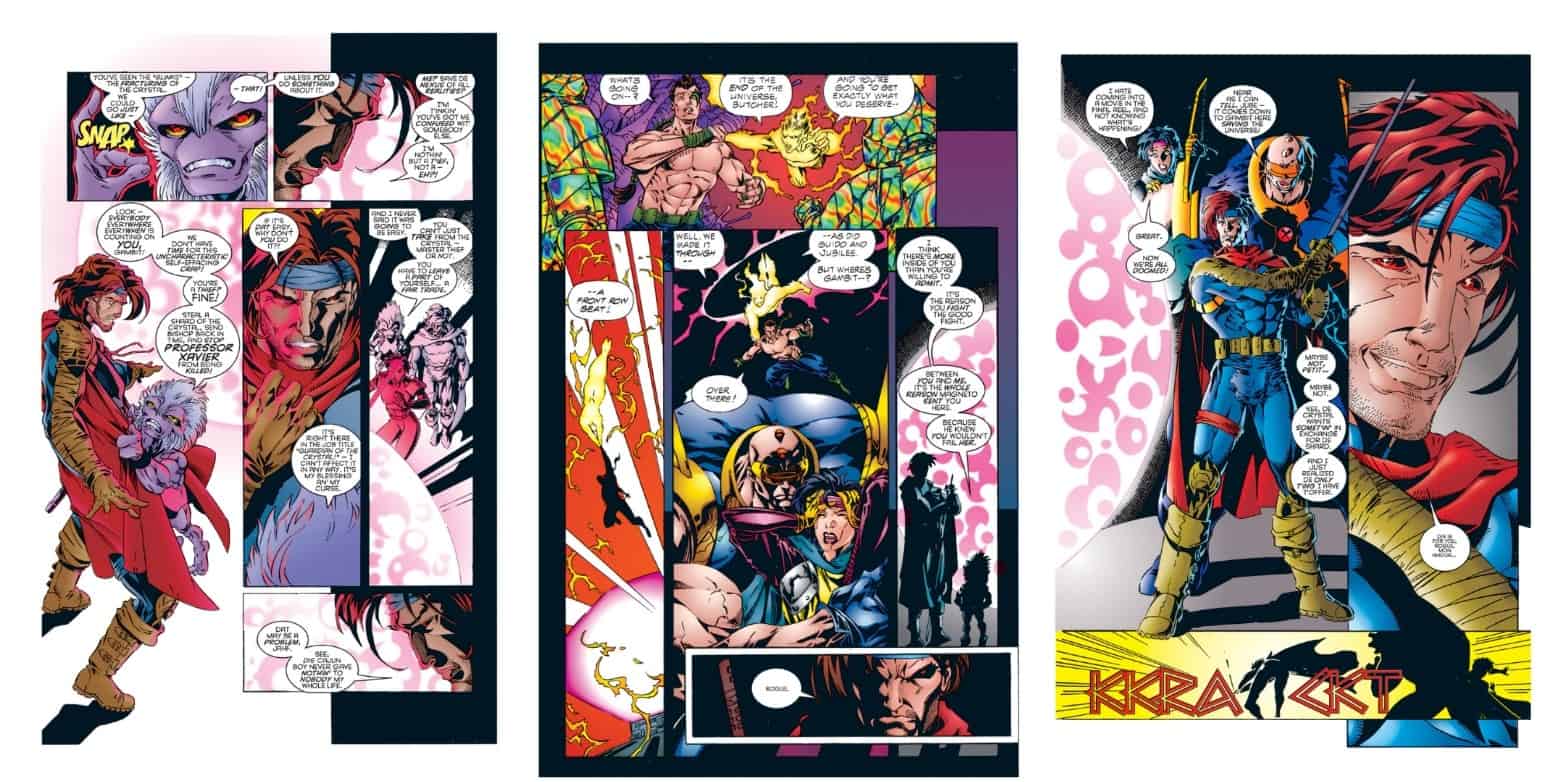 This is actually a major advancement in a solid character arc for Gambit. His unrequited love for Rogue is introduced chronologically in X-Men Chronicles #2 (though in publication order it was first seen in Astonishing X-Men #1). Gambit’s flirtatious behavior returns, chronologically, in Astonishing X-Men #1. Now that unrequited love is a major reason why the universe can be saved. This sets up a very good conclusion to the character arc in the series’ final issue.
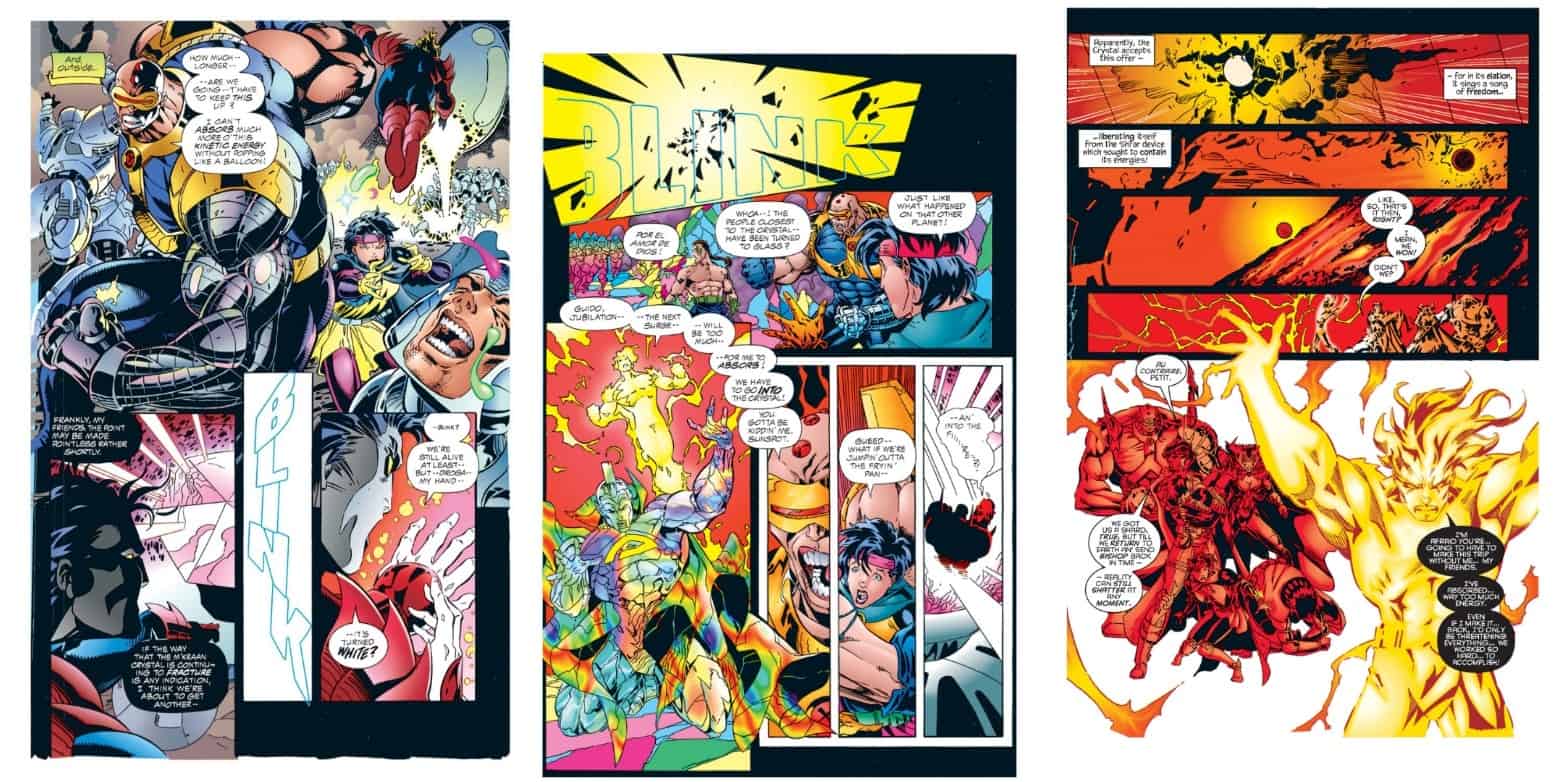 The BLINKs and Sunspot’s attempts to absorb the energy provides a nice counterpoint to the end of Legion Quest. The X-Ternals are busy pushing back and running from the onrushing end of the universe as opposed to the X-Men’s calm acceptance of the end. This is almost certainly not the point, but the heroes in Age of Apocalypse have a certain “rage against the dying of the light” quality in a more intense way than their counterparts in the original timeline.
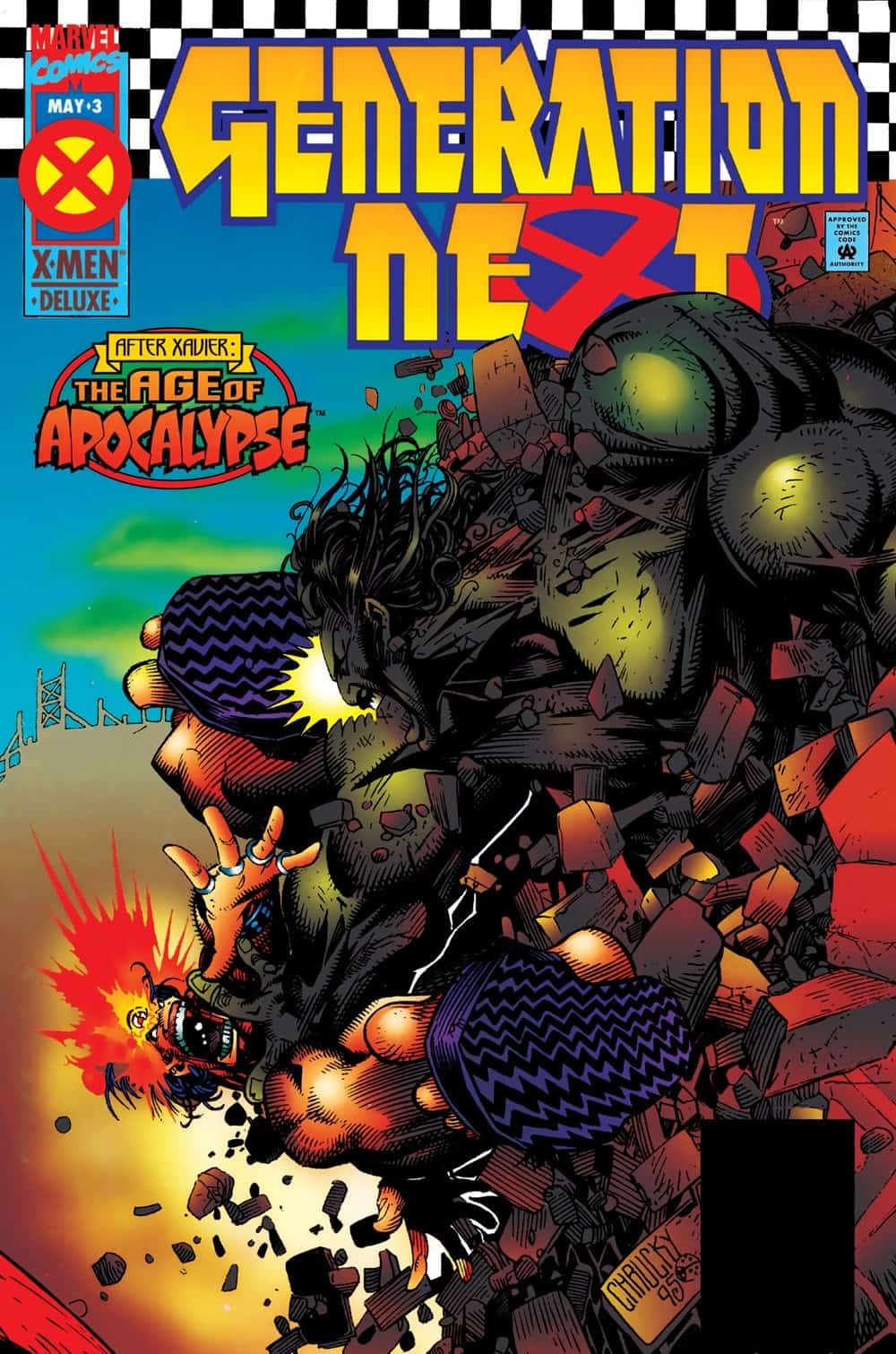 Generation Next #3
W: Scott Lobdell | P: Chris Bachalo | I: Mark Buckingham | C: Steve Buccellato & Electric Crayon | L: Richard Starkings & Comicraft
The team’s infiltration of the core continues. Chamber and Skin continue to pose as mutant workers in an effort to find Illyana. Paige and Vincente pose as Quietus, at one point dissuading Sugar Man from believing a warning that someone is planning to break into the core. Mondo uses his camouflage ability to make his way into the mine. Colossus and Shadowcat, courtesy of Shadowcat’s ability to become intangible, make their way toward the core’s front entrance. Sugar Man corners Chamber and Skin. Seemingly believing that Paige and VIncente are the real Quietus, Sugar Man orders him to kill the intruders. Colossus, advised by Know-It-All that four of their students are cornered, pushes back on Shadowcat’s suggestion that they help them. Colossus’s only concern is finding Illyana and fulfilling the mission–something Mondo has successfully done already.
Generation Next #3 is the comic book equivalent of empty calories. The only character who truly advances the plot is Mondo when he finds Illyana on the issue’s final pages. Lobdell checks in with the other characters and emphasizes their importance of the plan–but no one really does anything. This is especially noticeable with Paige and Vincente who achieve nothing despite the authority they possess by impersonating Quietus.
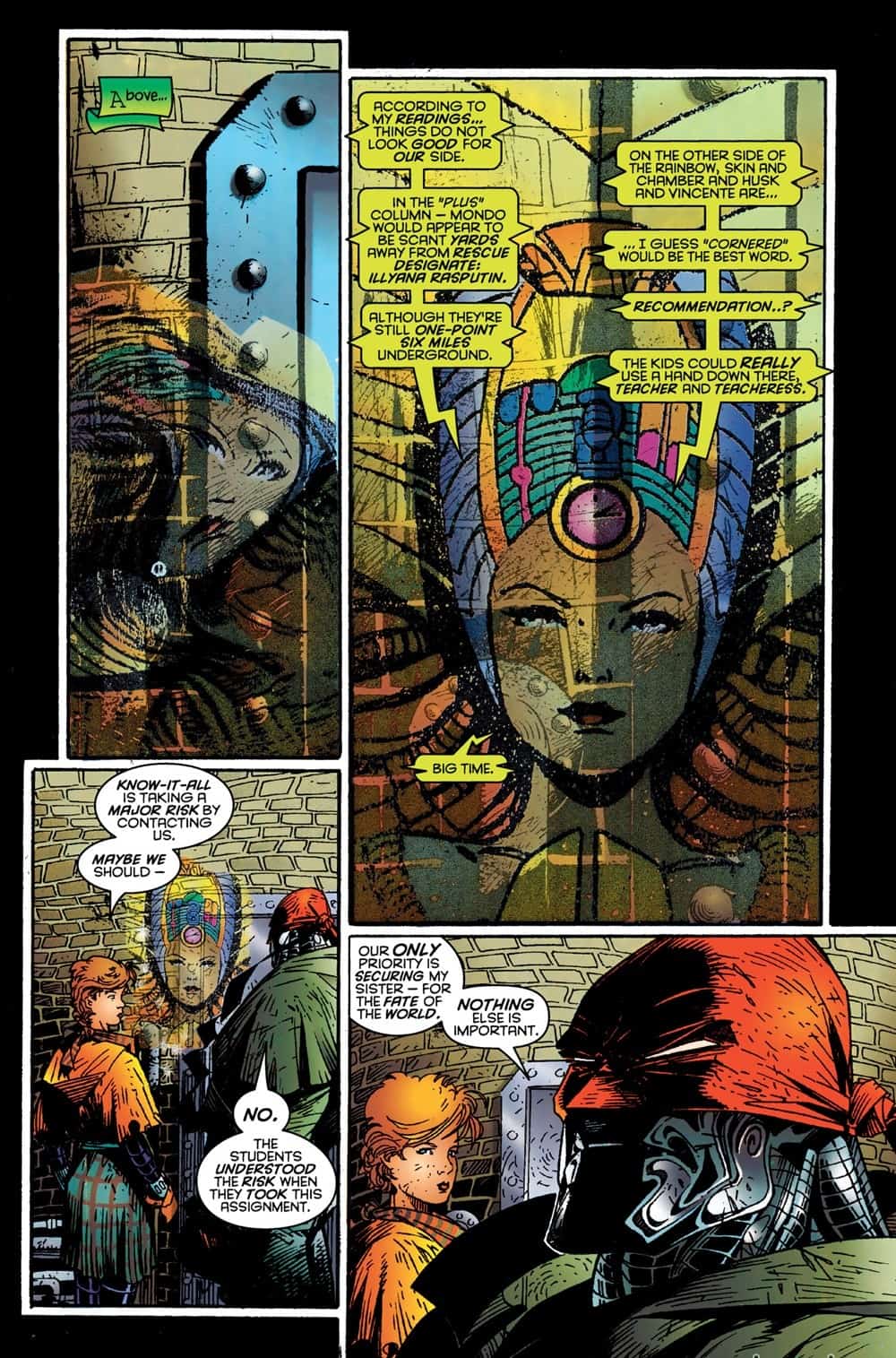 Colossus’s singlemindedness with regard to his sister is more explicit here. The mission is important, yes. But unlike Shadowcat, he shows little to no concern for the danger his students are in.
Sugar Man’s first real appearance is somewhat underwhelming in light of the menacing hints provided in the previous issue. Similar to the team of would-be X-Men, Sugar Man doesn’t do much of anything. The first action he takes in the issue is to terrorize Quietus’s elderly secretary (a slightly comedic moment that doesn’t land).
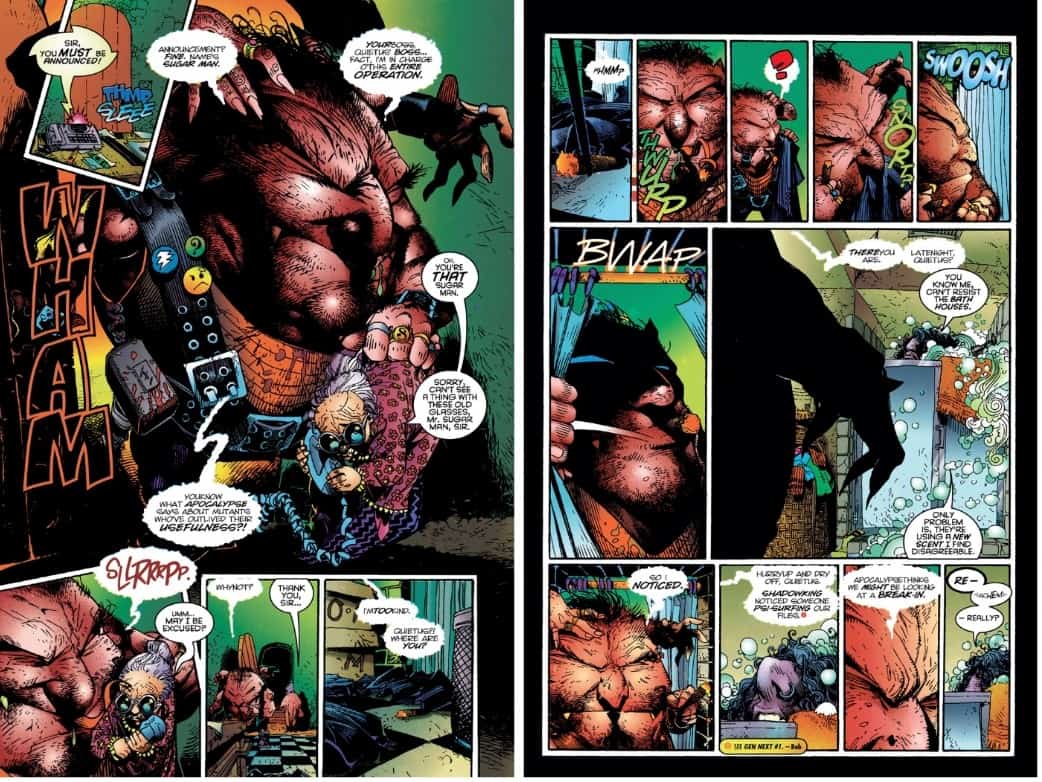 When he finds Chamber and Skin, he doesn’t take direct action. Instead, he delegates it to Quietus. Though this does pay off in the next issue as him suspecting Quietus of being an imposter, it undermines any potential menace from the character here.
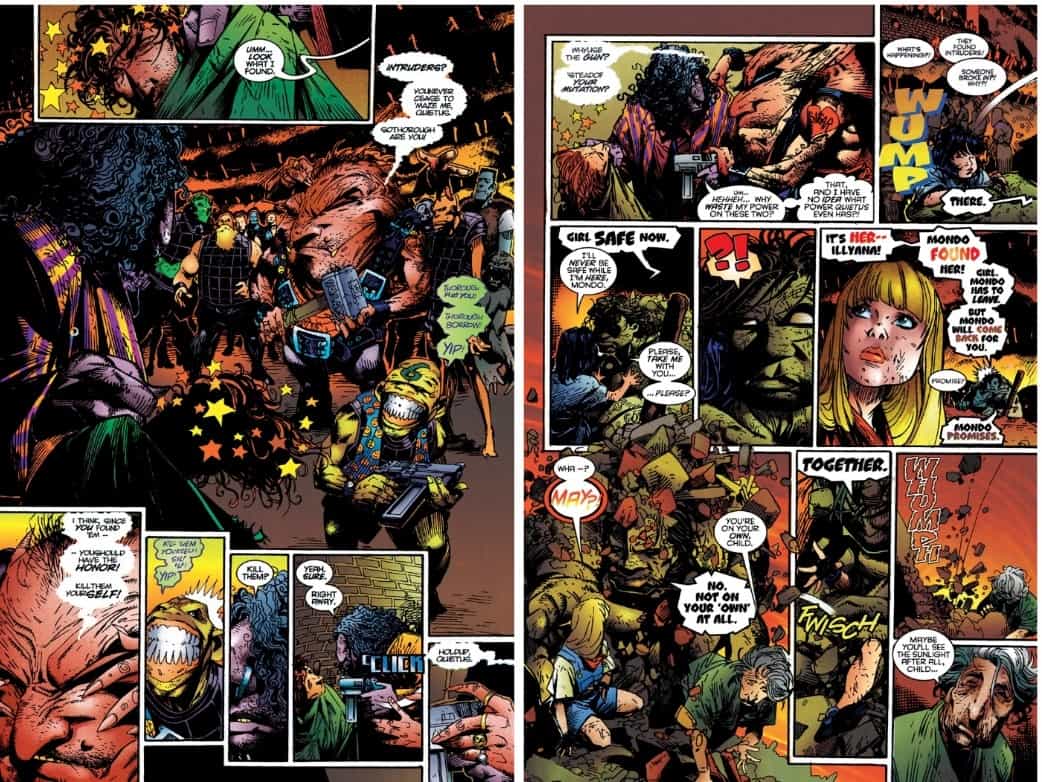 Even Sugar Man’s appearance is less imposing than it is odd.
Generation Next #3’s problem is one that the series as a whole suffers from. It moves at an almost glacial pace. The series also doesn’t provide much character development. This will prove problematic in the final issue. Further, there is limited world building. Compared to Lobdell’s work in Amazing X-Men, Generation Next is lackluster.
 X-Man #3
W: Jeph Loeb | P: Steve Skroce | I: Bud LaRosa & Mike Sellers | C: Mike Thomas | L: Richard Starkings & Comicraft
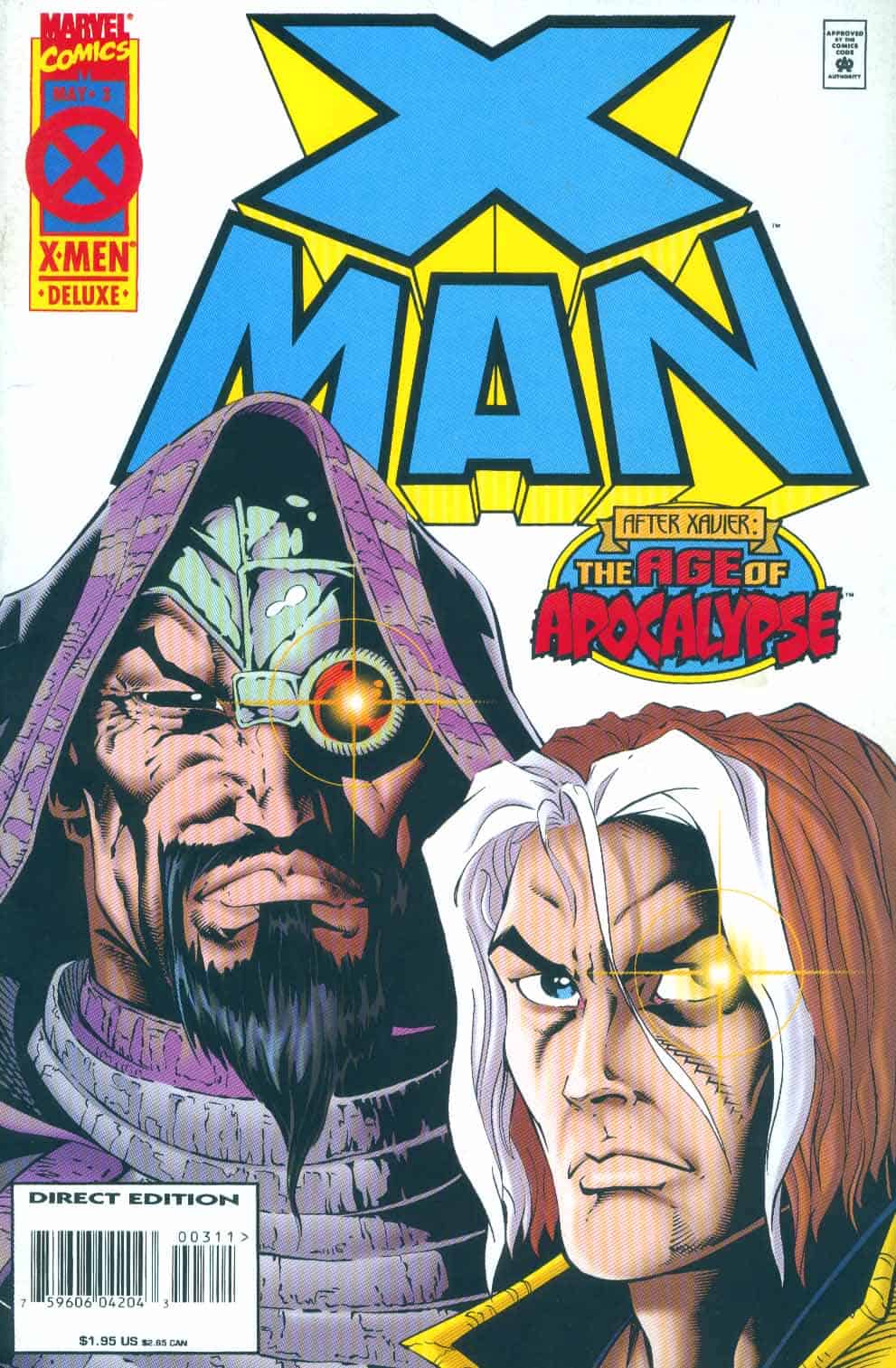
It’s Domino, Grizzly, and Caliban versus Forge, Toad, and Mastermind in X-Man #3. Nate, disobeying Forge once again, is rushing toward the battle but is absent during the main event. No one yet knows about the confrontation between Brute and Essex that took place at the end of the previous issue. Domino kills Mastermind. Toad kills Caliban. Grizzly kills Toad. Sonique and Forge kill Grizzly. Nate, when he finally arrives, lobotomizes Domino. In the wake of the costly fight, Nate comes to realize (much too late) that using his powers at full strength is too great a risk. Shortly after, Forge comes across Brute’s dead body. Essex lingers nearby. Forge is killed in the ensuing fight with Essex. Nate’s power rages out of control and he attacks Essex only to reveal the man’s true identity: Mr. Sinister.
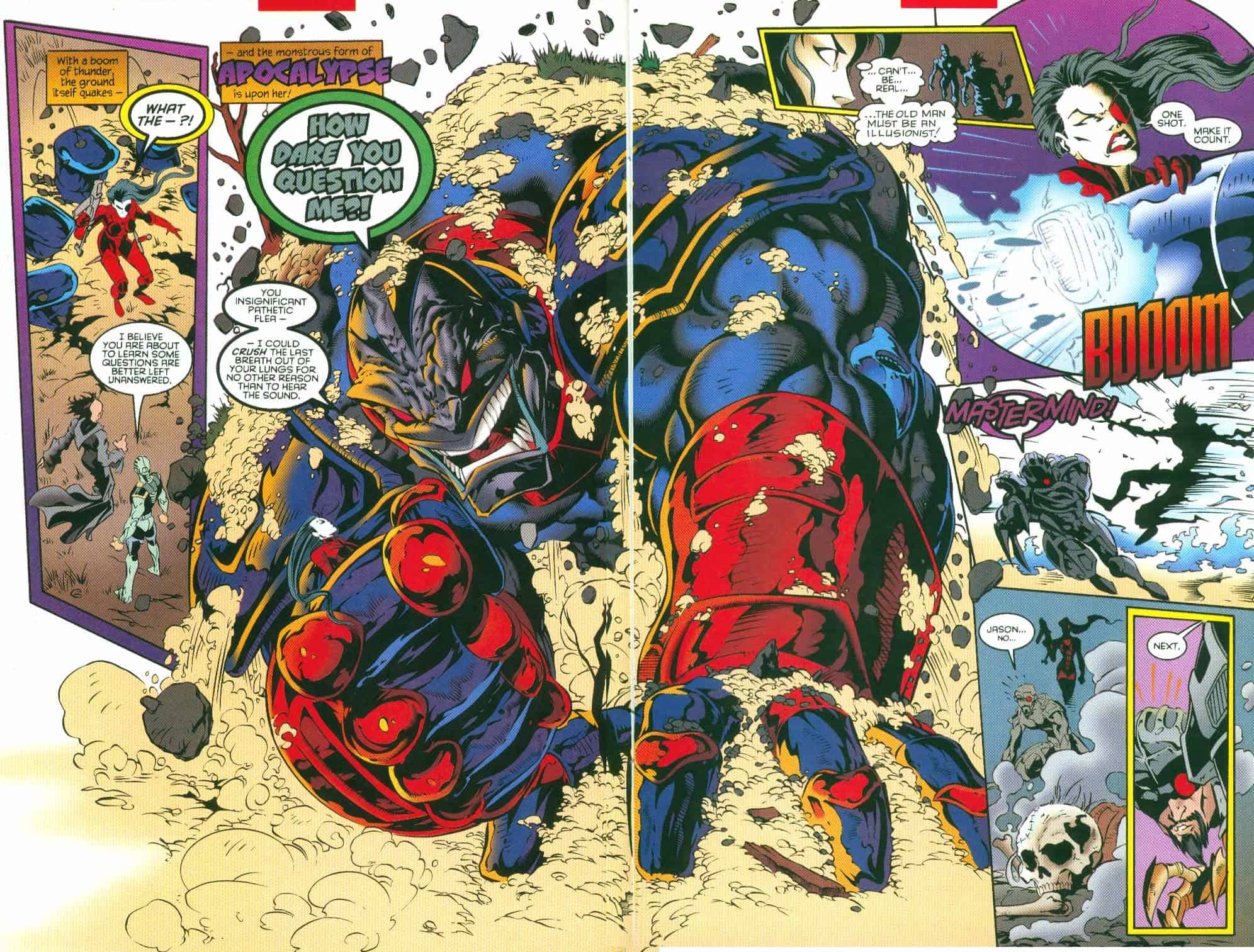 Skroce’s distinct style is on full display when Mastermind tries to fool Domino with a very big, very angry Apocalypse. The character spreads across two pages and truly looks nothing quite like any of the other depictions.
Nate loses what passes for his family unit and, more importantly, the closest thing to a father that he has. Forge’s death is the only truly emotional beat in the entire series. Until now, Nate’s emotional range has been impetuousness to…impetuousness. This moment succeeds overwhelmingly precisely for that reason.
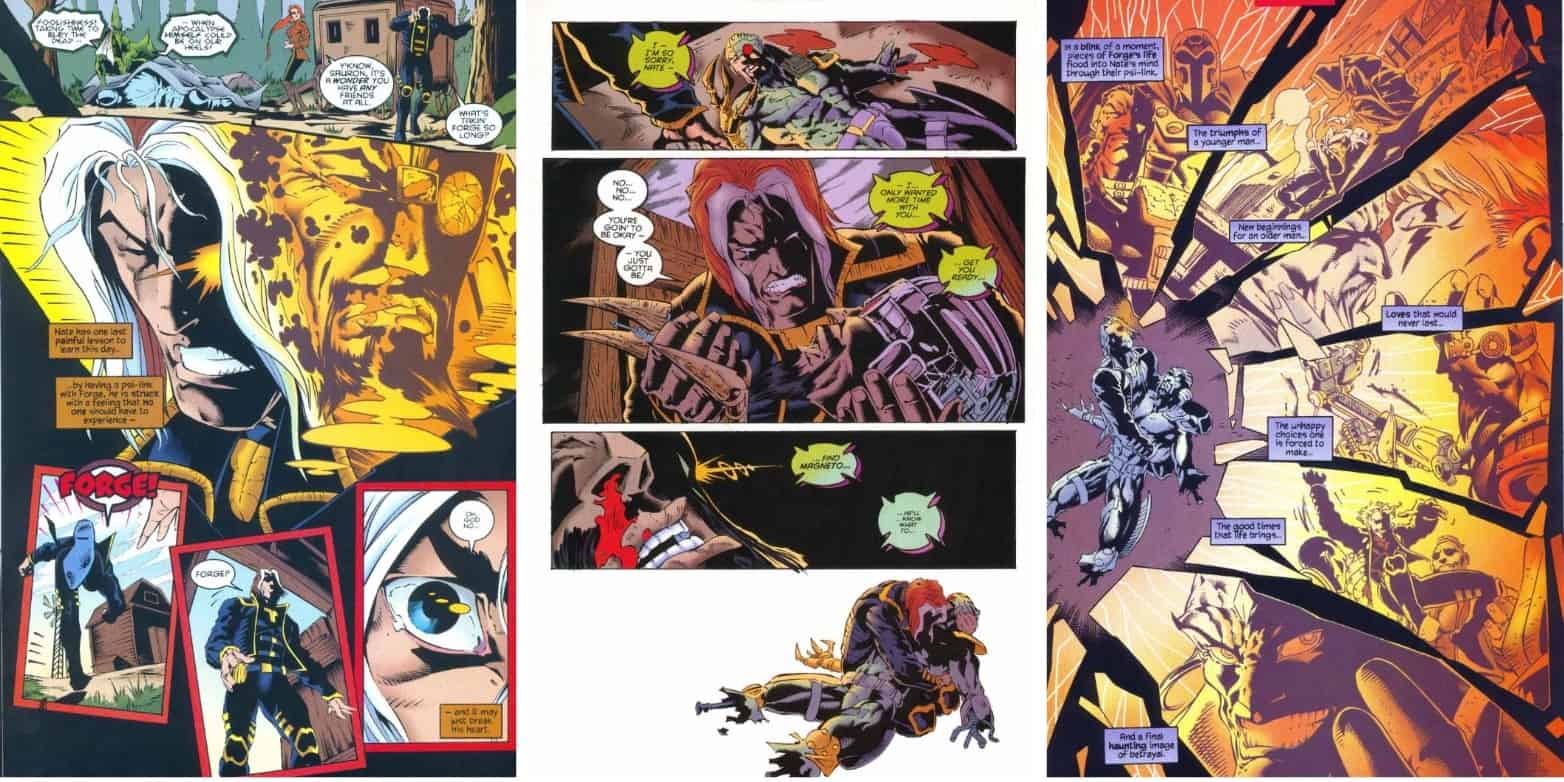 There are casualties galore in X-Man #3. The virtue of alternate universe stories is the ability to kill off anyone–and as many as desired. Sabretooth died in Astonishing X-Men. Sunspot died in Gambit and the X-Ternals. Just about everybody dies here. Loeb doesn’t pull any punches in how he kills these characters off, either. Mastermind is all but vaporized. Grizzly takes a bite out of Toad. Forge’s cybernetic limbs are ripped off.
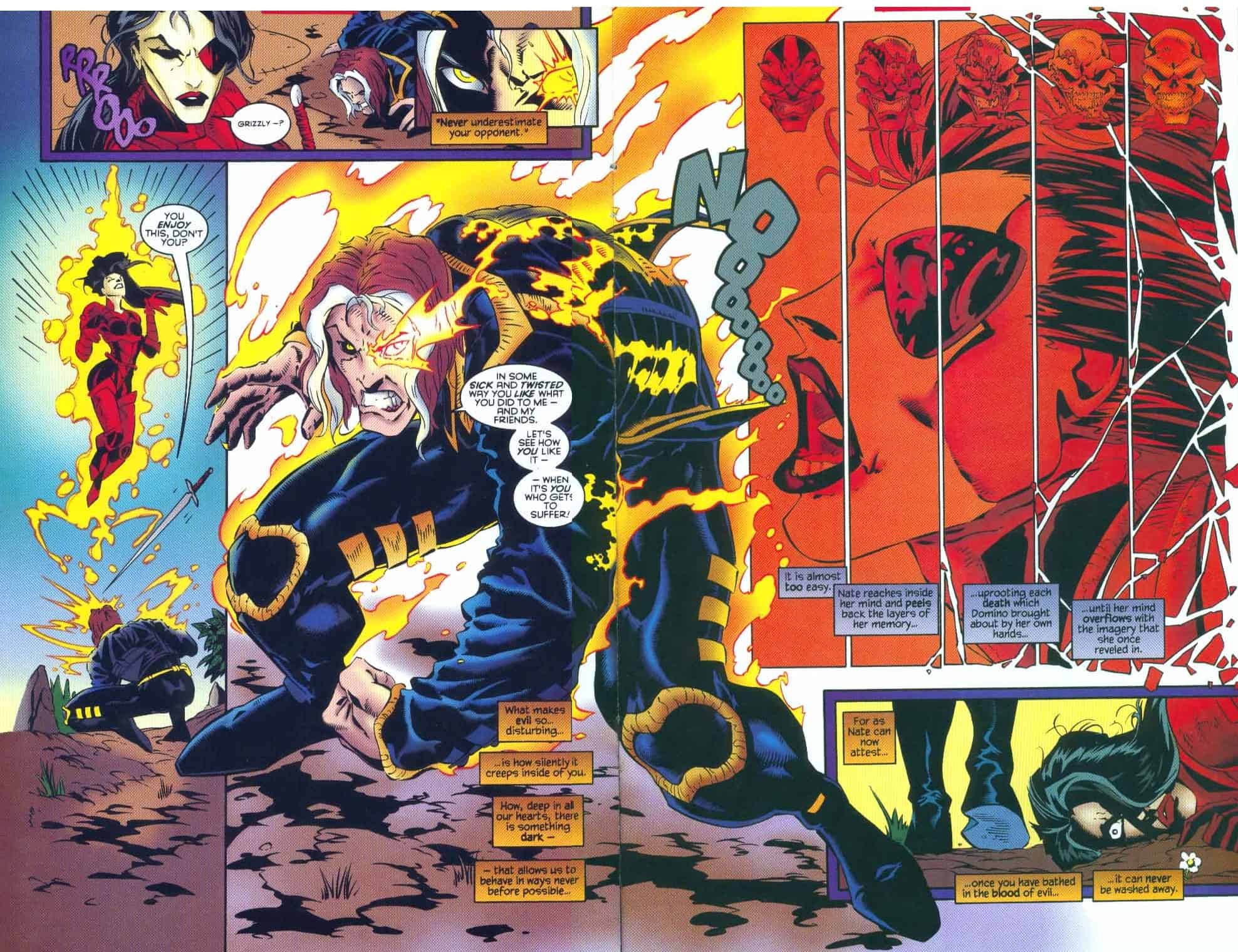 The way Nate takes out Domino is an especially creative use of the character and his powers. His combat abilities have so far been represented entirely by blasts of yellow/orange energy. As demonstrations of raw power go, it’s not particularly original. Peeling back Domino’s mind in this way is much more compelling than another blast-a-thon. It’s also a great way to separate Nate’s strength from Cable’s, one of the big ideas behind the character being that he is what Cable would have been had he not been infected with the techno organic virus.
The character becomes a loner for an extended period of time from this point. Loeb’s development of Nate for Age of Apocalypse ultimately justified his angsty attitudes for the series as it developed post Age of Apocalypse.
 Weapon X #3
W: Larry Hama | P: Adam Kubert | I: Dan Green & Mike Sellers | C: Joe Rosas | L: Pat Brosseau
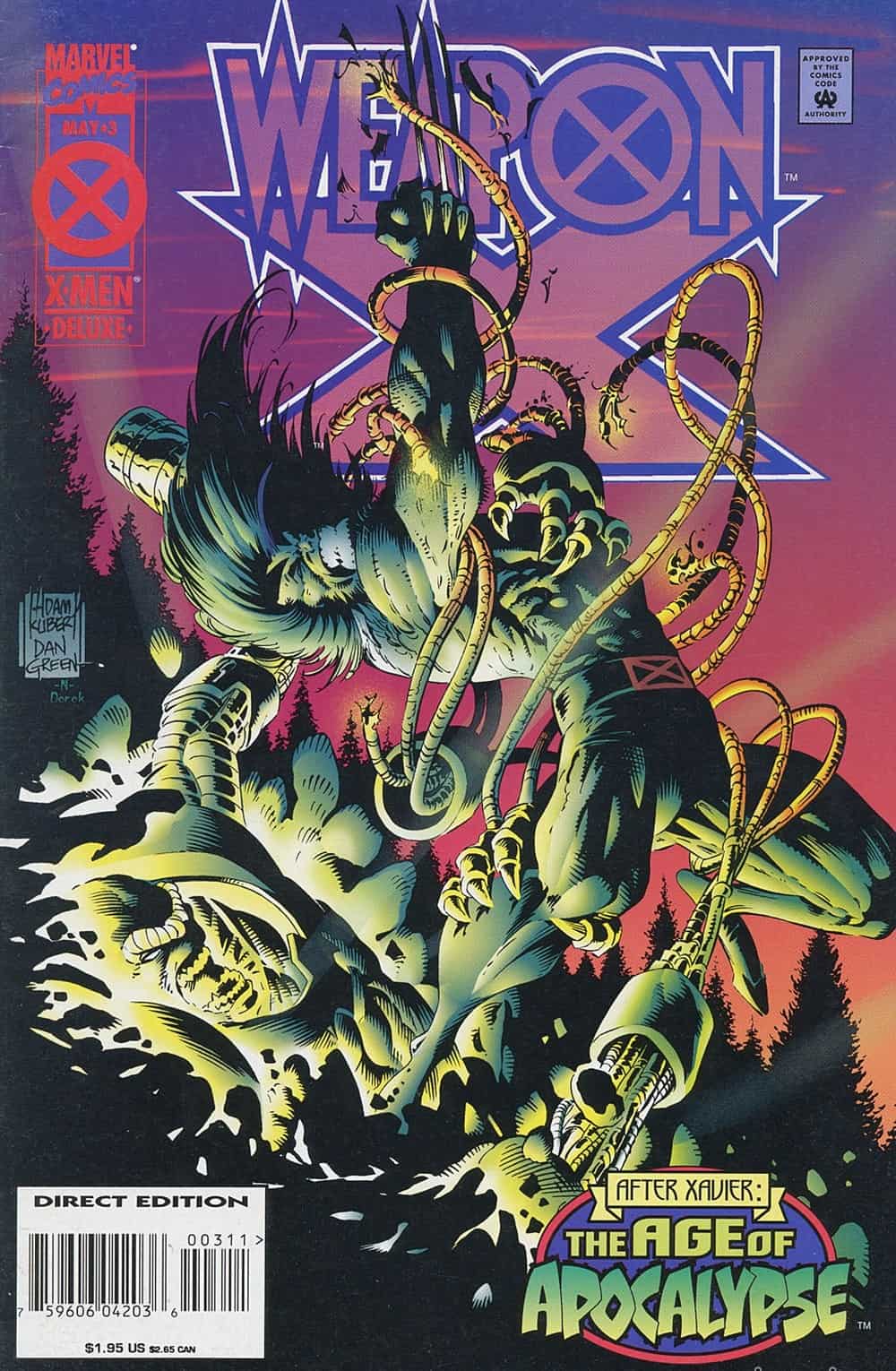
Logan journeys to the wreckage of the X-Men’s first base on Wundagore Mountain. With the navigation system for the Human High Council’s attack fleet destroyed, Logan is searching for the best human navigator there could possibly be. But that person–the mutant known as Gateway–is more interested in trying to absorb and preserve as much human knowledge as possible ahead of the final confrontation than he is with who (if anyone) might win. And Gateway’s self-appointed guardian, Carol Danvers, isn’t any help when it comes to changing his mind. Unfortunately Pierce’s altered humans have followed Logan. They attack, trying to kill Logan, Danvers, and Gateway. Logan and Danvers keep Gateway safe (with Danvers seemingly sacrificing herself in the process). In the fight’s aftermath, Gateway reconsiders his isolationism. He isn’t sold on piloting the armada, but he is willing to hear the Human High Council out.
There is no Age of Apocalypse character that is more of a 180° shift from the original timeline version than Gateway. He’s fully clothed, talkative, and so concerned with world culture that he’s trying to witness as much of it as he can. The difference is so stark it’s almost comical.
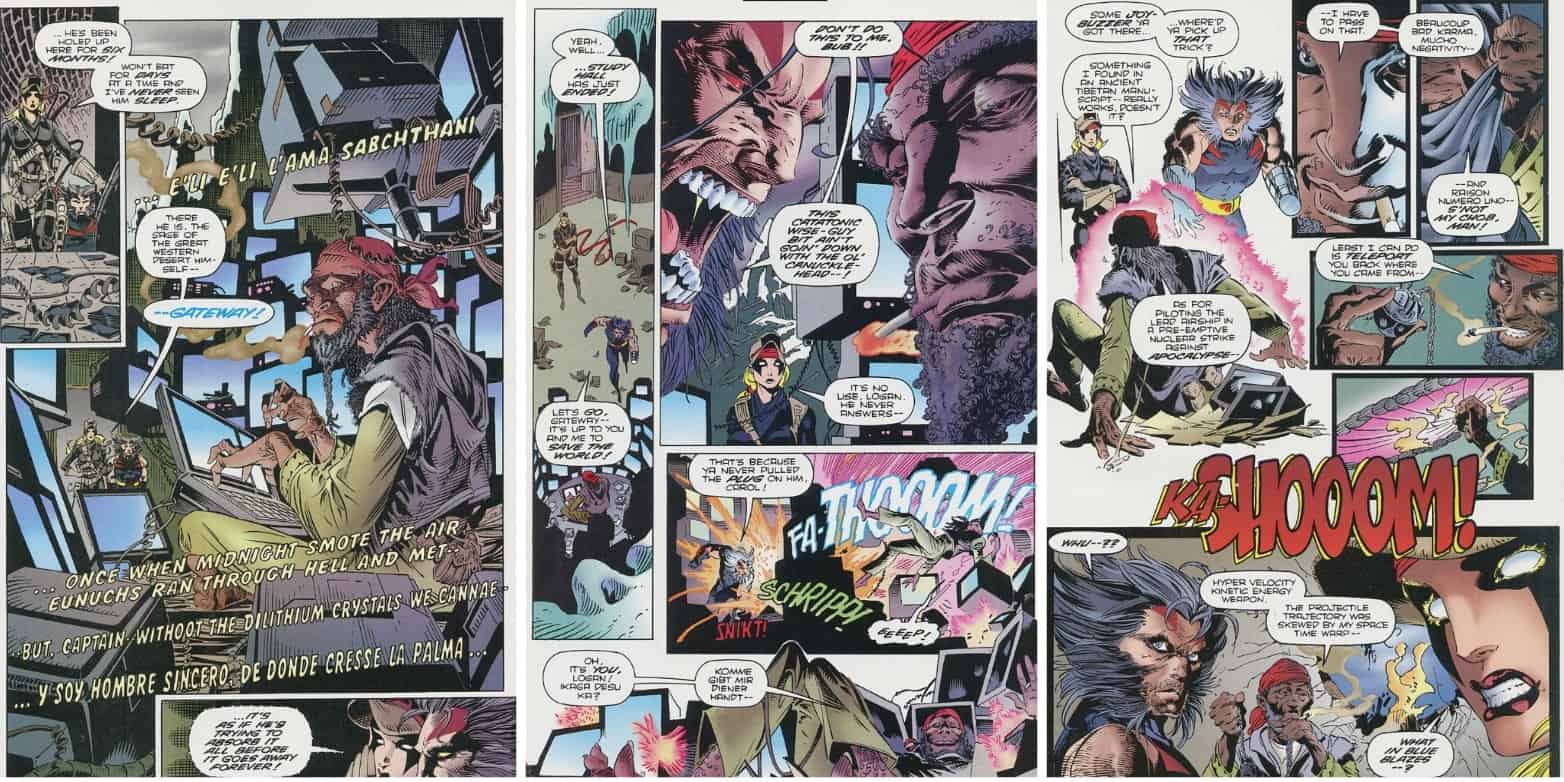 The idea of preserving history and culture is a classic one in dystopian and apocalyptic fiction.
Weapon X isn’t quite the same after Jean departs. Logan isn’t as emotional or introspective. That isn’t to say the character shuts down completely. Hama still finds ways to get inside Logan’s head. Weapon X #3’s setting of Wundagore Mountain allows Logan to take a tortured trip down memory lane. He remembers Wundagore both as the first real home he had and the sight of much darker times. The most poignant moment is when he comes across Wanda’s grave. It’s an effective sequence, enhanced by reading X-Men Chronicles #1 before this issue.
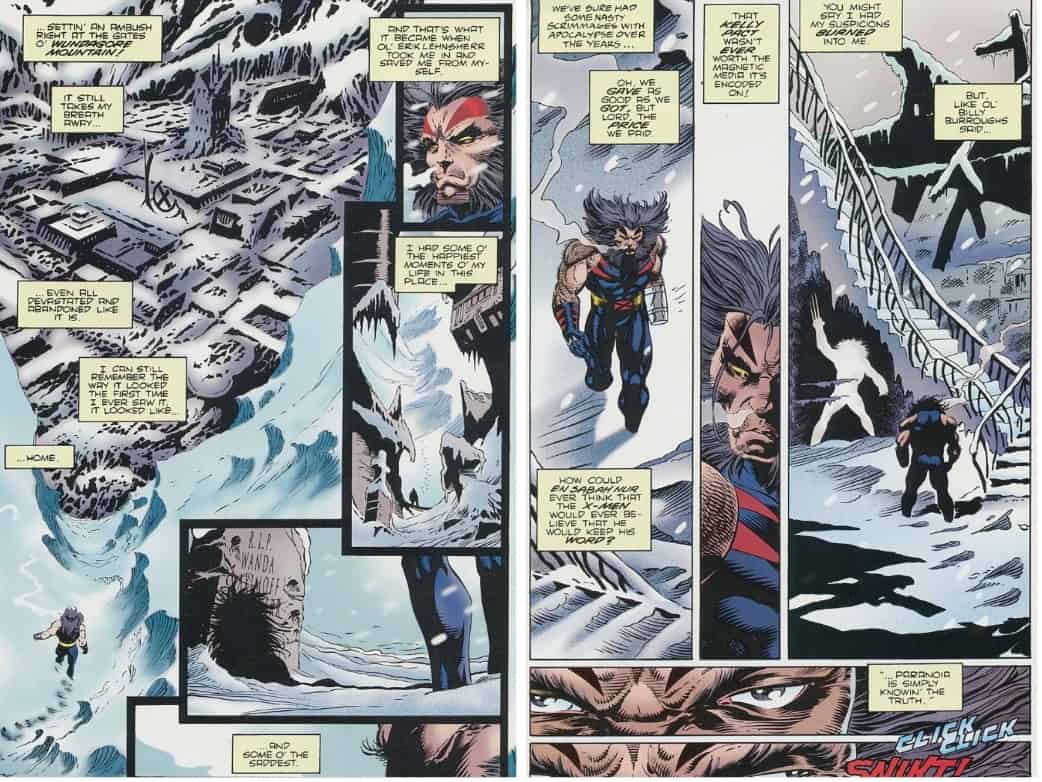 Kubert’s depiction of Logan is more or less static throughout Weapon X #3. The range of visual emotion is reduced to little more than anger. Interactions with Jean softened him at times, and Kubert was able to present something closer to visible vulnerability.
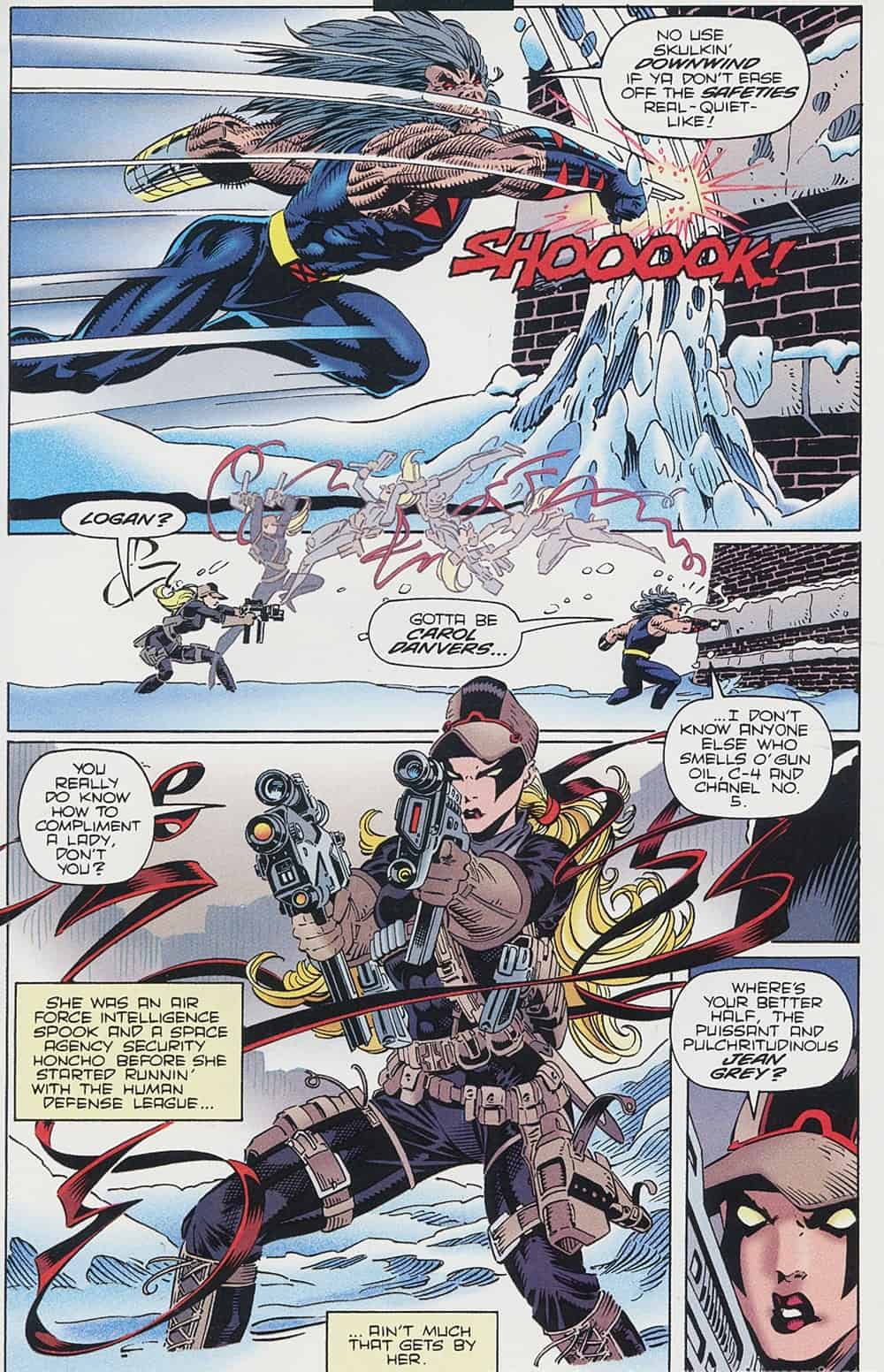 Carol Danvers’ design is memorable to say the least. As far as human characters in Age of Apocalypse go, she is easily the most militant–this includes what passes for the human resistance in X-Universe. It’s refreshing to see a human so hardened by Apocalypse’s rule. The only downside as far as the overall Age of Apocalypse story goes is that this kind of “resistance”–she’s really just guarding Gateway–is confined to Europe. This is also the case in X-Universe. From a storytelling point of view, the idea of an active human resistance in Apocalypse’s North America has definite potential. Though it’s unclear which of the existing series it would have had a place in.
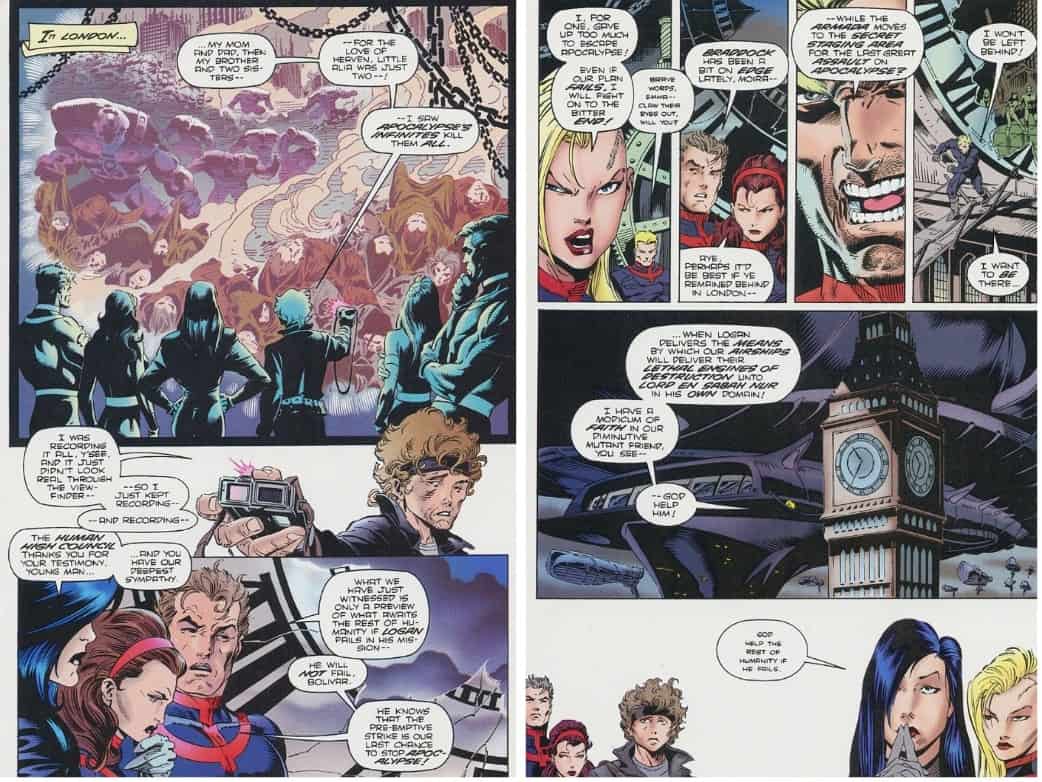 Meanwhile, Hama reminds us of the closest thing to an active human resistance that the Age of Apocalypse has: the Human High Council. And foreshadowing, perhaps?
Next time…Apocalypse’s first strike, the mysterious Mikhail Rasputin, and an old fashioned handbook!