Rogue #3

Jamison Nilsson
Recap
Rogue’s powers have begun malfunctioning unexpectedly, making answers about Project P.E.G.A.S.U.S. even harder to obtain.
More X-Men coverage from Comic Watch:
Review
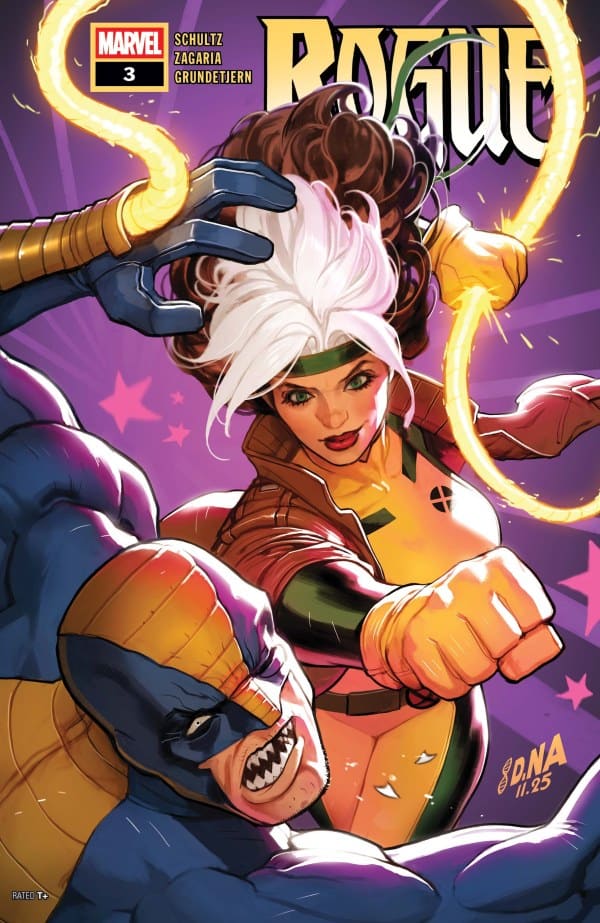
As Rogue’s search for answers about her past continues, the story moves its focus to Chicago to bring back the Constrictor, as seen on the issue’s cover art. Erica Schultz seems to be dipping the story into “greatest hits” territory, bringing back characters from Rogue’s past.
Taking away Rogue’s flight (in Rogue #2) limits her mobility, which pretty much traps the story in Chicago. This is fine except that there isn’t a strong enough story hook in Chicago to keep readers wondering what will happen next. Still, the malfunctioning powers storyline is interesting for Rogue, and seeing her go back to her basics is a refreshing take. It feels like something taken straight from the early 2000’s X-Treme X-Men stories, or at least pays homage to it.
So far in Rogue’s three-issue run, we haven’t learned much about John Stelton, aside from the fact that he worked at Project P.E.G.A.S.U.S. when Rogue and the Brotherhood of Mutants broke in. Despite not learning anything new about him in this issue, Stelton is given some development as we see a traumatic side of the character in three back-to-back pages. I won’t discuss here, to avoid spoilers.
Constrictor is one of Marvel’s more forgettable villains. He debuted in 1977, which would give the character plenty of time to have become a prominent figure in the wider Marvel mythos, but he simply never did. Erica Schultz gives Constrictor some of the limelight in this issue, but his effect on the story is marginal at best.
Luigi Zagaria’s art is, in my opinion, best described as “smooth,” and each page feels very light to read. There aren’t too many fine details stuffed into the environment, but characters are drawn with lots of depth and attention to spacing. For all three issues, Zagaria has drawn very clear motion in action scenes, making it hard to lose track of the characters, which helps the pacing feel even.
Espen Grundetjern adds plenty of shading to Zagaria’s artwork. There is consistent lighting throughout the issue, something I appreciated in particular. The color also adds a bit of personality to the characters; Rogue’s iconic yellow and green suit has simple contrasts that work well, for example.
Final Thoughts
Rogue #3 (of 5) doesn’t do a lot story-wise, but it’s a good transition issue. After Rogue’s powers begin to malfunction, it’s reasonable that a “bridge” issue is needed for both her and readers to adapt.
Rogue #3: Old Friends
- Writing - 8/108/10
- Storyline - 7.5/107.5/10
- Art - 8.5/108.5/10
- Color - 8/108/10
- Cover Art - 7/107/10