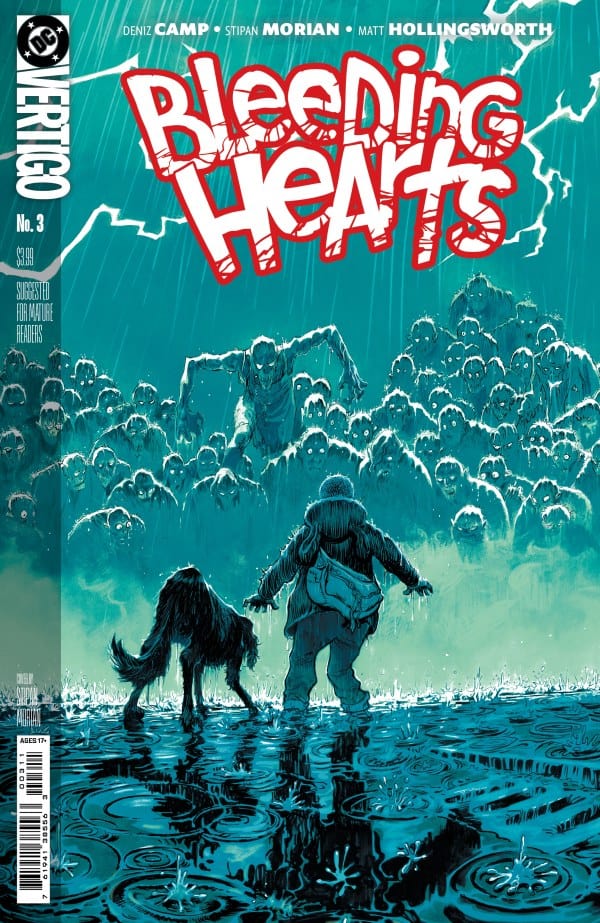
Bleeding Hearts #3

Anthony Bergamini
Recap
Poke returns to his horde after meeting Mama and Rabbit—profoundly changed and a bit confused. He's experiencing things he cannot explain...things like compassion and sadness. He's tried his best to convince Mama that he means them no harm and that they should stay hidden, but for Mama, trust is something hard-earned. So how much of a risk is she willing to take? And can Poke keep the latest hunting party from descending upon their hiding spot?
Review
Bleeding Hearts #3 picks up momentum after the first two issues, which were more focused on laying the groundwork for the plot and establishing the characters’ backstories. With that foundation now in place, the story wastes no time diving into the action. The issue opens with Poke having just rescued Rabbit and her mother from being discovered by a zombie horde. What follows is a classic misunderstanding, though one layered with surprising nuance, allowing the creative team to expand the world organically rather than relying on heavy exposition.
Because the earlier installments prioritized character development, this shift into a faster-paced, action-driven narrative feels both earned and seamless. Writer Deniz Camp and artist Stipan Morian demonstrate a clear command of complex, layered storytelling. On the surface, some readers might interpret the premise as a familiar “humans fleeing zombies” scenario, but there is far more embedded within each carefully constructed panel, line of dialogue, and narrative beat. The result is a character-driven story that uses the recognizable framework of a zombie tale as a foundation for something richer and more introspective.
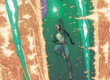
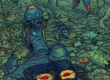
Much of that depth emerges through the interactions between Rabbit, her mother, and Poke. It becomes evident that they are unable to communicate through traditional dialogue, and their differing perspectives shape how they interpret one another’s actions. While readers are given the benefit of seeing both human and zombie viewpoints, the characters themselves experience distorted versions of reality, forcing them to rely on context and instinct to navigate their encounters. Camp’s layered writing is elevated by Morian’s artwork, which vividly conveys these fractured perspectives and reinforces the emotional and communicative barriers between them.
This central dynamic is what makes the narrative especially compelling. Rabbit begins to recognize the humanity in Poke, while her mother, shaped by trauma and survival, sees only another threat. This contrast not only highlights the impact of lived experience but also suggests a broader thematic exploration of innocence, how it can be both a strength and a vulnerability in a world defined by fear. Based on this issue, coexistence between humans and zombies seems unlikely; however, Rabbit’s openness and Poke’s apparent evolution hint that understanding, however fragile, may still be possible.
Final Thoughts
Bleeding Hearts #3 is anything but a surface level zombie story, taking an approach to the genre that feels wholly unique.
Bleeding Hearts #3: What Did He Say?
- Writing - 9.5/109.5/10
- Storyline - 9.5/109.5/10
- Art - 9.5/109.5/10
- Color - 9.5/109.5/10
- Cover Art - 9.5/109.5/10