M.A.S.K. #1

Anthony Bergamini
Recap
The world is becoming a terrifying place. Matt Trakker needs your help saving it. Enter M.A.S.K. — a network of specialists recruited to respond to the next global emergency. At a moment’s notice, Trakker and his agents can deploy bleeding-edge technology that converts their vehicles — and their drivers — into the ultimate weapon. But Miles Mayhem and V.E.N.O.M. are one step ahead in a secret arms race, scouring the globe for deadly weapons from this planet and beyond, ready to sell out the entire human race. Only M.A.S.K. can stop them... but will Trakker’s own secrets jeopardize their entire mission?
Review
M.A.S.K. #1 is the latest spinoff in Skybound’s Energon Universe, emerging directly from recent events in both G.I. Joe and Transformers. The series also marks the return of writer Dan Watters to the publishing line, who previously worked on the Destro series, a precursor to G.I. Joe’s formal introduction into the broader shared universe. Rather than starting fresh, Watters draws on many of the worldbuilding concepts and developments from the other series, using them to shape the world he builds based on the classic M.A.S.K. property.
For those unfamiliar, M.A.S.K., short for Mobile Armored Strike Kommand, was a 1985 animated TV series featuring Matt Trakker as the leader of the M.A.S.K. organization, battling Miles Mayhem’s V.E.N.O.M., short for Vicious Evil Network of Mayhem. Although the show only ran for two seasons, it made a lasting impression among fans of animated series from that era, especially since it spun off from an action figure line. While the idea of a heroic group versus a villainous one was common (with G.I. Joe versus Cobra and Autobots versus Decepticons anchoring other toy-based TV properties), M.A.S.K. stood out by blending elements from G.I. Joe and Transformers. The characters operated in military-style roles and used semi-transforming vehicles and advanced technology to achieve their missions. By its second and final season, the creative team changed direction, shifting the narrative focus from ground combat to vehicle races between M.A.S.K. and V.E.N.O.M.
Building on that history, the new M.A.S.K. series picks up in the aftermath of G.I. Joe and Transformers, where Miles Mayhem exploited his government connections and absconded with valuable resources, while Matt Trakker emerged from hiding to stop him, after briefly assisting the Joes alongside their new Autobot companion, Hound. This first issue fills in many gaps regarding the characters’ backgrounds, their previous relationships, and the reasons for their enmity. The U.S. government is deeply entangled in the conflict, unable to keep control, and the series establishes Mayhem’s motivations in the context of the wider Energon Universe. All these elements combine to create a compelling start, making the series accessible to fans of the original animated show and toy line, as well as newcomers seeking an exciting ongoing comic.
It’s almost impossible to discuss this series without referencing the other books in the Energon Universe, and such comparisons are a testament to its quality. If you’re interested in M.A.S.K. but uncertain about what to expect, it most closely resembles G.I. Joe, though it leans more toward covert operations and espionage. Matt Trakker evokes both Indiana Jones and James Bond, he radiates main character energy, not only in his physical and mental presence but also in his nuanced, sometimes flawed interpersonal relationships. Despite his mysterious and shadowy past, Trakker is easy to root for, with hints of greater depth to be revealed in future issues. In contrast, Miles Mayhem, who had a few appearances in Transformers, is much more fully developed here, offering surprising complexity that distinguishes him from typical antagonists. The dynamic between Trakker and Mayhem is clear and compelling, leaving readers eager to see their inevitable, face-to-face (or mask-to-mask) confrontation.
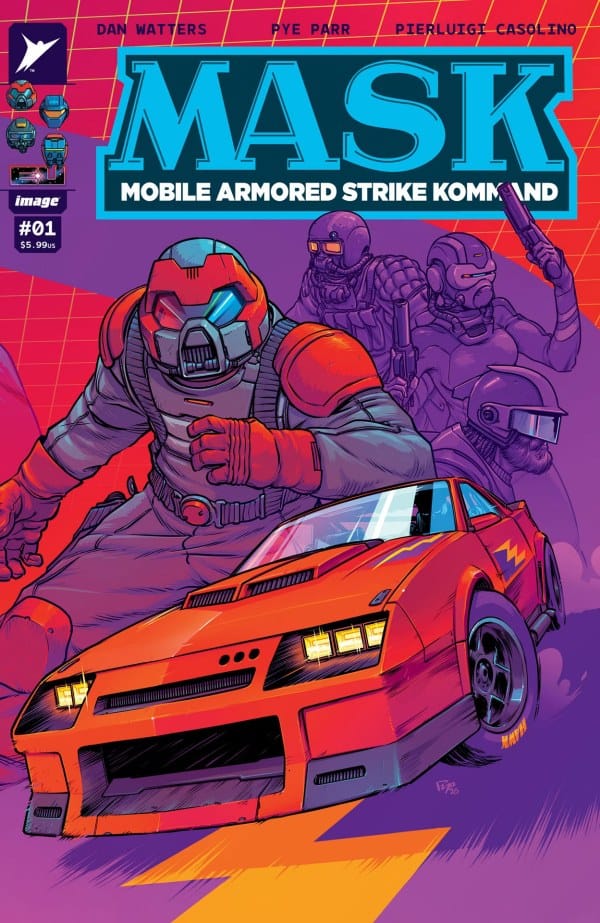
M.A.S.K. also shines visually, thanks to artist Pye Parr and colorist Pierluigi Casolino, who give the comic a uniquely vivid and tactile style. Parr’s pencils capture the fast-paced, dramatic tone of the story, especially in the opening chase sequence, where Trakker’s speed and determination leap off the page. There are hints of body horror woven throughout, lending the book a mature edge and foreshadowing how deeply it will explore its sci-fi themes. Casolino’s colors complement the artwork beautifully, ensuring each page is as vibrant as the last and that the action remains front and center. Where Hollywood often dulls colors in comic adaptations, Casolino’s palette demonstrates why rich, dynamic coloring is so prized in comics. It’s worth noting that the main cover for this issue makes it a must-buy as well. The wraparound cover delivers a taste of the high-octane action readers can expect from the series, rendered in striking red and purple hues that ensure the issue stands out on comic shop shelves.
Final Thoughts
M.A.S.K. #1 launches with a strong foundation, skillfully blending legacy elements with fresh storytelling and dynamic art.
M.A.S.K. #1: Have M.A.S.K., Will Travel
- Writing - 10/1010/10
- Storyline - 10/1010/10
- Art - 10/1010/10
- Color - 10/1010/10
- Cover Art - 10/1010/10