Space Ghost #11
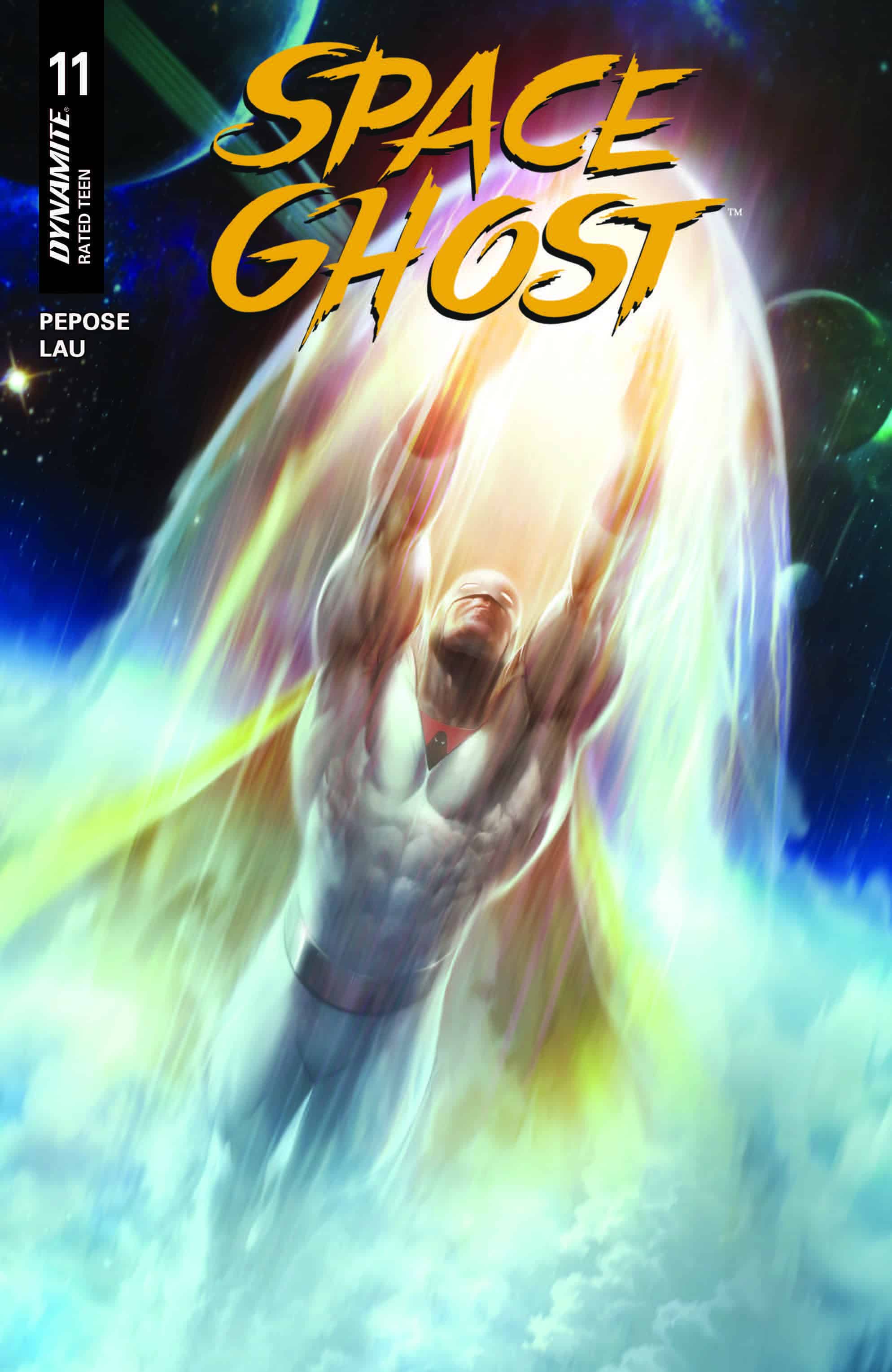

Theron Couch
Recap
Tempus the Time-Master, Part Two! Enter... the Time Tyrants! With Space Ghost trapped alone in the prehistoric jungle, he finds himself hunted by Tempus the Time-Master's enforcers: Toymaker, Tarko the Terrible, Barbos the Time-Pirate, and the Sorceress! Meanwhile, Jan and Jace must survive a dystopian future ruled by the Rock Robots! In order to survive this doomed timeline, they'll have to team up with a future from the past... as Space Spectre makes his triumphant return!
Review
Space Ghost #11 picks up shortly after the end of the previous issue. The Time Master monologues a little bit about his ultimate plan before sending his allies into the past to deal with Space Ghost. Everything moves at full speed from here. Like the previous issue, Space Ghost #11 is mainly an action oriented affair.
Pepose does something very unusual for the series and separates Space Ghost from Jace and Jan for all of Space Ghost #11. The choice changes the dynamic significantly, especially for Space Ghost who suddenly has no one to bounce dialogue off of. Internal monologue narration is not something Space Ghost typically does, so this does set up a situation where Space Ghost has to periodically talk to himself. Pepose doesn’t lean heavily on that, though–and it certainly never slows down events in Space Ghost’s time. Plus, Blip makes for an amusing companion for Space Ghost.
Jace and Jan’s storyline in Space Ghost #11 works a little better because the siblings are able to play off each other. Pepose has developed a back-and-forth quipping dynamic for their dialogue, and that back and forth interaction helps make up for Space Ghost’s absence. Space Spectre is a little two dimensional to really fill Space Ghost’s role.
It’s important to consider with Space Ghost #11’s parallel story construction that it’s made more compelling thanks to all the character development Pepose has done along the way. This is especially the case with Jace and Jan. If this storyline happened during Pepose’s first run, it would not have been as effective because the siblings’ development was limited. This second run spent a lot of time building Jace and Jan up, both as individuals and as partners. As a result, they are able to carry a less straightforward storyline because they are interesting in their own right. Additionally, if it were to happen that they are the ones who go on to save the day (rescuing Space Ghost along the way), that story development is earned and believable.
Lau is called upon again to deliver a lot of action in Space Ghost #11. The issue isn’t quite as action centric as the previous one, but it’s close. Lau is as adept in depicting action here as he has been all along. But the action in this issue tends to be set against more detailed backgrounds–whether in the past or the future. Lau brings a lot of detail to establishing panels as well as backgrounds during action sequences. There are times in Space Ghost action sequences when backgrounds are eschewed in favor of blank white backgrounds that put all the focus on the characters or thrown to bright Dalhouse colors. That is far from the case here where Lau leans hard into these settings and makes them very detailed.
The same kind of detail is brought to bear on the assorted characters in the issue. One of the best examples is Space Spectre who is working with Jace and Jan in the future. Space Spectre serves more as a plot device to move the siblings forward than a character. Much of the depth that he has in his brief appearance is the result of Lau’s art. There is one panel in particular that features Space Spectre without his mask where Lau’s very detailed art–rich line work and small fields of fully black shading–conveys how time and events have worn on him. Pepose gives voice to Space Spectre’s hard life in dialogue when he delivers exposition, but it’s Lau who gives him depth in this issue.
Dalhouse’s vivid action-oriented coloring is present in Space Ghost #11 as it is in most issues. There are, however, several more muted sequences where the main characters are set against Lau’s detailed backgrounds. This is especially the case in Space Ghost’s storyline in the past. There is more nuance here than is usually the case in Space Ghost because not as many action oriented panels are set against colorful backgrounds. None of this is to say that Dalhouse hasn’t shown such versatility in previous issues. But here, with Space Ghost in a natural setting as opposed to a futuristic science fiction one, this versatility is especially welcome.
There is a wide variety of lettering choices throughout Space Ghost #11. Multiple characters have dialogue in caption boxes. Dialogue is emphasized in a variety of ways from size to color to whether or not it fits inside a standard dialogue bubble. Esposito does a good job creating very engaging dialogue and sound effects throughout the issue while at the same time integrating well with the surrounding art.
Final Thoughts
Space Ghost’s battle with the Time Master and his forces continues to be a big event for the series. It works because Pepose’s intricate storytelling has created characters and stakes that are easy to invest in. Lau’s art is energetic and detailed–perfect for this issue. Dalhouse and Esposito round out the visual excellence. Space Ghost #11 is a key issue in the life of the series.
Space Ghost #11: Past and Future
- Writing - 8.5/108.5/10
- Storyline - 9/109/10
- Art - 9/109/10
- Color - 9/109/10
- Cover Art - 8/108/10