Beast of Borikén #1

Logan Mullins
Recap
Set in modern day Puerto Rico, the Beast of Borikén storyline follows the tale of a Puerto Rican activist fighting against an American resort company’s expansion.
Review
Beast of Borikén is a story about Puerto Rico. Not only in the literal sense (the story literally takes place in Puerto Rico), but metaphorically, in the wound it returns to. Julio Anta and Daniel Irizarri created a story that is uniquely the experience of Puerto Ricans. Beast of Borikén echoes the cultural memory of Hurricane Maria, the 2017 cyclone that devastated Puerto Rico. The issue opens with the protagonist, Loli Flores, during the hurricane. Hurricane Maria ravaged the island, claiming the lives of over 3000 people and destroying over $90 billion in property. It’s a tragedy still felt across the Puerto Rican population.
The underlying conflict of the issue stems out of that event as well. Loli Flores protests the overdevelopment of the island by American investors. After the fallout of the hurricane, one of the first industries to recover was the tourism industry. In 2019, Gay Myers of Travel Weekly wrote about the progress that the tourism industry experienced. Myers discussed how over 90% of the hotels in San Juan were back in operation. Around the same time, the Mercy Corps reported on collapsed utility poles and roofless homes. In a year where rural Puerto Ricans experienced day-long power outages, Frank Comito, former CEO of the Caribbean Hotel and Tourism Association (CHTA), was saddened by the 80,000 vacant hotel rooms across the Caribbean, according to a 2019 report by Laurel Kaufmann.
Simon Hunt, the American developer in Beast of Borikén parallels the resort companies that entered the island following its devastation. Hunt justifies his resort speaking in vague terms: prosperity, poverty rates, economic growth. Loli Flores resistance isn’t framed as one activist’s grievance; it reads as the frustration of a place that has repeatedly been the first to recover and the last to benefit. On a fundamental level, Anta writes about how the U.S. Territory recovered and left Puerto Ricans behind.
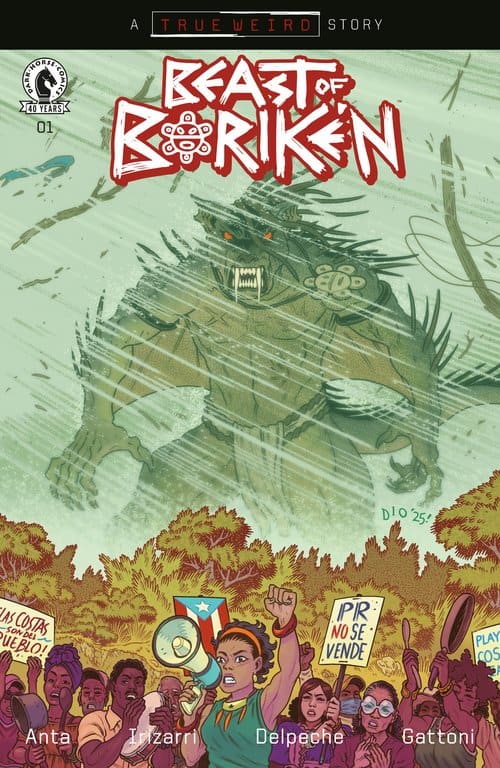
Daniel Irizarri’s art stands out as distinctly beautiful. Irizarri’s subtle linework adds a layer of nuance to the comic that words alone cannot capture: a small sweat mark on Simon Hunt when pressed by Loli Flores on a talkshow; the face of Pedro Albizu Campos, a Puerto Rican nationalist, on a bystander’s shirt; the contrast between modern and colonial buildings in wide shots of the Aguadilla. Irizarri’s Chupacabra, the titular Beast of Borikén, harkens back to classic folklore while having a modernized, comic book design. The color work by Patricio Delpeche ties the whole comic together, giving the book a visual style unlike anything else on the shelf.
Final Thoughts
Beast of Borikén #1 earns its presence. It doesn’t use Puerto Rico as scenery for a monster story; it uses a monster story to talk about Puerto Rico.
Beast of Borikén #1: Comic Book Folklore as Resistance
- Writing - 8.5/108.5/10
- Storyline - 9/109/10
- Art - 8.5/108.5/10
- Color - 9/109/10
- Cover Art - 7/107/10