Denver #1

Theron Couch
Recap
In a near-future world drowned by rising oceans, Denver survives as one of the last tightly controlled safe zones on the planet where every resource is rationed and every citizen is monitored. Max Flynn, a veteran border officer struggling to protect his family under these unforgiving rules, is shattered when his wife is suddenly kidnapped. A mysterious enemy forces him to betray Denver from within or lose her forever. As Max assembles a trusted crew and descends into the city’s underbelly, his desperate hunt threatens to expose the cracks in Denver’s rigid order and ignite a reckoning that could end the last safe city on Earth.
Review
Denver #1 brings a lot of recognizable dystopian elements to the table. The city for which the comic is named is one of the few surviving ones following a disastrous series of global catastrophes that saw the oceans rise precipitously.
Palmiotti and Gray open Denver #1 with a brief history of how the world turned into what is depicted in the comic. Dystopian stories can go either way when it comes to delivering a concrete backstory to explain why the world is the way it is. In the case of Denver #1, the backstory feels superfluous. It steals a sense of mystery from the issue’s first few pages which in turn reduces the tension.
This contrasts with the rest of Denver #1 which builds up Denver’s identity via character interaction and narration. The issue follows Max, an officer in the coastal border guard, telling the story entirely from his point of view. At times Max’s internal monologue narration ventures pretty far into tell rather than show territory, but for the most part this works as a way to explore Denver for the reader.
There isn’t much of a story here. What seems to be the inciting incident for a story doesn’t come until Denver #1’s cliffhanger ending. But the issue does open with what is effectively a vignette–Max and two fellow officers processing two new entrants into the city. This is an effective way to introduce the city and set Max in motion to interact with new characters. The world building that comes through this is enough to hold interest until everything ratchets up at the end of the issue.
Art in this issue is detailed, but it is more successful on objects and backgrounds than it is on characters. At more of a distance, the lower level of facial detail actually leads to better proportioned, less exaggerated expressions. Emotions remain fairly easy to interpret as well.
 Characters appear less refined in closeups. Their eyes tend to be either very narrow or overly large. Mouths are especially exaggerated. Max’s mouth extends almost from one side of his face to another. Female characters’ lips have an inflated quality regardless of expressions. There is also a repeated tendency to make female characters look almost worn with extra lines and slightly darker coloring under their eyes and across their noses. Fortunately these qualities don’t impede the ability to understand the characters’ expressions even though they might be too exaggerated at times.
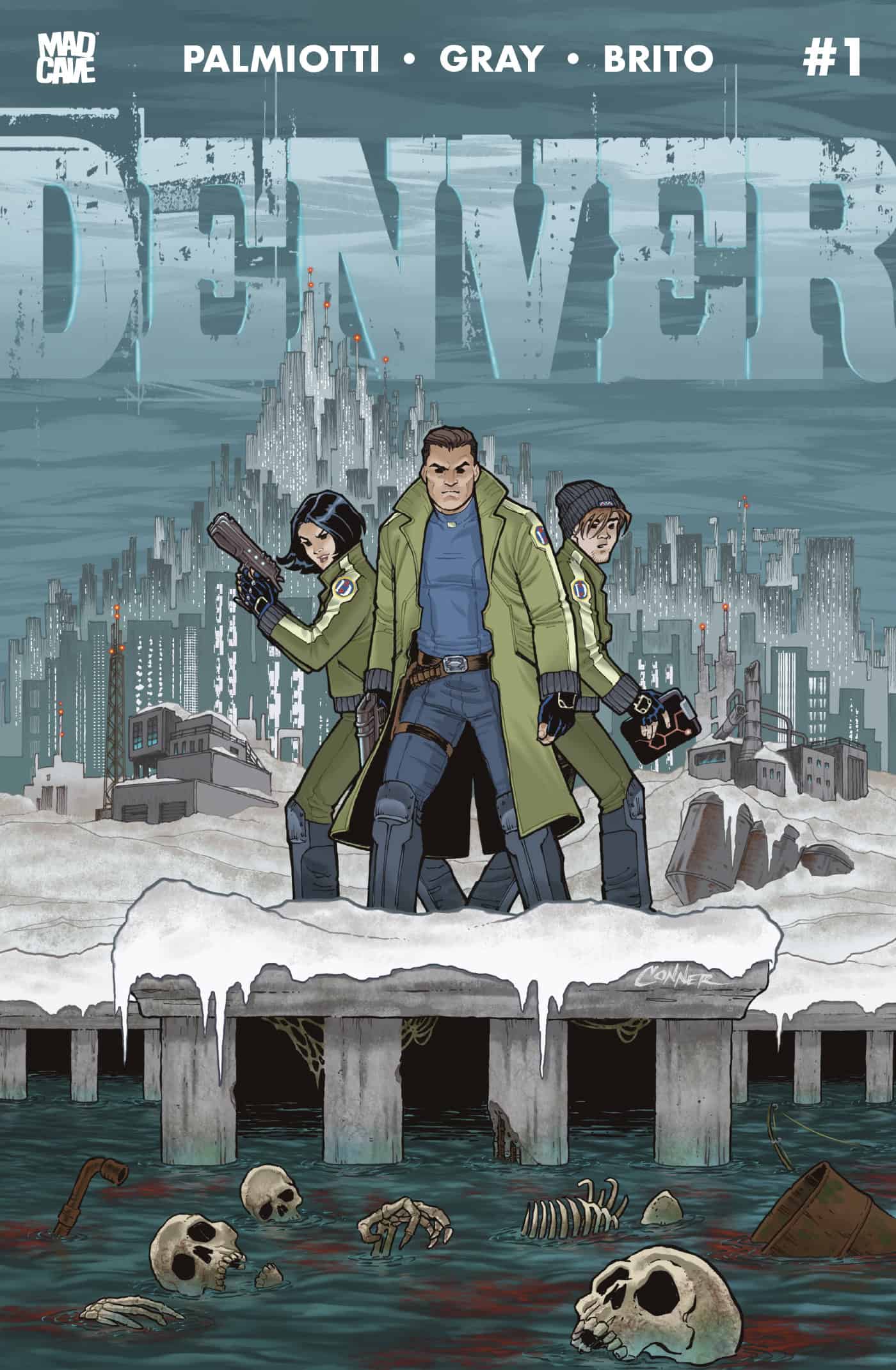
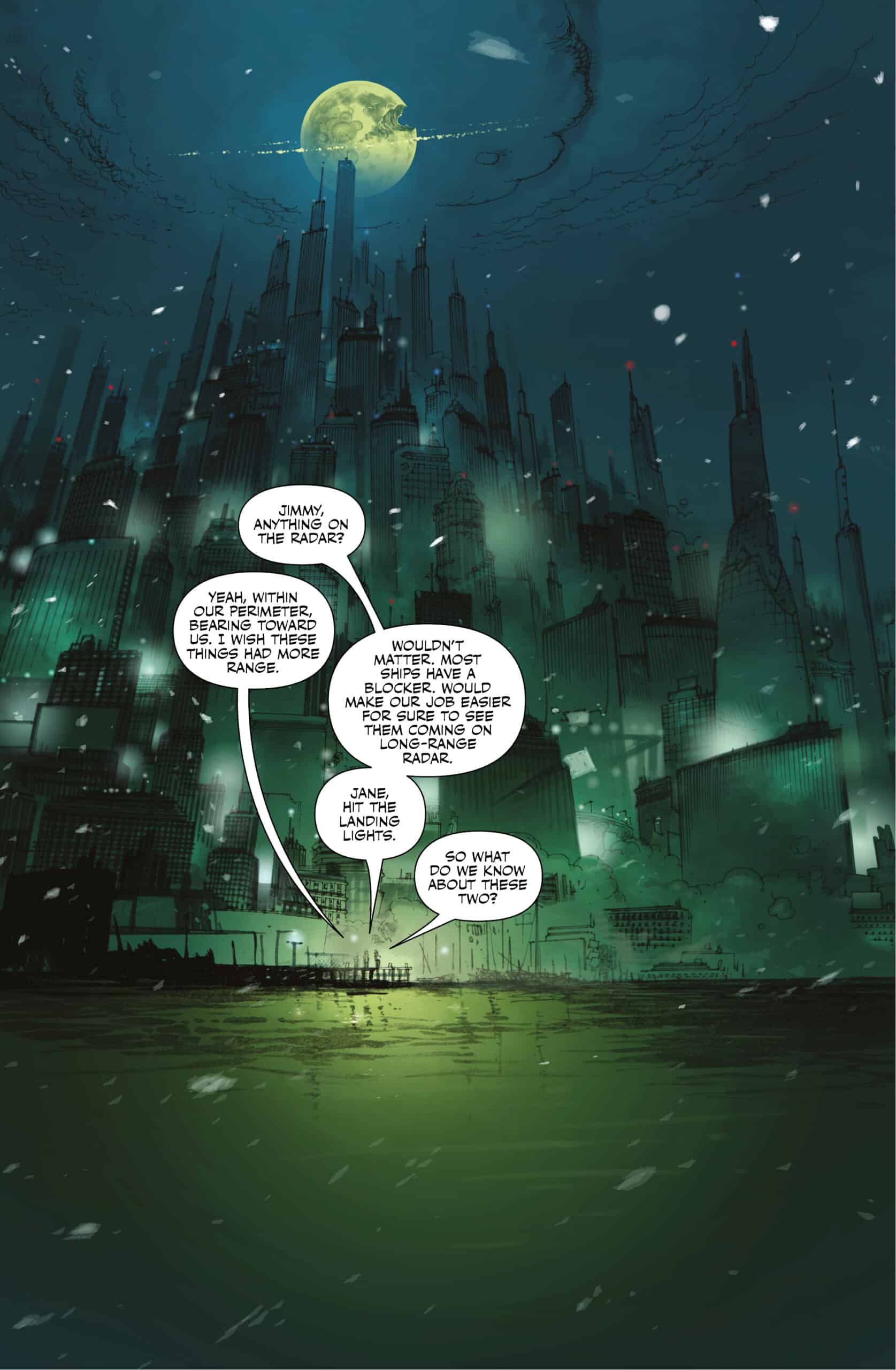
Brito’s coloring is more successful. Exterior sequences take place against a blue/green backdrop, even at night. It plays nicely into both the literal cold of the setting and a kind of narrative chill created by the city’s isolation and the dystopian world. Coloring overall is soft but features very effective contrast between visual elements.
Tortellini does a good job keep dialogue bubbles and caption boxes well organized throughout the issue. He also makes a good choice on the color of Max’s internal monologue boxes. The yellow/straw color contrasts heavily with Brito’s coloring choices and makes them stand out nicely.
Final Thoughts
Denver #1 is a fine enough read, but as a first issue it doesn’t do much to take familiar dystopian elements and make them its own. Character introductions and world building carry the narrative rather than a compelling plot. The issue struggles visually, but it’s not a deal breaker. In the end Denver #1 offers potential but doesn’t really stand out.
Denver #1: Unrealized Potential
- Writing - 6.5/106.5/10
- Storyline - 7/107/10
- Art - 6/106/10
- Color - 7/107/10
- Cover Art - 7/107/10