


X-Men '97

Recap
Previously on X-Men 97, the time-displaced mutants have returned to the 1990s, but not without cost. Apocalypse killed Magneto. Now, the X-Men have to grapple with the guilt of losing a loved one and the approaching Apocalypse.
Review
SPOILERS FOR EPISODES 6 AND 7 OF X-MEN ’97!
Both Episode 6 and Episode 7 spend their time developing a few core characters: Polaris in the former, and Nightcrawler and Colossus in the latter. All of these characters were severely underutilized in the original show, so it is welcome to spend more time with them now. Especially Colossus, who is such a crucial character to the X-Men mythos that it’s jarring that he wasn’t a core member of the original cast.
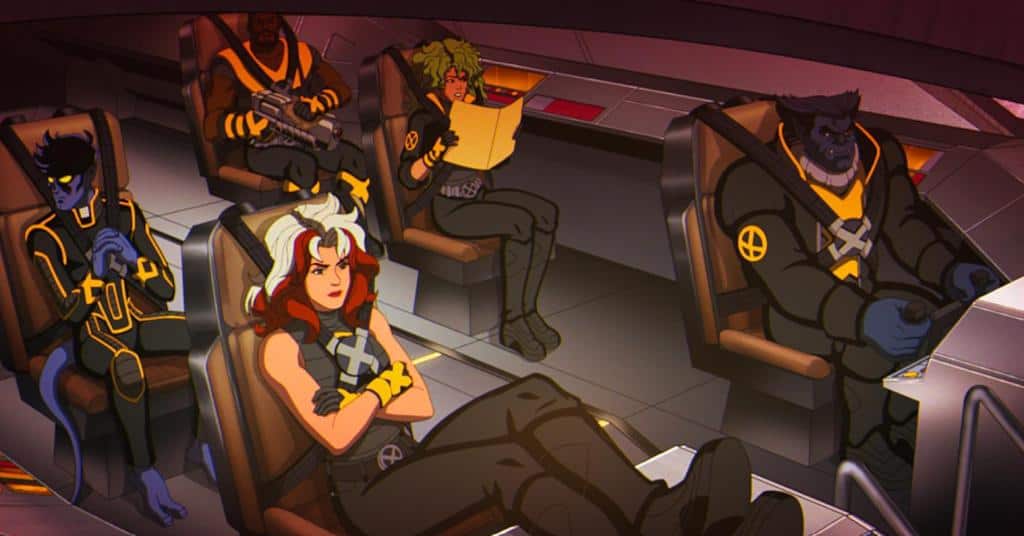
As with every episode of X-Men 97, the production quality is second-to-none. The animation is beautiful. Every frame could be a painting or a comic cover. Every musical moment is right on cue. Every fight, every flash, every moment is a visual masterpiece. The Savage Land sequences lean into the jungle aesthetic that contrasts sharply with Exodus’ base, and the framing during Colossus’s memorial wall lingers long enough to let the grief register. On the voice acting side, the show continues to excel: Carolina Ravassa as Polaris is loud and aggressive, selling her anger toward her father and her refusal to accept him; Robert Cait brings a wounded stillness to the role that sells his grief more than any action could.
The villains in these episodes are lacking. Of course, it’s going to be difficult to be as intimidating as Apocalypse, whose looming presence is felt in nearly every episode. Episode 6 has Danger, and Episode 7 has Exodus. Both villains give a very “side-boss” feeling to them. In Episode 5, at least the “side-boss” was a Brood-Infected Wolverine who slaughtered his old teammate and left an emotional impact on Morph. Neither Danger nor Exodus leaves a lasting impact on these characters; nor do they cause any emotional turmoil. Professor X does not feel guilt for the Danger protocol going rogue; Colossus does not seem shaken by Exodus’ death. While Danger is only mildly important to the X-Men mythos, Exodus has become extremely important to the X-Men franchise in recent years. Exodus was on the Quiet Council of Krakoa (the government of a united mutant nation); by killing him off so early, X-Men 97 robs Exodus of any future importance he may bring. These villains are a means to an end for the plot with little development of their own.
One exception is Graydon Creed Jr. Like his father, Sabretooth, Graydon Creed leaves an impact on the viewer. Nightcrawler believes that Graydon can be redeemed, while all others do not. Nightcrawler goes on trial, with Colossus as judge, with his own freedom on the line, just to give Graydon a chance. The speech given by Nightcrawler is a genuinely gut-wrenching speech about how hatred stems from trauma. It’s a raw, real analysis of the root causes of prejudice. But Nightcrawler extends an olive branch toward a raging fire, as Graydon Creed cannot change; no matter how kind Nightcrawler is, Graydon still despises mutants. Ultimately, Nightcrawler’s abandonment of Graydon in the snow is one of the most powerful scenes in the entire show.
As an aside, at the end of Episode 7, Nightcrawler asks Colossus if he had been convinced that Graydon Creed Jr. could’ve been saved. Colossus replies with “No… but you would’ve convinced Illyana.” While a cute moment to end the episode, it stands out for comic readers. Of the three Rasputin siblings, Mikhail (who is not in the show) is the crazy sibling, Peter Rasputin is the kind-hearted, loving, forgiving sibling, and Illyana is the violent, cold-hearted sibling. If any of these three would’ve forgiven Graydon Creed, it would not have been Illyana.
Parallel Graydon Creed from Episode 7 with Polaris from Episode 6. Both are characters that reject their parents, hating them with every fiber of their being. Both take that hatred out on the world: in Graydon’s case, with much more intention. However, Polaris is able to ultimately overcome her hatred of Magneto and move on. She embraces her heritage and accepts herself for who she truly is. It’s Graydon who is unable to see past his parents. The sins of Mystique and Sabretooth still weigh on Graydon.
A throughline between these two episodes is the tension between Bishop and Polaris. Without Gambit and Rogue, the show is left with an absence of romance (Scott and Jean are lovers, but they are not romantic). Their tension is enjoyable. Polaris and Bishop are vastly different as characters but very similar as people. In terms of power, they have little in common; in terms of personality, they share a lot of features. Both are quick-witted, snarky, and headstrong. Furthermore, these characters share little history in the comics. Giving them a romance would be a distinct characteristic of the show, allowing X-Men 97 to build more of its own identity.
The best part of these episodes is the endings. These episodes end with a teaser for Gambit as the Horseman of Death. Episode 6 shows his resurrection, and Episode 7 has his card on the corpse of Apocalypse. These teasers contribute more to the overall plot than the majority of both episodes’ runtimes.
Final Thoughts
Episodes 6 and 7 trade Apocalypse-sized spectacle for character work, both hitting and missing. Still, strong character dynamics and chilling teasers make for compelling and entertaining episodes.
X-Men ’97 Season 2: Episodes 6 & 7: Well-Deserved Spotlights
- Writing - 8/108/10
- Storyline - 7.5/107.5/10
- Acting - 10/1010/10
- Music - 10/1010/10
- Production - 10/1010/10
9.1/10
User Review
( votes) Comments Rating 0 (0 reviews)