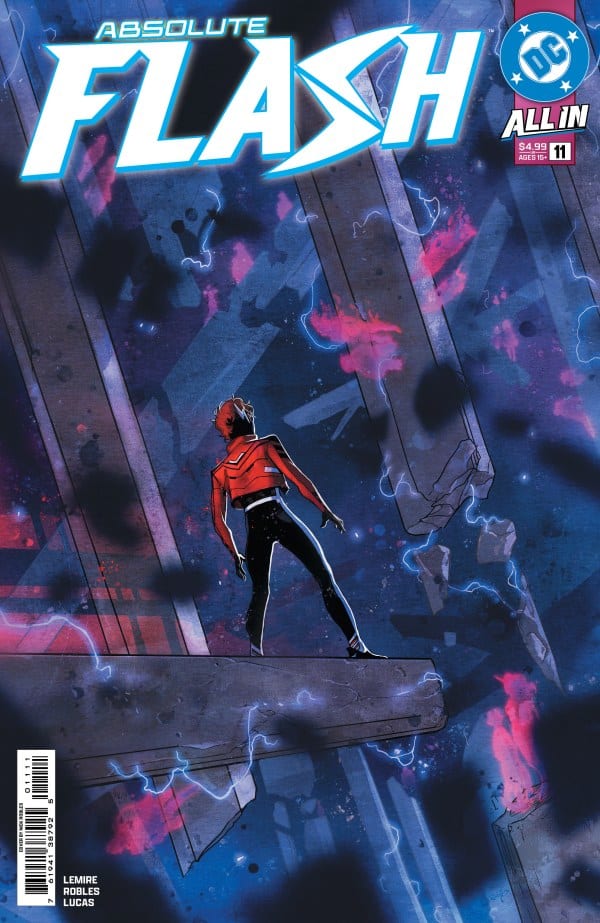
Absolute Flash #11

Jamison Nilsson
Recap
Wally West was launched inside the vortex as Eobard Thawne’s demonic form emerged and began attacking Fort Fox. Inside, Barry Allen extends a hand to Wally and welcomes him to a strange new dimension.
More Absolute Flash coverage from Comic Watch:
Absolute Flash #8: Where It All Began
Review
For ten issues Jeff Lemire’s Absolute Flash has been building up momentum for a big moment. I, like many readers, assumed the “War of the Flashes” two-part storyline would be that big moment, but I was wrong, at least so far. Compared to the past ten issues, issue #11 of Absolute Flash does a lot more of the same; it sets up plenty of new questions without answering any of our old ones. We get a handful of small clues, but no answers.
The one half-answer we do get is in regard to Barry Allen, who was “killed” back in issue #1 last year. We found out on the very last page of last month’s Absolute Flash #10 that Barry Allen was inside of the strange vortex inside his former lab, the “red light,” as it’s called in this issue. The eleventh issue does finally tell us why Barry Allen was sucked into the vortex while Wally got superpowers instead, but it never reveals what that means. There’s an obvious connection to Darkseid, the bright red light motif, and the seemingly endless void that inhabits it, but what’s given only serves to set up future story threads in the Absolute Universe. That would be fine, but it does it at the expense of nearly half of Absolute Flash #11’s page count.
A lot of the storytelling techniques being implemented here come from “shock and awe,” as betrayals, such as last issue’s reveal of a traitor among the rogues, and new powers, like Grodd’s force field also in the previous issue, are used one after another to replace the kind of momentum usually generated by important dialogue. A hint here and a half-answer there keep the story moving, but they don’t breathe life into its characters or setting. On the other hand, no reader likes to get flooded with exposition, but enough dialogue is necessary to keep the story flowing and the characters growing.
Nick Robles’s artwork is excellent in a weird science-fiction way that promotes the atmosphere the story is trying to create. All of the characters are drawn well, and the small amount of action in the issue is given enough balance between motion and chaos that it’s effective enough as a vehicle for the storytelling. Despite its craft and quality, the art seems to have settled into a comfortable position, refusing to do more than what the story just barely requires beyond a few choice pages that peak in quality early or just before the pacing accelerates. None of the pages aside from one full page are particularly notable, even with clean line work and spacing that match the bare minimum standards of DC Comics. There isn’t anything you’d miss on a first read-through and nothing you’d see for the first time on a reread. In simpler terms, the art is survivable but doesn’t go beyond the limits of its comfort zone.
Final Thoughts
Absolute Flash #11 is effective as a direct continuation to issue 10 but fails to answer any of the readers' questions regarding the experiments in Fort Fox or the nature of Wally West’s superpowers. The momentum of Jeff Lemire’s Absolute Flash storyline is beginning to slow despite nearly a dozen issues of building this far; this makes the issue into purely connective tissue for the previous issue and the next, which may alienate a number of current readers if it fails to deliver on any of the major plot threads that Lemire has set up in the course of a year’s worth of writing.
Absolute Flash #11: Back to Barry
- Writing - 7/107/10
- Storyline - 7/107/10
- Art - 7.5/107.5/10
- Color - 8/108/10
- Cover Art - 7/107/10