


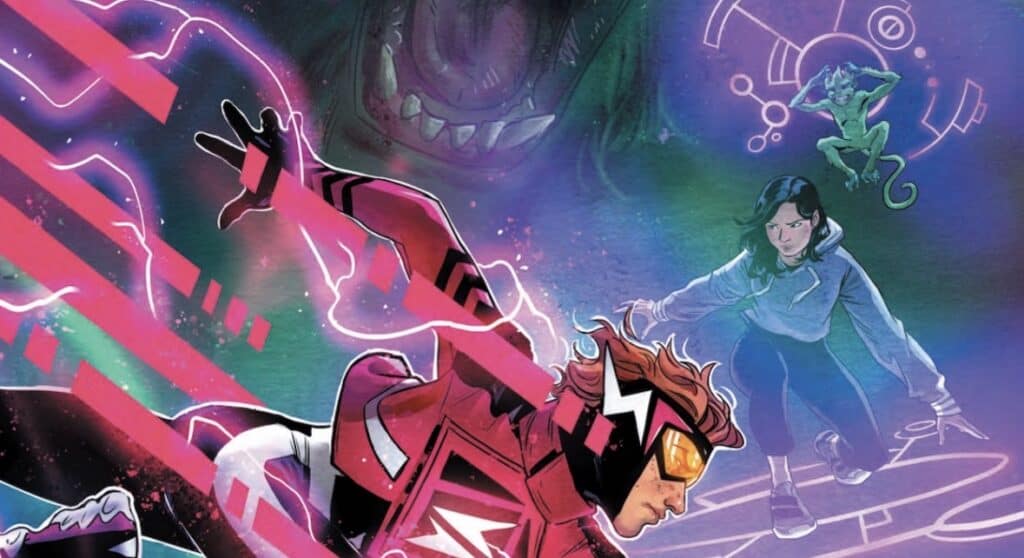
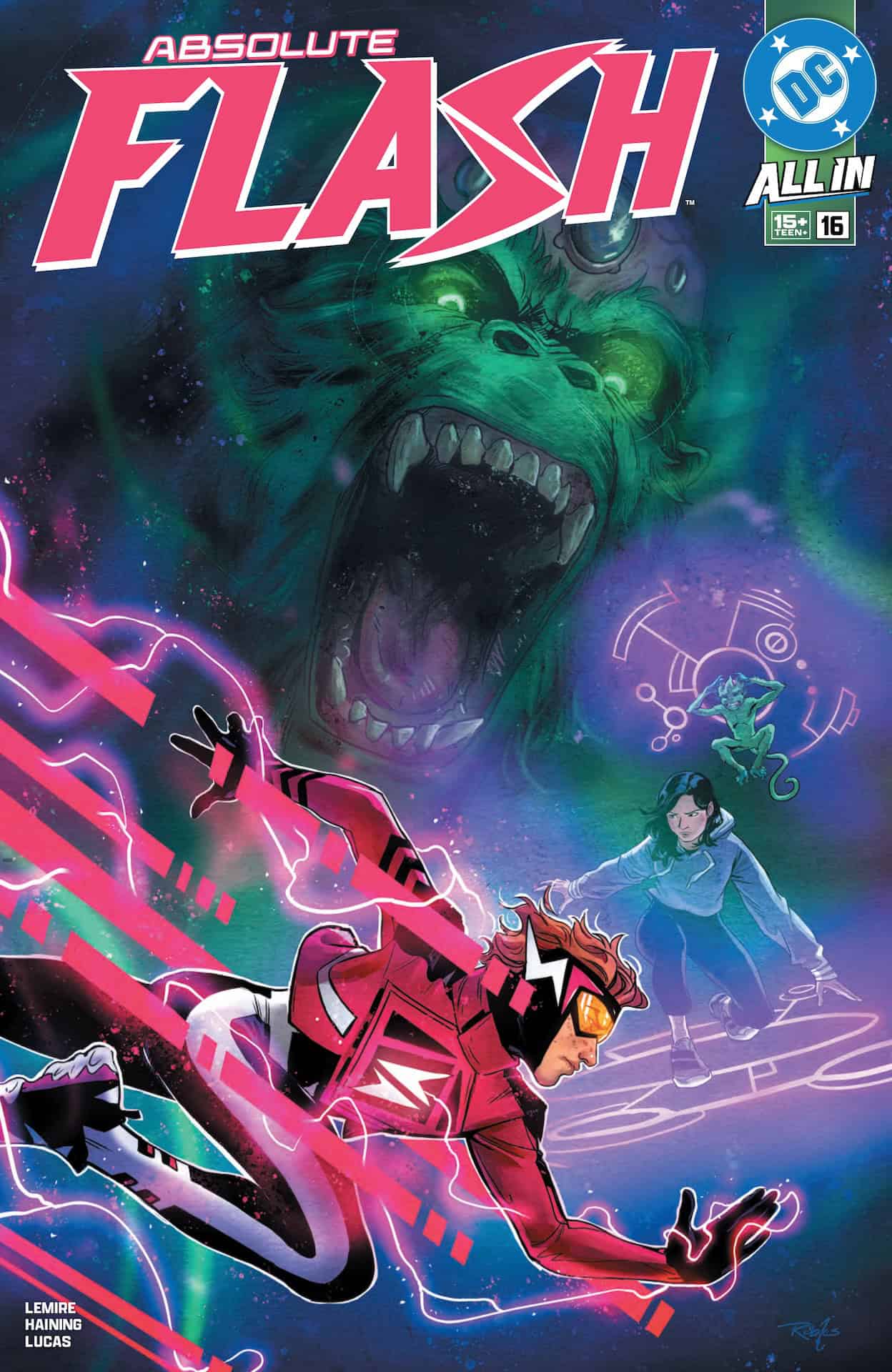
Absolute Flash #16

Recap
During the hectic battle at Fort Fox, Grodd found his father and the two left the battle together and haven’t been seen since. In that time, Wally has been tracking down Ray Palmer with the help of Linda Park at the request of Sam Scudder.
Review
What do you do when you’re tasked with writing an adventure storyline about a character who can cross continents in seconds? Simple, you give him people to care about and rely on. That’s the crux of issue #16 as Wally needs Linda’s help while he runs headfirst into danger for Grodd.
Despite disconnecting itself from the Ray Palmer storyline in the first few pages, albeit with a few hints for that storyline’s future, Absolute Flash #16 doesn’t feel like a side quest or filler. Primarily because of the work it does with its three main characters.
Wally, Linda, and Grodd all have a distinct voice in this issue and quickly play their own respective roles in the emerging storyline. All three put narrative pressure on the other two, with Wally needing to run to Grodd’s aid in his moment of need and Linda wanting to not only help Wally but also help Grodd.
The adorable telepathic gorilla, who made his Absolute Universe debut back in Absolute Flash #3, is front and center this issue with the beginning to a new two-part “Gorilla City” story arc. Grodd’s role as the focus of the issue mainly works because of the empathy readers are rightly expected to have for him due to his role as Wally’s sidekick for several issues between the two main Fort Fox storylines.
Jeff Lemire is able to seamlessly weave the three protagonists together in a believable way for the new arc without having to break into multiple viewpoints for long, which would normally slow the pacing to a grind. From what we are shown in this issue, the Gorilla City storyline intends to bring a fittingly darker kind of Grodd mythos to the Absolute Universe.
Haining returns to art on this issue, bringing back their anime-esque style of smooth line art and detailed backdrops for the panels to stack on top of. Because of that technique, a single page is able to have “extra panels” by placing one part of the backdrop towards the top of the page and another towards the bottom, while displaying different parts of the same scene without the need for an extra two panels. It makes sense for The Flash to be difficult to approach in terms of scene transitions due to his super speed, but Haining’s art handles this by bridging the scenes with the above-mentioned backdrops, most of which are full of fine details.
Wally moves, at super speed, consistently through the pages, bringing his lightning trails with him, which are easy for the reader themself to track. Grodd’s personal psychic panel layout, such as when he connects his mind to Wally’s, is able to be totally unique without changing the tone of the storyline. Mostly because it fills in gaps we already have as the reader, making Grodd feel more important and developed as a character.
Adriano Lucas’ colors have this fade-in, fade-out effect in this issue that makes panel transitions between so many illustrations feel coherent. Textures like Wally’s suit or his lightning trails are handled completely differently than Grodd’s fur or the metallic signs inside of a strip mall. Then there are these panels with single-color backdrops that work as emotional transitions, such as a flash of red or yellow, giving characters like Grodd believable reactions from panel to panel without the need for extra dialogue.
Final Thoughts
Issue #16 is tightly paced from start to finish, with every line of dialogue either developing the bonds between the characters or pushing the storyline to the next page. Even the last few pages don’t feel like bait for the next issue because they actually answers the reader’s questions rather than simply kicking the can down the road.
Absolute Flash #16: It’s All Grodd
- Writing - 9.5/109.5/10
- Storyline - 9.5/109.5/10
- Art - 9.5/109.5/10
- Color - 9.5/109.5/10
- Cover Art - 10/1010/10