


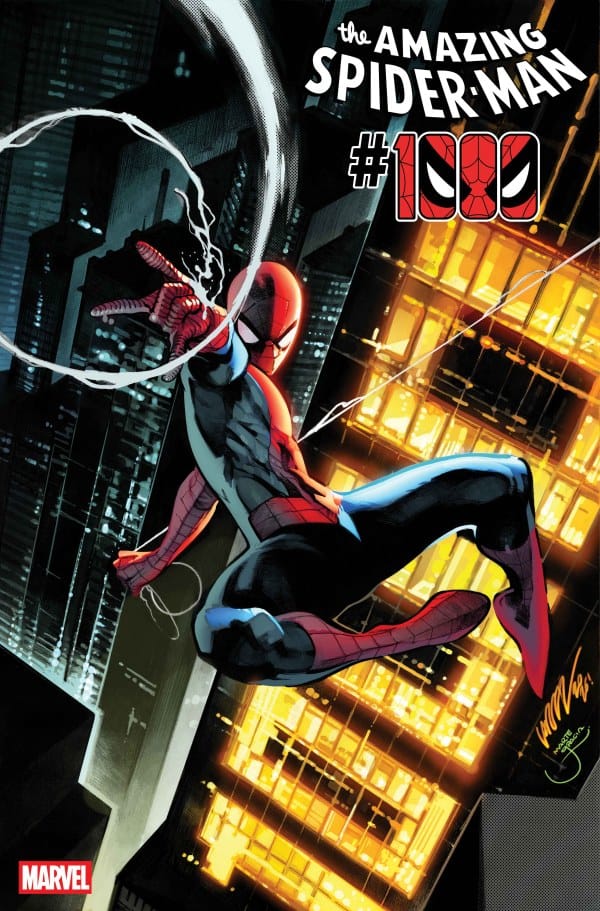
The Amazing Spider-Man #1000

Recap
Spider-Man faces his greatest fear and his most frightening new villain in decades... RAVAGE! Plus, some of the greatest creative minds on Earth honor one thousand issues of THE AMAZING SPIDER-MAN! NOAH HAWLEY (Alien: Earth, Fargo, LEGION) makes his comic book debut, Frank Miller and Peach Momoko collaborate for the first time, Stuart Immonen and Brian Michael Bendis return to Spider-Man together, and some of the best ASM creators return to the title!
Review
After sixty-plus years and countless adventures, spanning every conceivable medium of storytelling, Peter Parker has finally hit one thousand issues in the book that started it all, The Amazing Spider-Man. The journey here has been an interesting one to say the least, as a mountain of doubt about the current editorial and creative teams behind Spider-Man has left readers anxious about whether this milestone issue could live up to both those that came before and inspire a strong future for the title.
Packed with eight stories, The Amazing Spider-Man #1000 falls somewhere in between those expectations, a bulk of its stories the kind of backup fodder that has plagued milestone issues for the last decade. However, there are still gems in the mix that make this celebration of the character a worthwhile one.
– – –
RAVAGED
The main event continues Joe Kelly’s run, and while the direction is fairly predictable, it kicks off a story that plays with the decades of love between Peter Parker and Aunt May in a way that carries serious potential. Returning to art duties, Pepe Larraz delivers some of his best superhero work to date, with page after page of meticulously considered storytelling. His pacing shines in both the quieter emotional beats and the larger action sequences, giving the issue a sense of momentum even when its biggest revelations remain just out of reach.
The lack of any truly conclusive shake-ups keeps this from reaching the same heights as an issue like The Amazing Spider-Man #400, but Kelly is laying the groundwork for the rest of his “Ravage” arc in a way that could leave a lasting mark on the character sixty years after his debut. It’s gut wrenching to see Peter’s life with may ripped from her mind, Peter’s undying heroism weaponized against him as Cormac leads him on a trail of violence, hacking away at this soul in every passing panel.
Cormac’s turn as a nefarious villain looking to replace Peter and push him even deeper into isolation is hardly shocking, but the stakes and unanswered questions surrounding his origins keep the story moving at a thrilling pace. There’s an unmistakable echo of the early Clone Saga here, which also began with a hospitalized May Parker and the arrival of a villain threatening to destroy everything Peter holds dear. Whether that parallel is intentional or simply the result of decades of serialized storytelling circling back on itself, it works as a strong thematic parallel to the last time it felt like the character still had a sense of momentum to his growth.
That said, the lack of any major revelations beyond Cormac’s predictable turn keeps this milestone from immediately joining the ranks of the all-time greats. Kelly has clearly planted the seeds for something much bigger, though, and if “Ravage” continues to build on what’s established here, this could eventually earn its seat at the table.
– – –
STILL STANDING
When it was announced that Noah Hawley would be penning a story for this anthology, there was considerable uproar over an author with no Spider-Man history being given a spot over legendary Spider-Scribes like J. Michael Straczynski or Tom DeFalco. Yet in only 23 pages, Hawley proves himself a wonderful writer for the character, especially when paired with an artist like Patrick Gleason.
“Still Standing” is an emotional tour de force and the standout gem of this issue. It’s a reflective yet deeply heroic Spider-Man story centered on Peter Parker at the end of his life, surrounded by the family he’s always dreamed of and proud of the life he got to live. When a ghost from his past returns to threaten the stability of his mind, Peter is forced to confront the best and worst of his past with nothing but his humility to carry him through to the end.
There is so much I could say about this story and its emotional impact. The highest praise I could give it is that Hawley has delivered a tale in the vein of The Dark Knight Returns for Spider-Man that actually draws from the power of the character and the multilayered tones of his publication history to examine what the end of Peter Parker’s life could truly be. It captures the spirit of that classic without simply mimicking Frank Miller’s edge,understanding the unique soul of the character beneath it.
The symbolism of what Spider-Man means pours out of every page, from his relationships with his children to the memories of lovers long past and the endlessness of his connection to his villains. This is a story that brought tears to my eyes as the warmth of Peter Parker fights against the callousness of his demons, inspiring future generations while allowing those who have brought harm to his doorstep to find redemption at the end of their own days.
It’s a special piece of superhero fiction, one that understands why Peter Parker has endured for so many generations and what his legacy can ultimately mean. It’s worth the price of admission for this oversized issue alone, but Patrick Gleason ties it all together with such vivid imagery and pacing work that reads as cinematic without stripping away the creative choices only a comic book artist can make.
– – –
THE BACKUPS
As for the smaller stories here, they’re evenly split between good and mediocre. While the stronger backups manage to deliver some good feels and celebratory anecdotes, the weaker affairs often left me wondering why editorial couldn’t have cut them to give more space to either the main story or some of the other backups.
Requiem for a Goblin sees J.M. DeMatteis returning to the funeral of Harry Osborn, a moment in Spider-Man history he directly worked on back in the ’90s. While it mostly showcases DeMatteis working with a bag of old tricks, his fundamental understanding of the dynamic between Peter, Harry, and the Osborn legacy offers a unique flavor of emotional messiness. That stands out in a series of backups that mostly leave Spider-Man as a figure of heroic inspiration, when the real reason people love this character is the imperfections he fights to overcome. Getting to see Humberto Ramos bring his iconic style as a modern Spider-Man artist to a decades-old era is also a treat.
The Gesture marks Brian Michael Bendis’ return to writing the character as he focuses on the dynamic between Peter’s self-wallowing humor and the impact he has on the wider Marvel Universe. The first chunk reads like an average issue of Spectacular Spider-Man, as Peter faces down a group of D-tier villains while trying to distract himself from his poor state of life. He prioritizes the needs of those in front of him over an Avengers summons. It has a touching resolution and understands the role Peter plays within the wider scope of Marvel’s New York.
I Can Never Rest reunites Dan Slott and Marcos Martin as they revisit the death of Uncle Ben from the perspective of the police officer who was attempting to apprehend the burglar on the night of Ben’s death. While very short, it’s a poetic example of how Peter overcoming his selfishness and stepping up has inspired others to make better choices with the direction of their lives. It’s an idea that directly reflects an audience that draws so much personal inspiration from the character’s trials and tribulations. There’s a sense of rest in seeing a reader learn from the relatability of a character who grows from the worst of his mistakes.
The other three backups have merit, especially in the art department, but don’t necessarily stand out as “milestone” worthy in terms of their themes or creativity. They wouldn’t feel out of place in your average annual, and they often left me wishing their pages had gone toward expanding the real estate of the other stories in this collection.
Final Thoughts
The Amazing Spider-Man #1000 may not be the most monumental of the character's milestone issues, but it is one still full of heart and beautiful art that serves as a strong celebration of the character in his sixtieth-fourth year, duds and all.
Amazing Spider-Man #1000: One Thousand Down, Two Thousand to Go
- Writing - 7.5/107.5/10
- Storyline - 7/107/10
- Art - 10/1010/10
- Color - 10/1010/10
- Cover Art - 6.5/106.5/10