


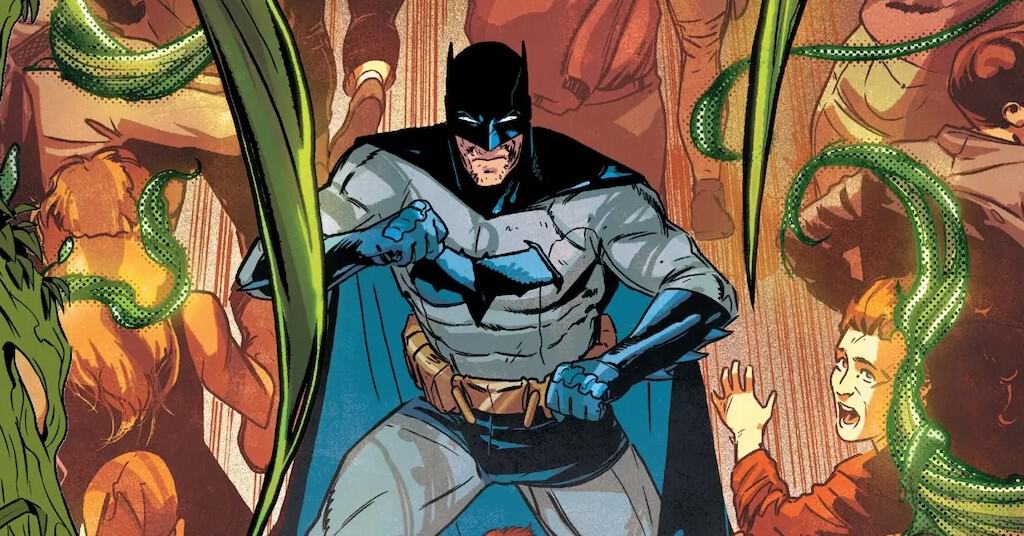
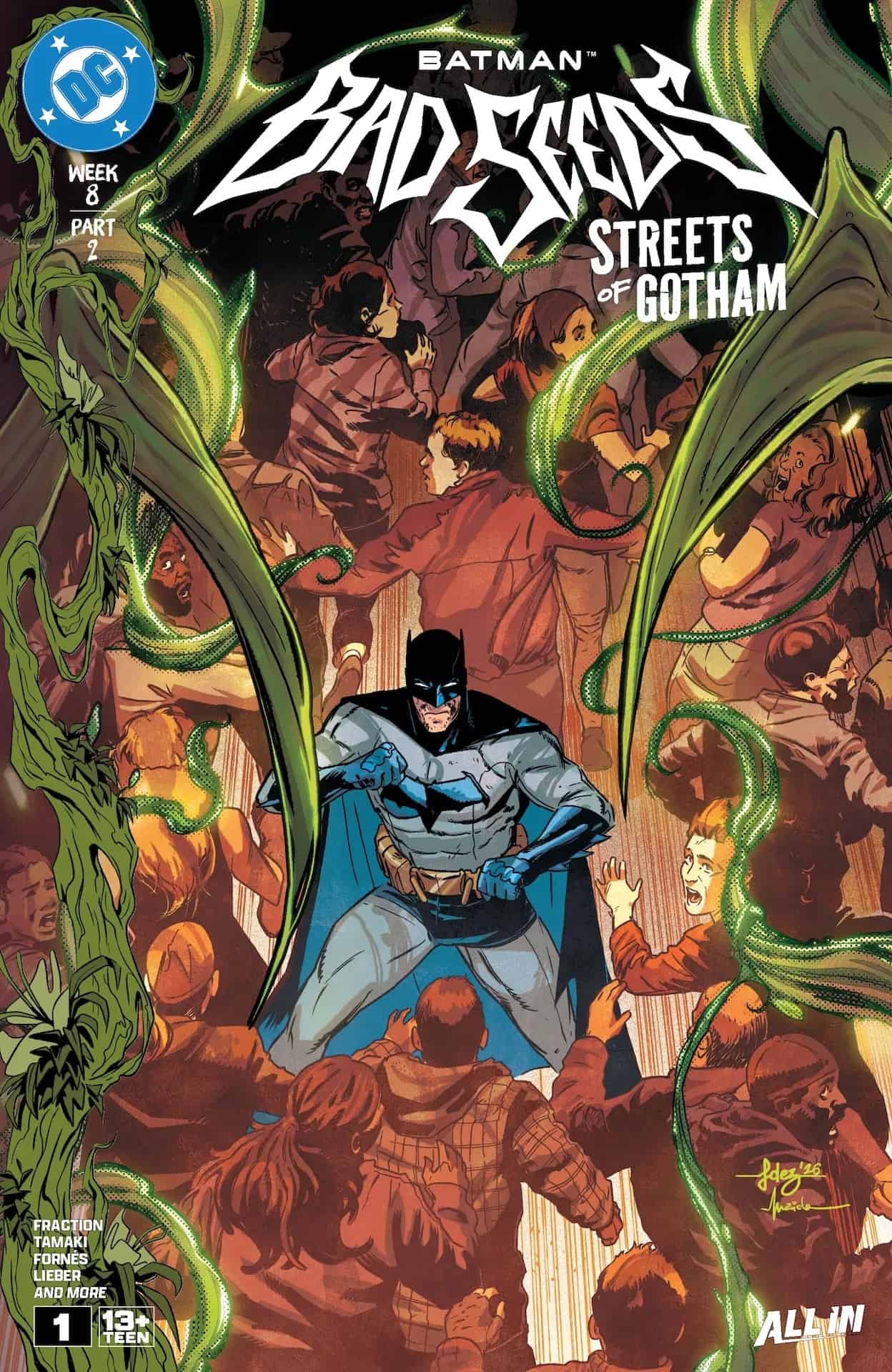
Batman: Bad Seeds - Streets of Gotham #1

Recap
SIX STORIES OF SURVIVAL FROM SUPERSTAR WRITERS MATT FRACTION AND MARIKO TAMAKI!
As the chaos of Bad Seeds erupts across Gotham City and the Bat-Family races against daylight, the citizens of Gotham City must endure the threats of Poison Ivy's superbloom on their own.
Join Eisner Award-winning writers Matt Fraction and Mariko Tamaki as they tell six street-level tales of fear, courage, and perseverance, starring everyday people who must learn what it means to be a hero — with or without a cape.
Review
Matt Fraction and Mariko Tamaki take readers on a night time tour of Gotham City in Batman: Bad Seeds – Streets of Gotham #1. The oversize issue delivers six stories, three from each writer. In the middle of yet another apocalyptic event in Gotham City, these stories run a gamut of emotions from funny to heartfelt to dire.
Four out of six of the stories in Batman: Bad Seeds – Streets of Gotham #1 are lighter fare with little consequence to Bad Seeds specifically or the Bat adjacent titles generally. The weakest of the four, “The Stand,” comes from Tamaki. A group of children, two of which are playing dress up as Batman and Nightwing, go outside and save someone caught in the clutches of one of the prehistoric plants overrunning Gotham. The children succeed as this person’s savior, somehow avoiding the significant danger this plant life is presenting everywhere else in the event. Paired with Lusky’s art and colors, this story feels painfully out of place, closer to something aimed at a much younger audience. And the idea that a group of random kids playing dress up can save the day somewhat undermines the threat Bad Seeds is supposed to present.
The remaining two stories from Tamaki and one of the stories from Fraction, “The Party,” “The Pitch,” and “The Long Walk Home” respectively, are more in keeping with the concept of Bad Seeds if not necessarily the tone. “The Party” is a lesson in “crime doesn’t pay” as one half of a two person robbery team ends up at a rooftop barbecue and the other steals a TV and gets eaten by a plant. “The Pitch” leans into comedy as several employees at a PR firm try to finish their assignment of creating a new campaign to attract tourists to Gotham. “The Long Walk Home” leans into comedy, some of it coming from a place of cynicism, while including a bit of action featuring Signal. None of these stories have much depth to them, but they’re enjoyable enough.


Ching’s art in “Balladeers” has a rough-edged quality. This is very much the case with the characters, especially during the action sequence featuring Tim. Ching tends toward sharp angles for everything as opposed to softer curves. Lucas uses a variety of colors but opts for darker hues for most of them in keeping with the overall darker blue used for the nighttime setting.
“Primaries” rounds out the issue, and it is by far the most intense of Batman Bad Seeds Streets of Gotham #1’s offerings. Fraction centers the story on a half crazed, trigger happy, self-important TUCO trooper who simultaneously has a bit of a victim complex over the idea that Gotham’s citizens look down on him. The TUCO moves through the city, his squad utterly uninterested in helping civilians. Indeed, when they come upon Signal trying to help a group of trapped civilians, the squad happily goes after him instead of helping the civilians who are in danger. The TUCO at the center of the story is practically salivating at the opportunity to kill a Bat vigilante. Fraction tells the story almost entirely through the TUCO’s internal monologue. He is a distasteful character lacking any redeeming qualities. Fraction doesn’t use misdirection to suggest the TUCO may choose to change his behavior for the better by the end.
Black and gray are dominant throughout “Primaries.” Other colors lean toward darker hues. Stewart’s color scheme works very well with Fornés’s art which uses a lot of dark, thick lines and bigger patches of black shading. This works especially well with the TUCOs whose dark appearance fits with their depiction as villains–especially when paired with the brighter Signal.
Final Thoughts
Batman: Bad Seeds - Streets of Gotham #1 is an enjoyable enough read, but most of its stories are unlikely to leave much of a lasting impression. Most of the writing and art is good quality (with the exception of “The Stand” which feels incredibly out of place). Ultimately, though, the issue’s primary audience is probably Bad Seeds completionists.
Batman: Bad Seeds - Streets of Gotham #1: Fine But Forgetable
- Writing - 7/107/10
- Storyline - 5/105/10
- Art - 6.5/106.5/10
- Color - 7.5/107.5/10
- Cover Art - 6.5/106.5/10