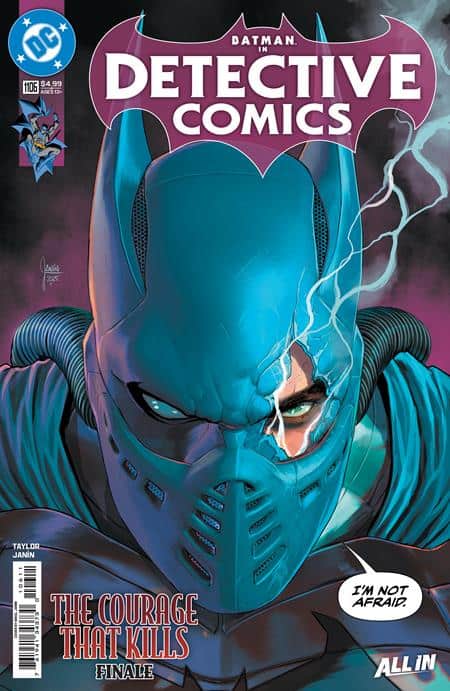
Detective Comics #1106

Jamison Nilsson
Recap
Detective Comics #1106 marks the end of Tom Taylor’s six-issue “The Courage That Kills” storyline. A storyline that has focused almost entirely on the newest Batman villain, The Lion. The Lion’s “Courage” virus is the exact opposite of Scarecrow’s iconic fear toxin. Instead of inducing fear, it annihilates fear to create dangerous levels of courage and self-confidence.
More Bat-family coverage from Comic Watch:
Review
As the finale to a six-part story arc, Detective Comics #1106 is all pace and no breaks. It’s an ending after all, and it has to cover all of its bases. As a storyline, “The Courage That Kills” has not been a particularly accessible story arc for new readers. While it’s a perfectly inviting story for any longtime Batman fans coming to Detective Comics from other formats, newly cowled fans of the caped crusader will find themselves feeling a bit lost in motion from the first issue of this storyline onwards.
Leo Kingsford, aka The Lion, is a mirror of both Bruce Wayne and Batman. “I know what it’s like now. Trying to help a city that kicks you in the face.” This line spoken by the Lion in this issue is the crux of his arc through this six-part story and the perfect framing of him as a character who is the thematic reverse of Bruce Wayne. “The Courage That Kills” leverages the legacy of Batman’s iconic character.
Even people who have never read a comic or played a video game know Batman’s origin story. It’s one of the most famous superhero stories in the world. Taking Bruce’s story and turning it inside out would veer into lazy storytelling territory if it were just for a single issue, but as a six-part story arc, it gives Tom Taylor time to use the Lion as the lever to push Batman forward.
The issue’s artwork reflects the story, similar to how The Lion reflects Batman as mentioned above. As fear begins to clash with courage, the fight scenes start to meld together. Leo Kingsford becomes a demonic figure in Bruce’s eyes, like those that have been created by Scarecrow’s fear toxin in older stories. The scene composition is excellent, action has a clear progression from start to finish with a twist along the way, and no page wastes any space on blank lines. There aren’t any density problems either, granular details are packed into small corners of the page or into the background, such as scenes of Gotham’s rioting citizens, which gives depth to the characters that are front and center.
The color in #1106 has both a temperature and a heartbeat to it. The city of Gotham is breathless; the now fearless residents of one of the scariest fictional places to live are rioting, and it feels heart-pounding to the reader due to the stuffed pages full of nameless characters and city-wide carnage that grows as the story reaches its climax. As for its temperature, scenes in isolation are cold and detached, much like how a fear of loneliness would feel, especially to someone like Bruce Wayne.
On the opposite end, the action is visually heated. From the early pages, flames lick at the gates of Bruce’s manor and enhance the raw menace of The Lion himself as Bruce’s fear begins to resurface. All of this works really well with the storyline on a not-so-subtle but still very psychological level. As the two of them inevitably duke it out, the fire grows hotter and begins to spread through the scene much like the growing chaos in the city. It’s an effective tool for the art to reflect the story, just how the Lion reflects the Batman, both as incomplete opposites of the other.
Final Thoughts
The Lion may not be the next big Bat villain, and this story arc may not be the thing to redefine Batman for a new audience, but when all is said and done, “The Courage That Kills” was an effective storyline. Tom Taylor’s run on Detective Comics has been more of a checkpoint for who Batman is now and where his psychology has taken him over the years. It doesn’t challenge Bruce like it challenges Batman, and that may be where Taylor left a lot of meat on the table. As for the Dark Knight's legacy, Tom Taylor isn’t trying to change Batman or reveal any deeper layers the fans of several decades have been missing up until now.
Personalized recommendation: If you have collected the previous 5 issues (#1101-#1105) of this story arc, then Detective Comics #1106 is a natural capstone to that collection. However, if you’ve not yet picked up any of the six issues or only have a few of them, I would recommend reading the entire story before committing to a full collection.
Detective Comics #1106: Fear Is A Mirror
- Writing - 8.5/108.5/10
- Storyline - 8/108/10
- Art - 9/109/10
- Color - 9.5/109.5/10
- Cover Art - 9/109/10