


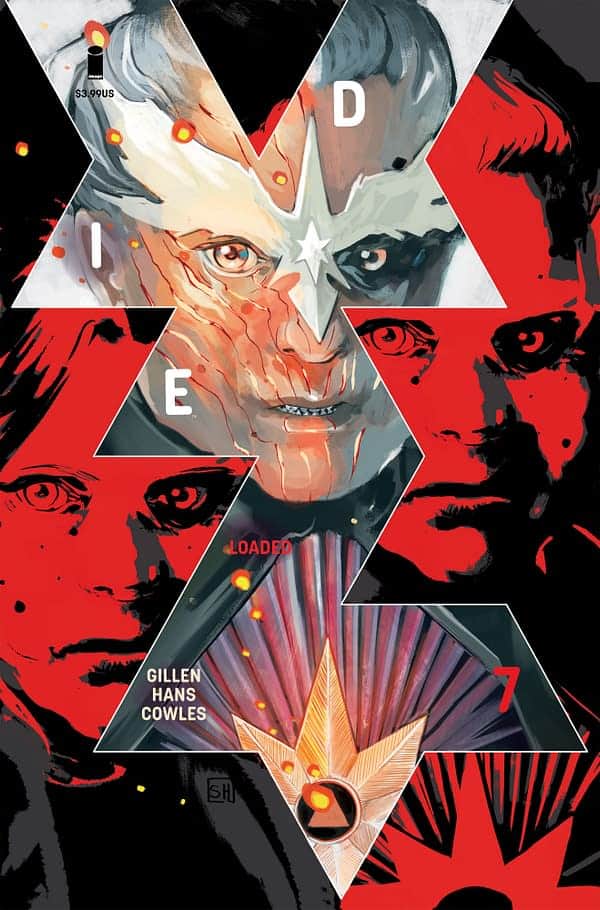
DIE: LOADED #7

Recap
Sophie finds the party's final member, Tommy, in a fever-dream hospital where his wife lies dying of cancer. Together, she and Tommy return to find Callum has killed off the rest of the party and doodled a penis on the wall with their blood. This is why you don't stay at the Prancing Pon(e)y.
Review
Between this issue and the end of DIE: LOADED’s first arc, I lost two extended family members I loved dearly. The irony of losing two loved ones in between issues of a comic series all about death is not lost on me. It has changed my relationship to DIE: LOADED irrevocably, but also emphasised what makes the original DIE and its sequel series great in the first place.
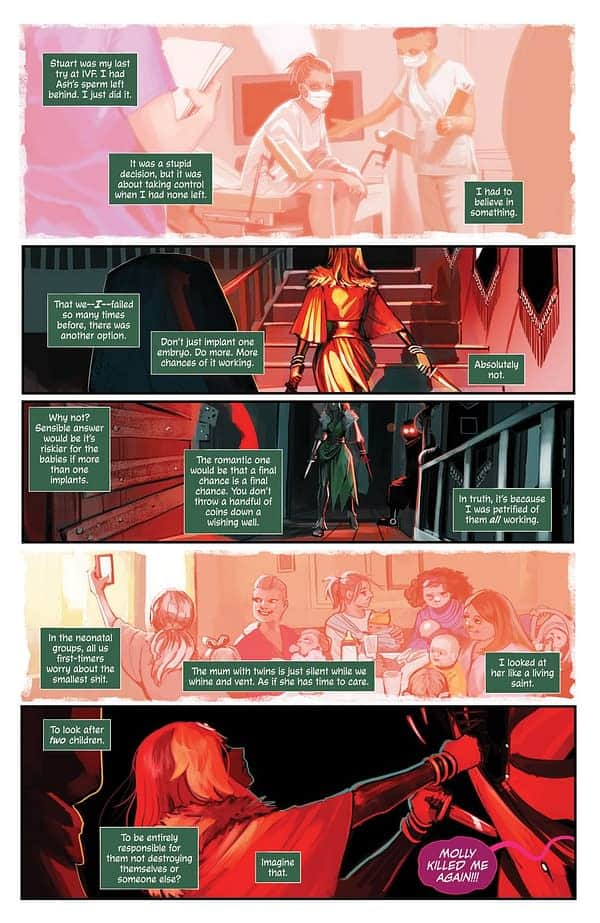

In The Grasshopper: Games, Life and Utopia, philosopher Bernard Suits asserts that “playing a game is a voluntary attempt to overcome unnecessary obstacles.” DIE and DIE: LOADED point to the ways games may also help us confront the necessary ones. Kieron Gillen, Stephanie Hans, and Clayton Cowles’ DIE comics have never shied away from difficult subjects. Indeed, at the world’s heart lies the idea that fiction and roleplay offer a means to escape harsh realities and process difficult subjects (e.g. gender identity, parenthood, classism, mortality) from a distance. But this escape can’t be the same as complete, eternal avoidance. In the previous issue, Sophie found Tommy—the party’s final member—in a fevered recreation of his dead wife’s hospital room, where she lives on, forever dying of cancer and never dead because Tommy is unable to accept it. Tommy might have tech powers here, but his wife’s cancer and death remain real horrors that must be faced and accepted. This worldview also applies to the real-world traumas explored in the newest issue.
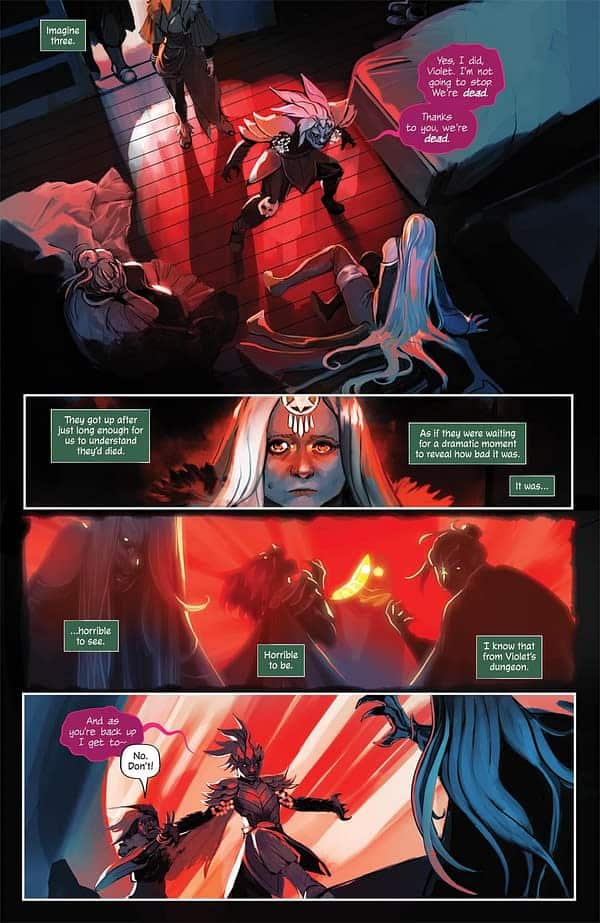
While trying to save the rest of the party, turned into cannibalistic undead by the events of DIE: LOADED #6, Sophie and Tommy stumble upon a cosplay contest where Die’s fantasy world denizens are dressed up as humans, with a prize for whoever can be the most authentically human—for whoever feels most real. Of course, Sophie and Tommy compete. Gillen’s script embraces the comedy of the situation, but the cosplay contest also becomes a revealing, heartbreaking moment as both protagonists open up and publicly share traumas they’d prefer to keep hidden. And as DIE: LOADED #7 emphasises, not every grief and every loss is because someone has died.
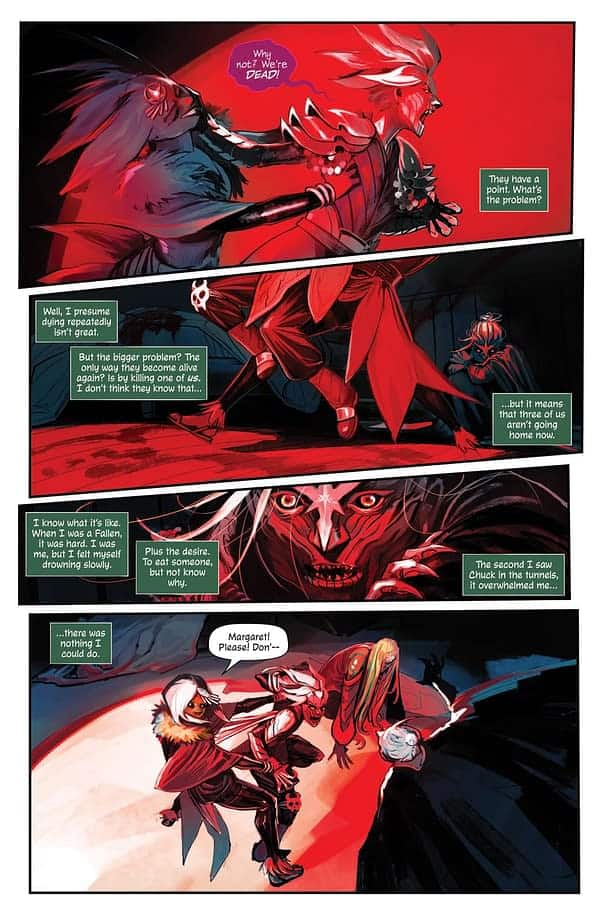
While the world of Die is a vivid one of bloody, urgent reds and majestic golds, artist Stephanie Hans renders these painful memories in hazy lavenders and pinks. They feel, by comparison, fragile and impermanent. While Hans now works digitally, these memory scenes speak to her watercolorist’s sensibility. One feels they could wash away in the rain.
The cosplay scenario also offers its readers ample opportunity to reflect on what it means to share grief, external judgment we may receive, and the line between sharing and performance. This is, after all, a contest. At its heart, the comic forces us to consider what emotions and experiences are deemed authentic. Whose grief gets to be real?
Final Thoughts
DIE: LOADED #7 provides a candid look at grief and the ways we share it.
DIE: LOADED #7: Can I Be Real for a Second?
- Writing - 10/1010/10
- Storyline - 10/1010/10
- Art - 10/1010/10
- Color - 10/1010/10
- Cover Art - 10/1010/10