



Dog Tag #1

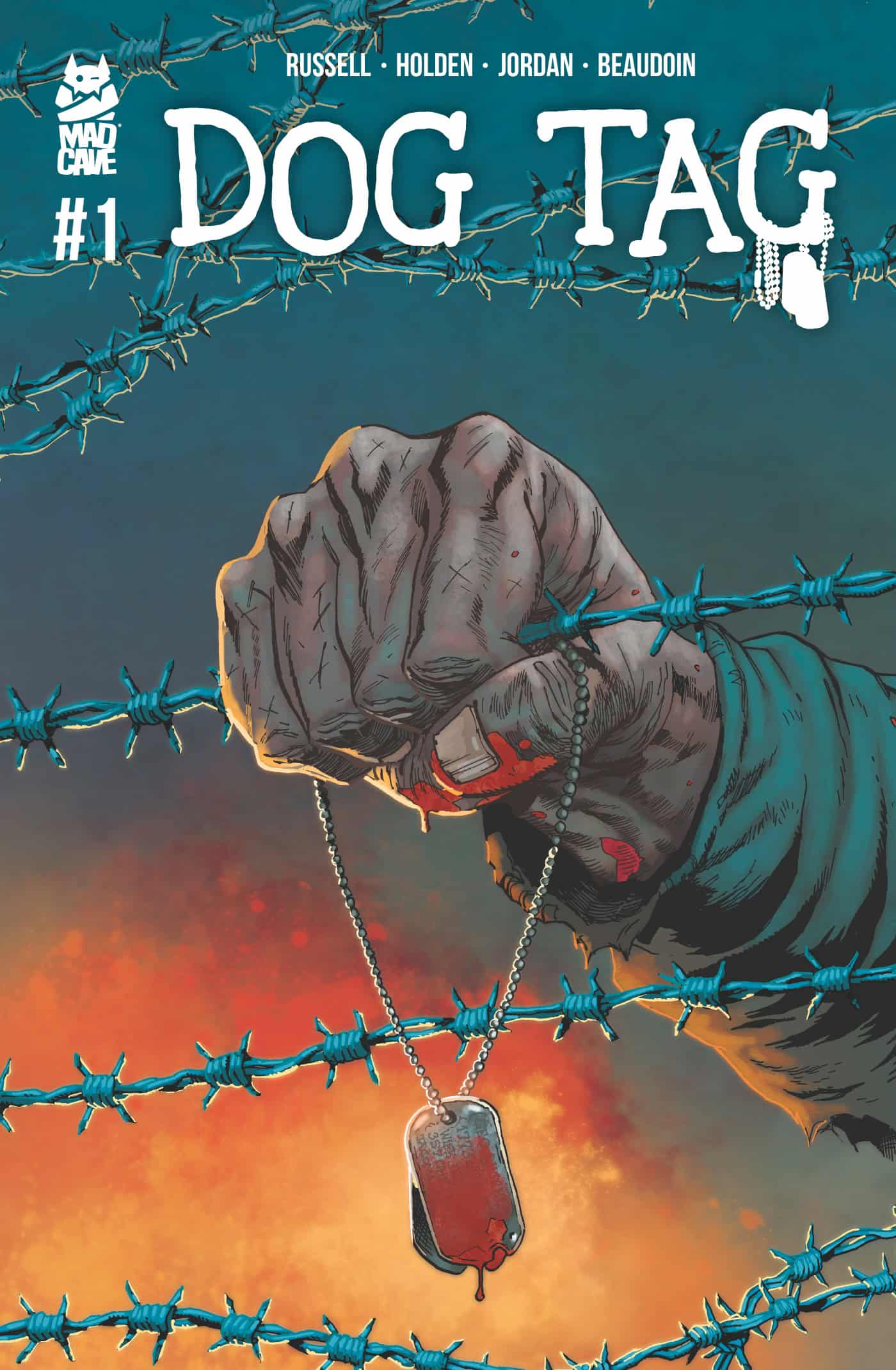
Recap
Dog Tag is a fictional story about a very real war. It follows the life and thoughts of Corporal Tom Fuller through the final year of World War II as his service takes him from the invasion of Normandy to the surrender of Japan. Borrowed from real world stories and little known events of the war, Dog Tag asks big questions about the war while focusing on the heroism of the ordinary people who lived and died during the conflict.
Review
Dog Tag #1 is the opposite of almost every World War II story. There’s no frontline reporting, and the dramatic D-Day landing is only one splash page. Indeed, the issue takes those ideas and completely turns them on their head via main character Tom Fuller. Tom is in the army and hopes to cover the invasion and the battles that follow as a journalist. Instead, he is sent to Dover, the site of inflatable tanks and wooden bombers, to write propaganda about how the allies’ troops there are preparing to invade. Tom, wanting to be a reputable journalist, pushes back on the propaganda order. He loses.
Russell’s story is a compelling blend of history and character development. The events at Dover as described in Dog Tag #1 are basically true. And strangely, the time spent at Dover makes the war seem more real. World War II wasn’t just an action movie. There were a lot of moving parts, all of them essential, and some of them not remotely exciting.
Tom’s character is heavily built around the lack of anything real happening. He is a bystander, not propelling the story through actions. Russell tells the story almost entirely through Tom’s internal monologue (revealed to be a diary). Tom isn’t really proactive in any way and simply appears in different situations in different collections of panels. The consistent attitude in Tom’s internal monologue is a general impatience to experience something real as opposed to the seemingly unending deception at Dover.
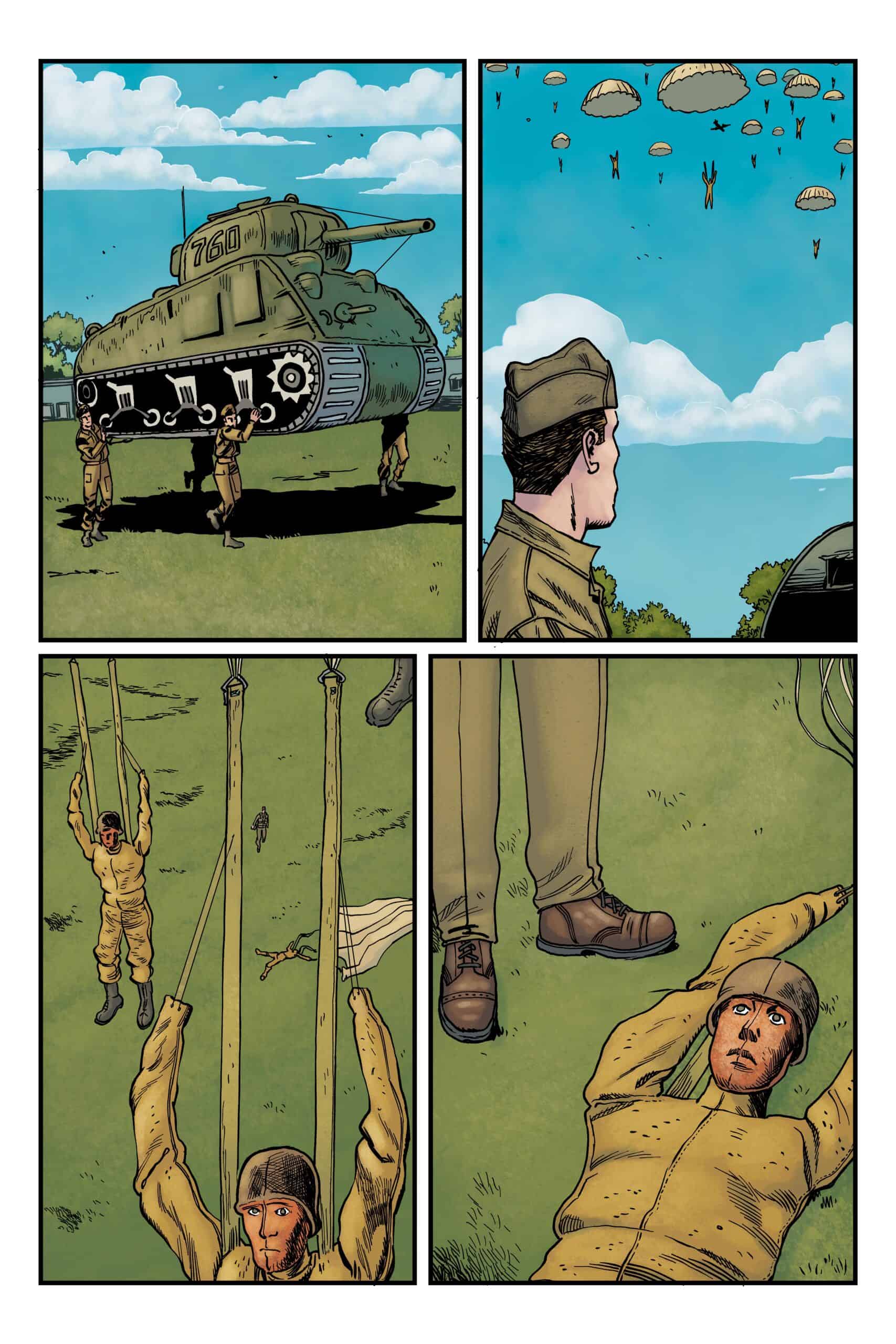

There is a measure of uniformity in how Holden draws the characters. Everyone has a ramrod straight quality when standing, and every character’s face has the same rectangular base. Holden does add enough detail that keeping characters straight isn’t difficult. It’s also enough detail to make the characters expressive when needed. Tom’s internal monologue notwithstanding, a lot of his development comes via his expressed emotions during his time at Dover.
The single page D-Day landing is detailed but not visceral or overly intense. It’s presented more as a visual juxtaposition to Tom’s propaganda about the personnel at Dover waiting for the invasion to happen. The single page is enough to make this still feel like a World War II story despite the main character’s extreme distance from where the war is being fought.
Jordan’s color scheme is fairly vivid throughout. Given that so much of Dog Tag #1 is set away from the action and even in relatively peaceful confines, the coloring gives the issue an overall sense of lightness. It’s a strange feeling from a seeming war comic.
Beaudoin uses rectangular but irregular caption boxes for Tom’s internal monologue, which is revealed to be diary entries. The caption boxes suggest tattered paper which seems appropriate for Tom’s mood throughout.
Final Thoughts
Dog Tag #1 is an unusual World War II story. The Dover setting allows for a fascinating character exploration. Russell does a good job combining a familiar concept–the young man waiting to go to war–with an almost existential musing about being so far removed from anything that feels real. It’s a very compelling read.
Dog Tag #1: Realties of War
- Writing - 9/109/10
- Storyline - 9.5/109.5/10
- Art - 7.5/107.5/10
- Color - 7/107/10
- Cover Art - 8/108/10