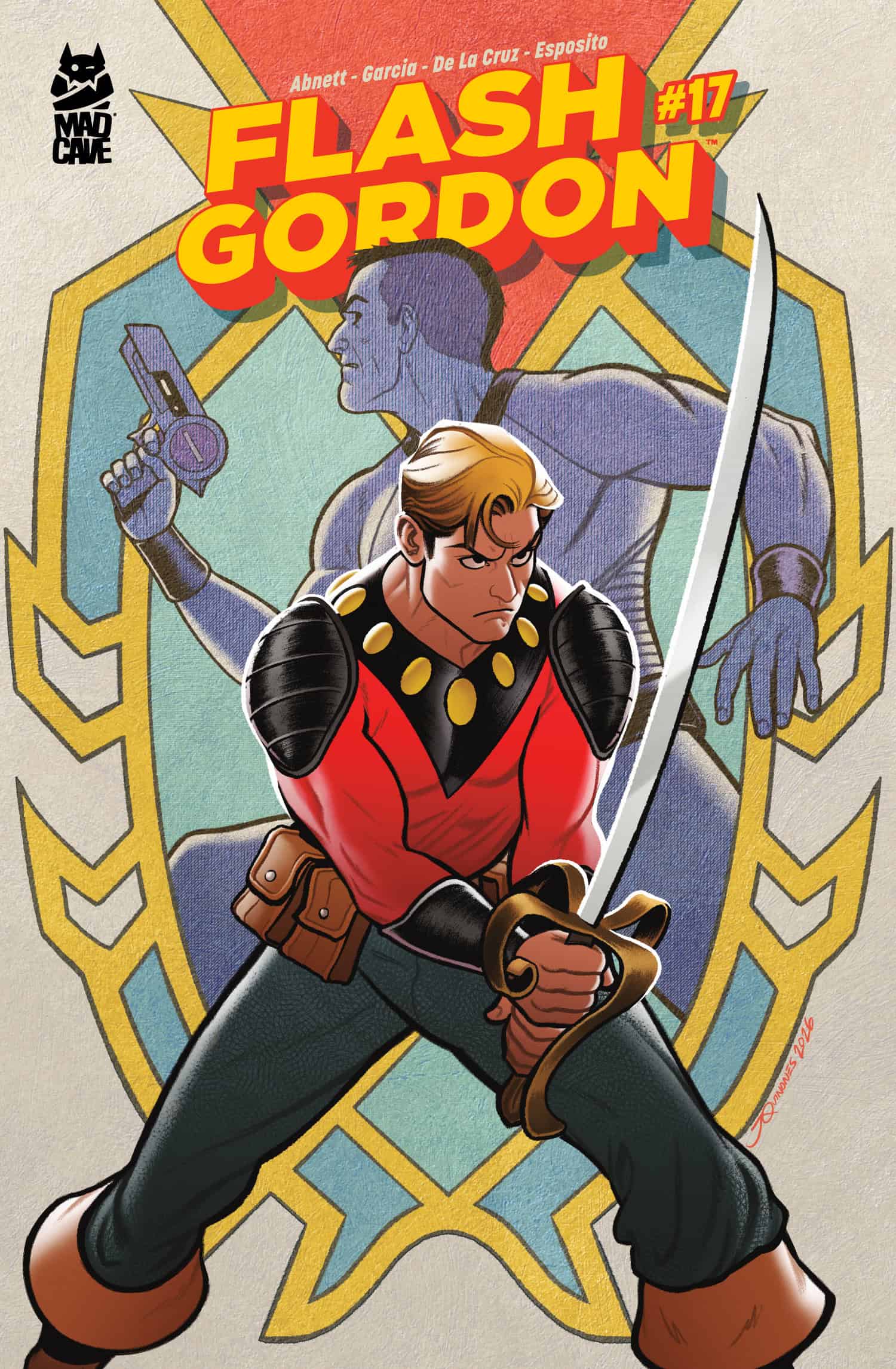
Flash Gordon #17

Theron Couch
Recap
CRASH BONDING ON A B.D.O! Flash Gordon’s on an illegal mission to save the world! But Dane Albright, chosen representative of the Earth Rocketry Administration, is determined to beat him to it and claim the glory. Both of their plans go disastrously wrong when their ships are pulled in for crash landings by the planet-sized “Big Dumb Object” they’ve come to investigate! Now the rival parties find themselves back-to-back against enemies on a strange new world. Part Two of Dan Abnett and Manuel Garcia’s ongoing space opera!
Review
It didn’t take long for Flash Gordon to take out his sword and fight some aliens. Flash Gordon #16 did a good job building out the world Flash lives in now as well as developing him and other characters. With that out of the way, Flash Gordon #17 is a mostly action packed, space adventure affair.
A big change to the current Flash Gordon status quo is that Flash is supposed to be grounded while the new Earth Rocketry Administration handles everything space related. Flash Gordon #17 opens on their ship, en route to the giant Mars-sized planetoid headed for Earth. Abnett doesn’t spend a lot of time on these characters, but it is the first look at what are supposed to be Earth’s new space heroes. It’s nice to see them a little more fleshed out than their introduction in the previous issue.
The rest of Flash Gordon #17 follows Flash and his comrades Dale and Zarkov as they explore the same planetoid that the E.R.A. ship is headed for. Abnett writes some clever dialogue for all three characters. It doesn’t do much to enhance Flash and Dale’s characters, but Zarkov comes off as slightly unhinged which provides the lightest bit of comic relief. Abnett weaves in a slight sense of wonder and exploration when first settling on these three characters, but the story almost immediately turns to action when the trio sets off to rescue the crashed E.R.A. ship.
Flash Gordon #17 becomes a bit of a contrast in sub genres with pulp sci-fi on one side and more modern space opera on the other. The E.R.A. wear matching uniforms, use energy weapons, and are vaguely military with their hierarchy while Flash has his bright red outfit and sword. The fight with the aliens is vintage Flash Gordon in a way, but the world Flash now exists in is anything but.
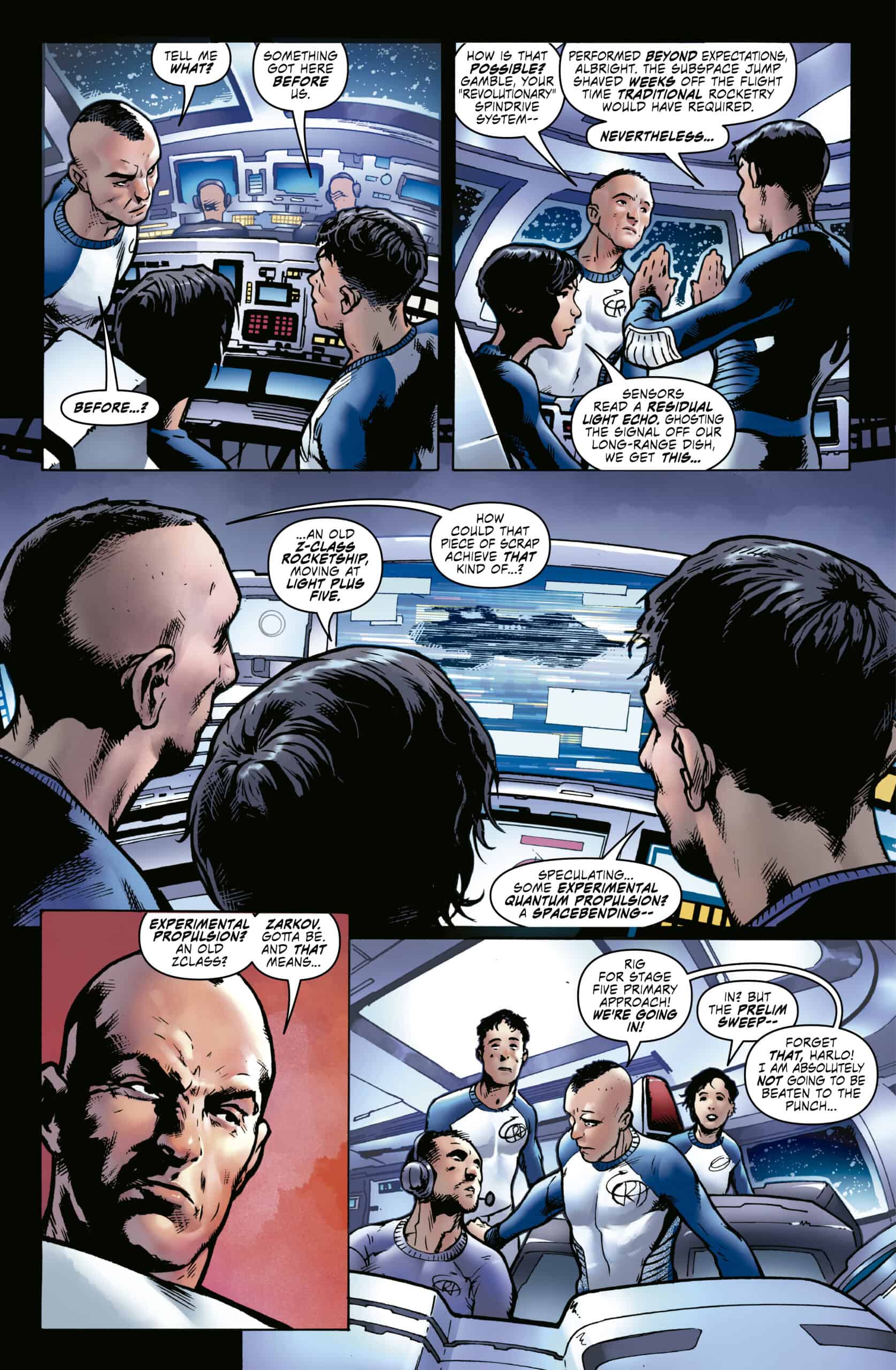 Garcia’s art during the issue’s main action sequences is particularly effective. When it comes to the actual action, Flash is the only character who really moves. He fights aliens with his sword whereas everyone else is using guns. His poses are dynamic, and Garcia does a really good job tracking Flash’s movement from panel to panel. In one panel that takes up most of a page, Garcia effectively depicts Flash’s entire summersaulting jump from atop a giant alien to the ground with several poses drawn on the way to Flash’s final one as he touches down.
The characters are very expressive in this sequence as well. A lot of what they convey is the result of how Garcia draws their eyes–how wide or narrow they are, any added lines around them, the direction their pupils are looking. Sometimes there are additional small lines on the face to accentuate a furrowed brow or a cheekbone or jawline, but those are applied with a light touch. An interesting quality of Garcia’s work is that this extra detail when seen in closeup works better during the action sequences than during quiet discussion. Characters’ more neutral expressions don’t work quite as well.
The color scheme in Flash Gordon #17 is rich without being especially vivid. The design of the characters’ outfits as well as the look of the aliens contrast nicely. De la Cruz doesn’t use specifically primary colors, but different elements have distinct color identities. Flash and Dale have bright red tunics. The E.R.A. crew has mostly blue uniforms. The aliens are purple. Zardov’s coat is brown. The lack of color overlap keeps anything from being lost on the page. And Flash and Dale’s red tunics especially stand out.
Action sequence notwithstanding, Flash Gordon #17 is text heavy at times. Esposito does a good job emphasizing specific words and phrases in dialogue exchanges, using an italicized bold effect on the text in question. The style choice is used selectively, making it easy to pick out and thus maintaining a good flow of dialogue while getting the extra impact of the words and phrases in question.
Final Thoughts
This new direction for Flash Gordon continues to feel fresh as it moves beyond an establishing phase and into a larger action story. Though the previous issue was the ideal jumping on point, this issue is still easy for a new reader to pick up, understand, and enjoy. Flash Gordon #17 is a fun blend of light humor and big action that is perfect for fans of classic pulp science fiction and standard space operas.
Flash Gordon #17: Time for Adventure
- Writing - 7.5/107.5/10
- Storyline - 7/107/10
- Art - 7.5/107.5/10
- Color - 7.5/107.5/10
- Cover Art - 7/107/10