Green Lantern #33
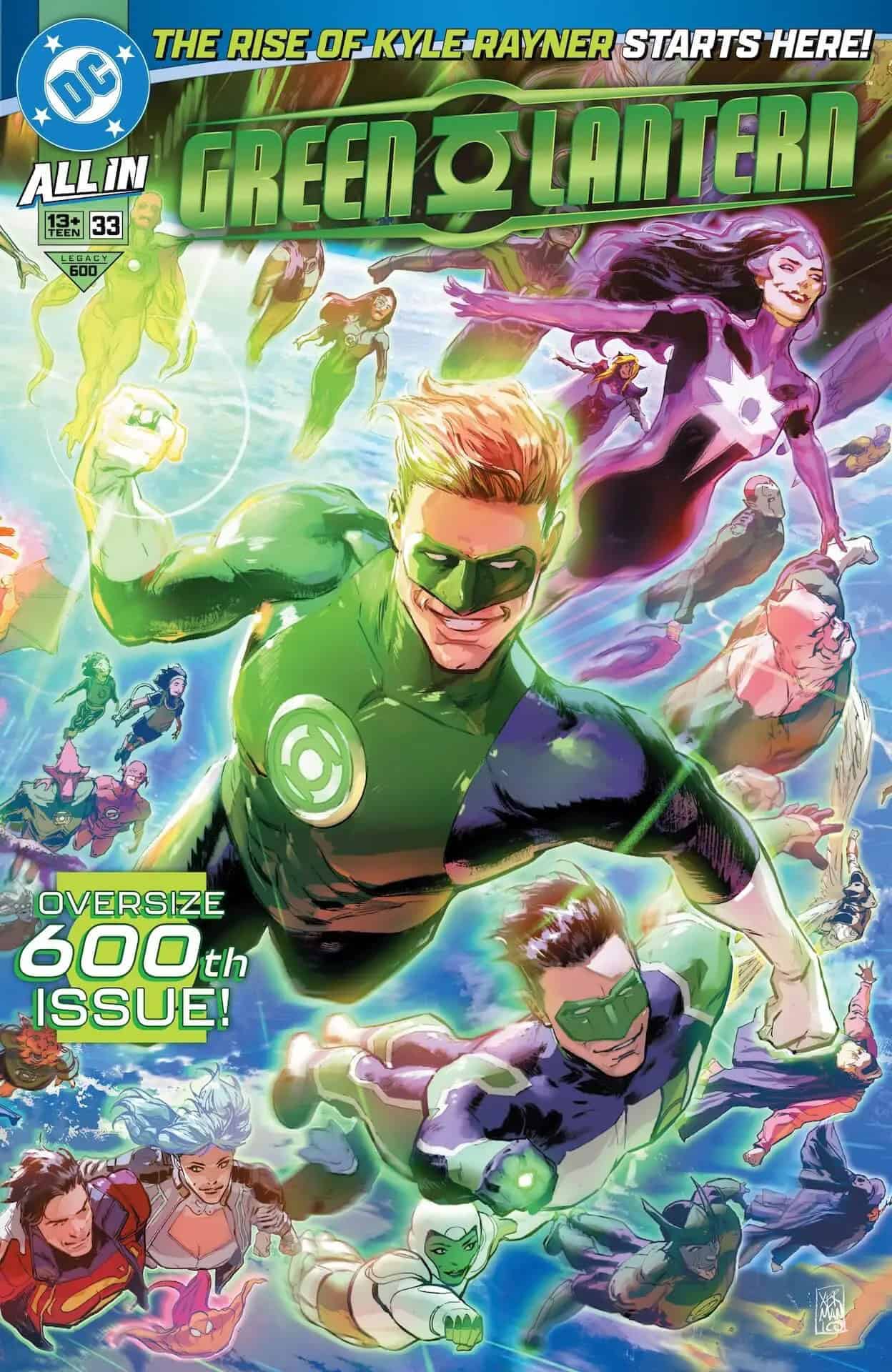

Theron Couch
Recap
KYLE RAYNER LEADS THE NEXT CHAPTER OF THE GREEN LANTERN MYTHOS STARTING HERE! CELEBRATE 600 ISSUES OF GREEN LANTERN WITH EPIC STORIES, LEGENDARY CREATORS, AND NEW COSTUMES DESIGNED BY SUPERSTAR ARTIST DAVID NAKAYAMA!
In this special, oversize 600th issue, Hal Jordan will be tested as never before... and a new Lantern stands poised to step in should he fail. Hal embarks on a mysterious mission while Kyle Rayner finally moves back to Los Angeles and again takes up the mantle of Green Lantern of Earth. Join Kyle as he finds a job, navigates traffic, and chases down escaped villains from Oa! All this, plus a host of legendary guest artists and writers from Lanterns past, and an answer to the question posed to Star Sapphire in the last issue...
More DC heroes coverage from Comic Watch:
Nightwing #136: Something Rotten in Bludhaven
Lobo #1: Meet the Next Reality Star - Lobo: The Bounty Hunter
Review
Major anniversary issues are often filled with fluff. There will be a main story that may or may not connect to an ongoing storyline, and that will often be followed by little vignettes. It’s not uncommon for those vignettes to include some kind of origin recap for the title character. Green Lantern #33 (Green Lantern #600 based on legacy numbering) largely follows this pattern but with unexpected success.
Hal Jordan (who has been a multi-issue visit to Earth) only appears on Green Lantern #33’s first page. From that point on the issue becomes almost entirely a Kyle Rayner concern. Kyle and Odyssey (who he met in the lead-up to the Starbreaker Supremacy) are getting an apartment in Los Angeles, and he is introducing her to the city in a story appropriately titled “I Love L.A.”
Green Lantern #33 isn’t just a love letter to the City of Angels, though. Through a series of events, Kyle ends up on a studio lot where the studio head has fired his entire creative staff in favor of relying on A.I. to produce everything. Adams and Xermánico create a villain that makes perfect sense within a Green Lantern series while simultaneously arguing strongly that A.I. content being entirely derivative and thus inferior to original creations. “I Love L.A.” makes its point well while delivering a good amount of humor and fun character interaction.
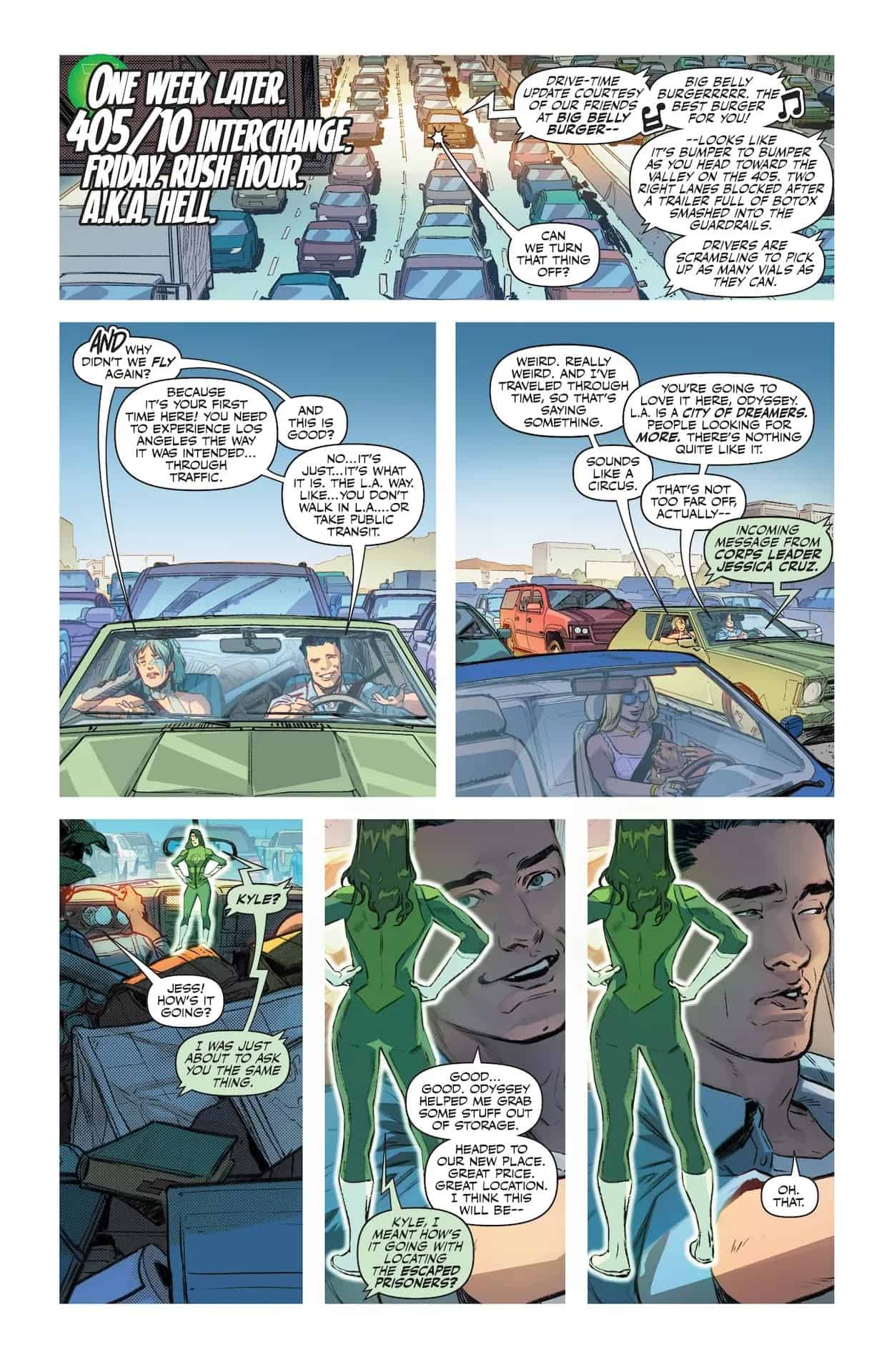 Included within “I Love L.A.” is “City of Angels – The Origin of Kyle Rayner.” Adams fits this in by way of an exchange: Odyssey will tell Kyle her origin if Kyle tells her his. “City of Angels” isn’t anything special when it comes to an origin story, but it’s nice to see an attempt made to work it into the larger main story. It is also welcome in the sense that Kyle’s origin isn’t necessarily as well known to readers as Hal Jordan’s and this is a good way to introduce him to readers less familiar with the character.
Adams also pens a Hal Jordan origin story (“Brighter Day – The Origin of Hal Jordan”). Unlike Adams’ attempt to work Kyle’s origin into the main story, “Brighter Day” has only a token connection to larger storylines. Adams uses Krona’s ongoing development as a one page lead-in to “Brighter Day” with the justification that Krona needs to learn more about the clone body he was reborn into. There’s nothing here that is revelatory.
Ron Marz delivers the final entry in Green Lantern #33, “Light in Darkness.” Marz pens a kind of love letter to Kyle where he helps a pair of rookie Green Lanterns and they fanboy out a little bit about Kyle’s legacy serving as the only Lantern and helping to rebuild the Corps. “Light in Darkness” is a very light affair that is fun for Kyle fans.
Xermánico and Fajardo Jr. are always a strong artistic duo, and they work very well on “I Love L.A.” Xermánico’s style doesn’t often use large patches of shading. Instead, details come from very thin lines, sometimes a few grouped together. Thicker lines, relatively speaking, are primarily reserved for outlines of characters and other objects. But even then, those lines are not especially dark.
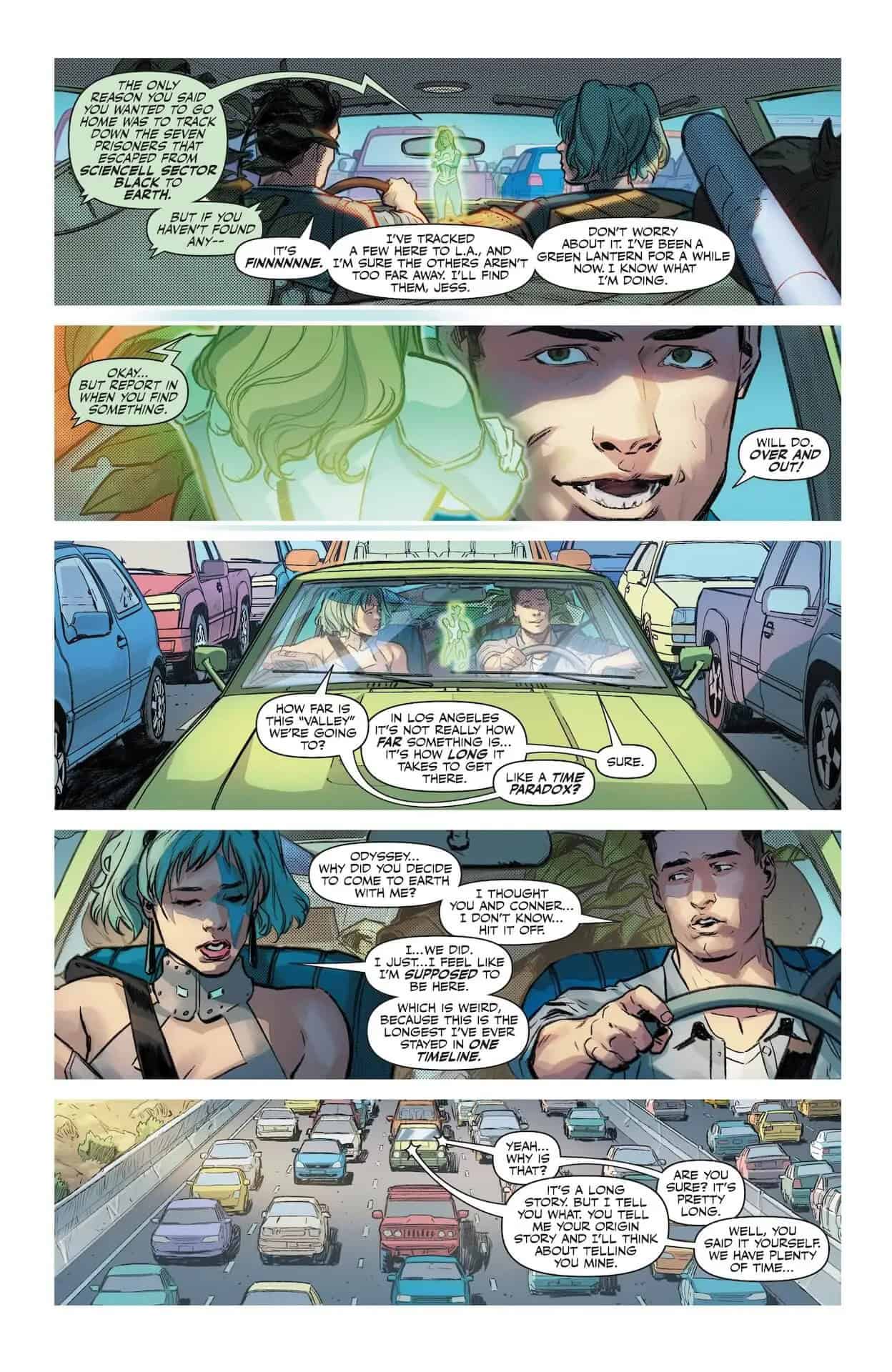 This pairs well with Fajardo Jr.’s coloring which is typically vivid but very soft. Fajardo Jr.’s skill at adjusting color tones in response to implied light sources and thus emphasizing shadows is a good complement to Xermánico’s very conservative use of heavy shading.
Even with Xermánico’s line and shading economy, he is still able to deliver very expressive characters. Kyle and Odyssey and guest character Wally West convey a good amount of emotion without overly exaggerating.
Marion’s work for Kyle origin story, on the other hand, is significantly more expressive–pushing almost toward an exaggerated style. This is typical of Marion’s work. Here it is quite effective, especially in close-ups. Kyle’s emotions are rich and obvious. There isn’t much subtext, but overall it makes Kyle engaging and someone who the reader will want to get to know. Gandini’s bright coloring is a good complement.
Jurgens and Banks in “Brighter Day” and “Light in Darkness” respectively don’t hit the same heights when it comes to their characters. They aren’t as nuanced nor do they deliver quite the same range of emotion. Poses are less dynamic. In the case of “Brighter Day” that’s not necessarily surprising; Jurgens is simply delivering panels that go along with a very static retelling of Hal’s origin. “Light in Darkness” has much more action but doesn’t deliver much visual urgency.
Sharpe handles the lettering for the entirety of Green Lantern #33. He keeps lettering choices consistent throughout and organizes everything successfully throughout.
Final Thoughts
Green Lantern #33 (Green Lantern #600) is a near perfect jumping on point. The issue does pick up two ongoing story threads very briefly, but it makes them relatively easy to understand. Meanwhile, it brings Kyle Rayner back for an extended period, kicks off that run with a fun and easy to get into story, and even provides his origin story. Adams and the assorted art teams absolutely nail the landing on this one.
Green Lantern #33: Kyle, L.A., and 600 Issues
- Writing - 8/108/10
- Storyline - 7/107/10
- Art - 7/107/10
- Color - 7.5/107.5/10
- Cover Art - 8/108/10