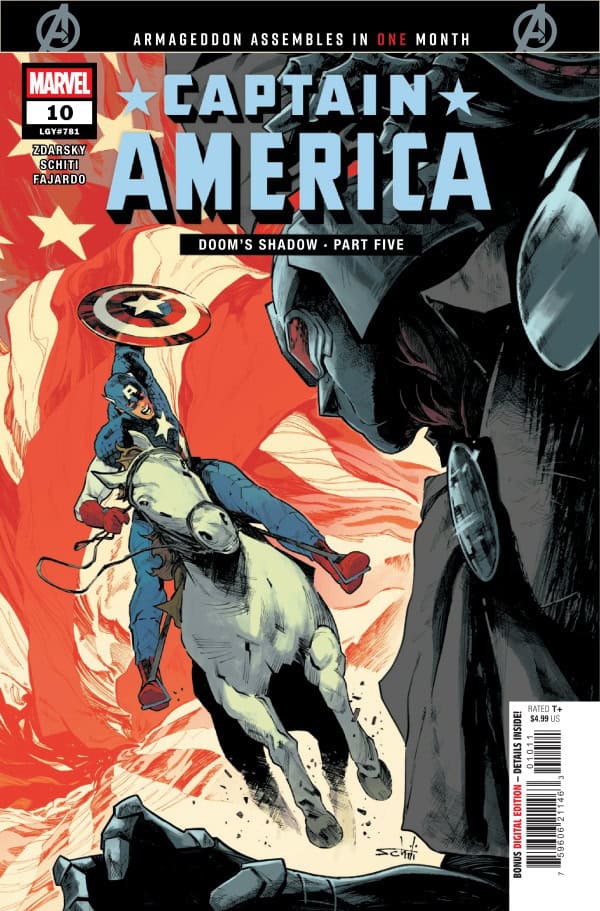
So, its all come down to this. Salvation has his back against the wall, Doctor Doom‘s WMD has been located, and Steve Rogers stands at the head of a revolution that might finally free the people of Latveria from the influence of fascism. In a penultimate issue like this, to a story that has been as politically heated as it has been thrilling, these key ideas coming together should be incredibly cathartic. However, Captain America #10 feels repetitive and lost on the road to Armageddon. Its clear political overtones have grown muddy, not due to complexity, but a lack there of. A constant grasping at the straws of shocking betrayals and reveals has weakened the writing of this arc. Its a disappointing stumble within a unexpectedly shaky second arc that has squandered so much potential.
There is still a lot of good here. Valerio Schiti carries the momentum of this issue with dynamic page layouts and impactful moments within the panels that add to weight of Steve’s fight with Salvation. The pacing of Red Widow‘s betrayal is tense, and the moments of unity around the idea of American Idealism is structured well enough to separate itself from the fascist heart of the government presented in this story. On a visual level, and especially in the structure of its plot, it all works incredibly well.
Its the writing that got us to these moments that falters. There’s an over reliance on Steve proclaiming ideals that aren’t backed up by what we’re seeing. There a great moments that are immediately undercut by the disconnect between what Chip is trying to say, and what is actually unfolding. The broken dance between the message and the imagery is not part of the point though, and instead actively leads to the undermining of communal pride being a force for good against those who seek a road of control bathed in blood. The story often validates Steve’s worldview without forcing those ideals into situations where they cost him something, which leaves those proclamations feeling hollow instead of hard earned.
The abandonment of nationalism for the sake of a greater good established in the last issue via Red Widow’s philosophy is ruined by her betrayal. That nuggets of personal ideals made her character so interesting in the few scenes we’ve had with her, and yes, the betrayal makes sense and does push the narrative forward if we are to believe that she was lying through her teeth for the sake of her true Russian mission. That is just significantly less interesting, given how one of the most captivating beats in this arc was how multiple different ideologies can come together to pave the road for a better tomorrow. With how this all coalesces, it paints Steve’s path as the only one worth believing in, but that path is one that chooses the spectacle of the American flag punching bad guys over the heart of its writing.
Yes, General Thunderbolt Ross is here as a representative of imperialistic politics only making these kinds of human rights crisis’ worse, but he’s been such a footnote to the real themes of this arc. Everything feels like its running towards the event its setting up, instead of taking the time to unravel its own ideas in a competent manner. The book is still very exciting superhero fare and enjoyable, but when you set yourself up to make grand political statements in the heat of a moment that is reflected in the real world, that has to be done with better care in order to really mean something.
Pile on top of that a reveal that feels shocking for shocks sake, and what should have been a beautiful climax winds up feeling hollow. Said reveal can definitely prove itself over the next few months of being interesting, but I doubt it will lead to something as captivating as the ideological struggles that this arc was born out of. Even if the ideological execution is shaky, there is a long tradition of Captain America stories pushing Steve’s worldview as the moral anchor. The difference is that the best runs earn that by putting him through systems that nearly break him. Here, the story wants the weight of that tradition without doing the same narrative labor.