Theron Couch
The 30th anniversary look at Age of Apocalypse continues (even if it’s now technically 31).
 You know in those days, you would read a crossover and have to read all 23 parts of it to makes sense. I was adamant and Bob was supportive of saying, “Let’s not do it that way. These characters need to be here by the end of your fourth issue to lead into X-Men: Omega. How you get them there is completely in your hands.” It took people a bit from our fellow creators to roll with it. At first they were like, “Well, you’re just leaving us out here.” And I go, “We could tell you where to go, but I think we’re giving you the freedom. Go have fun with it.” – Scott Lobdell
I’m sure that’s what Bob said in theory, but it wasn’t remotely that in practical application. Because Scott and Bob had no real idea exactly how this story was going to end, many of the titles had to do a tremendous amount of juggling on the fly to patch in new ideas or fixes, all for the sake of establishing an ending we didn’t have yet. – Fabian Nicieza
I have gotten better over the years as far as plotting out a story six months ahead. But back then I used to infuriate Fabian. Fabian usually has like 25 issues planned for whatever book he’s working on. I was like if someone said to me, “Hey, that’s a great cliffhanger,” I would be like, “Yeah, I can’t wait to figure out what happens next.” Rational being, if I could surprise myself, I could surprise the reader. For me, if you planned too far ahead it would be like chewing your food twice. – Lobdell
My relationship within the group dynamic — from a working standpoint, not a social one — had become severely strained, so the entire process was antithetical to how I like to write. Most fans remember AoA as a tremendously cool project that turned mainstream superhero publishing upside down for several months, while I remember it as a tremendously cool project that turned mainstream superhero publishing upside down for several months and that was an incredibly unsatisfying work experience. – Nicieza
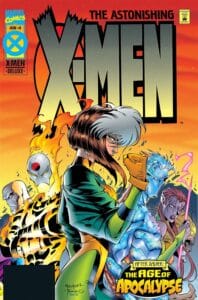 Astonishing X-Men #4
W: Scott Lobdell | P: Joe Madureira | I: Tim Townsend & Al Milgrom | C: Steve Buccellato & Digital Chameleon | L: Richard Starkings & Comicraft
ESSENTIAL – Fueled by rage over Sabretooth’s apparent death, Blink takes on Holocaust by herself. At the same time, the rest of the team fights its way through the army of Infinites that Holocaust has been making. Meanwhile, back in Manhattan, Apocalypse gloats to Magneto about the inevitable death of his X-Men and failure of the Human High Council’s attack on North America. Back at the Infinite-producing plant, the X-Men free the captured humans before joining Blink in her fight against Holocaust. The horseman escapes, intending to take Rogue with him, but she is saved at the last minute by Iceman who has arrived to take Rogue home in anticipation of the final fight against Apocalypse. Also, Sabretooth is alive.
Astonishing X-Men goes out on one long fight sequence. There are some good moments. Blink’s response to seeing what she thinks is a dead Sabretooth is a strong one.
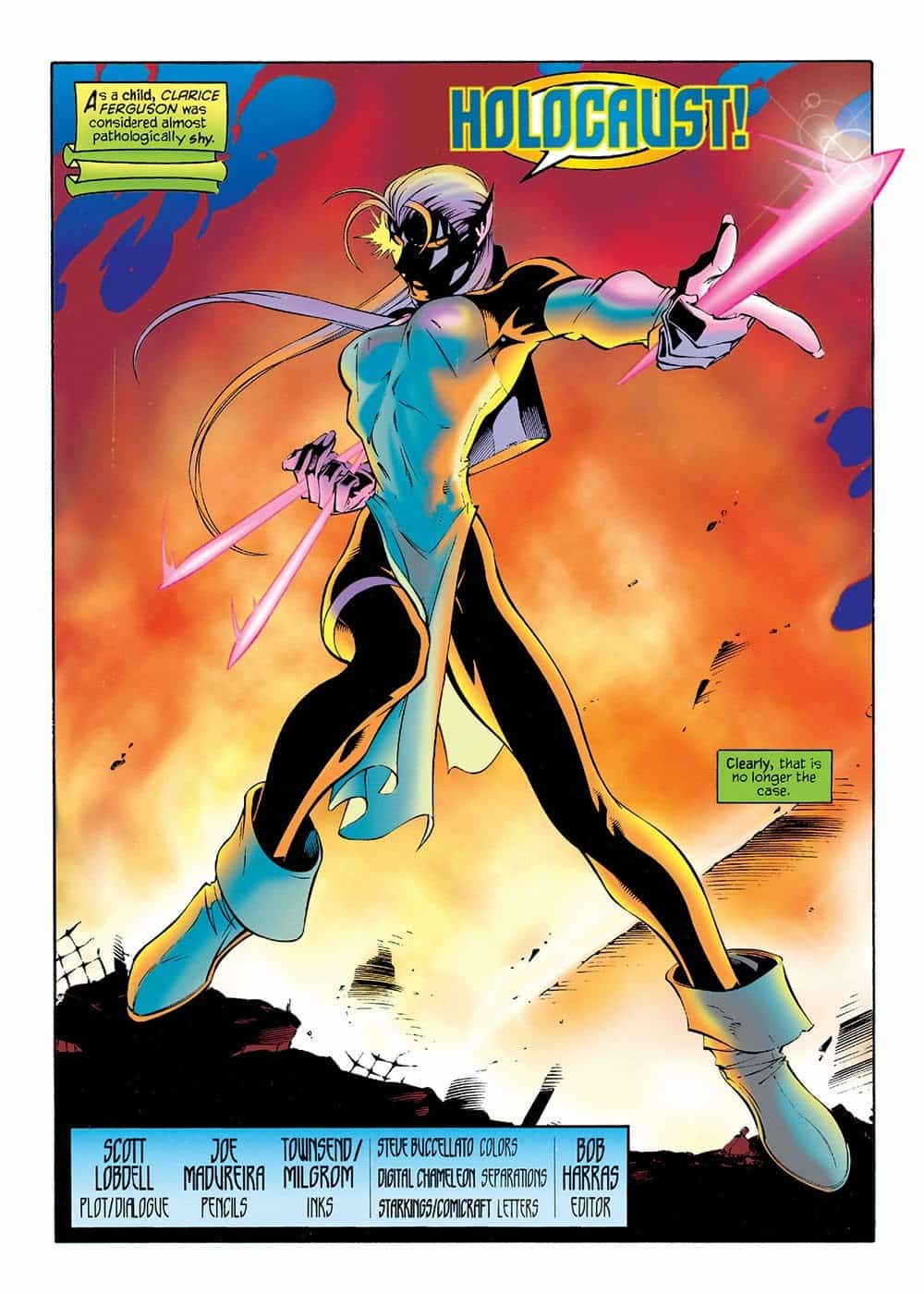
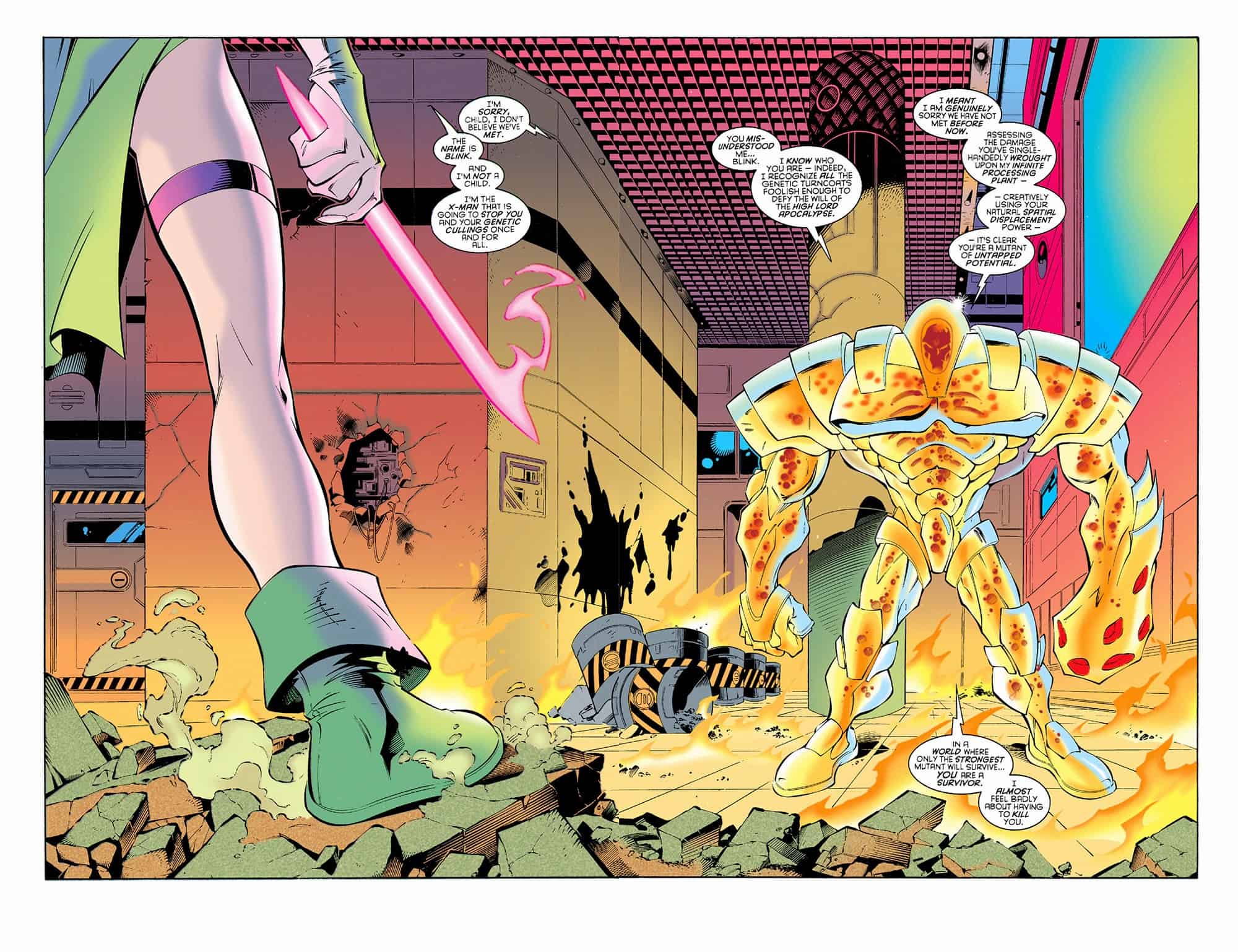
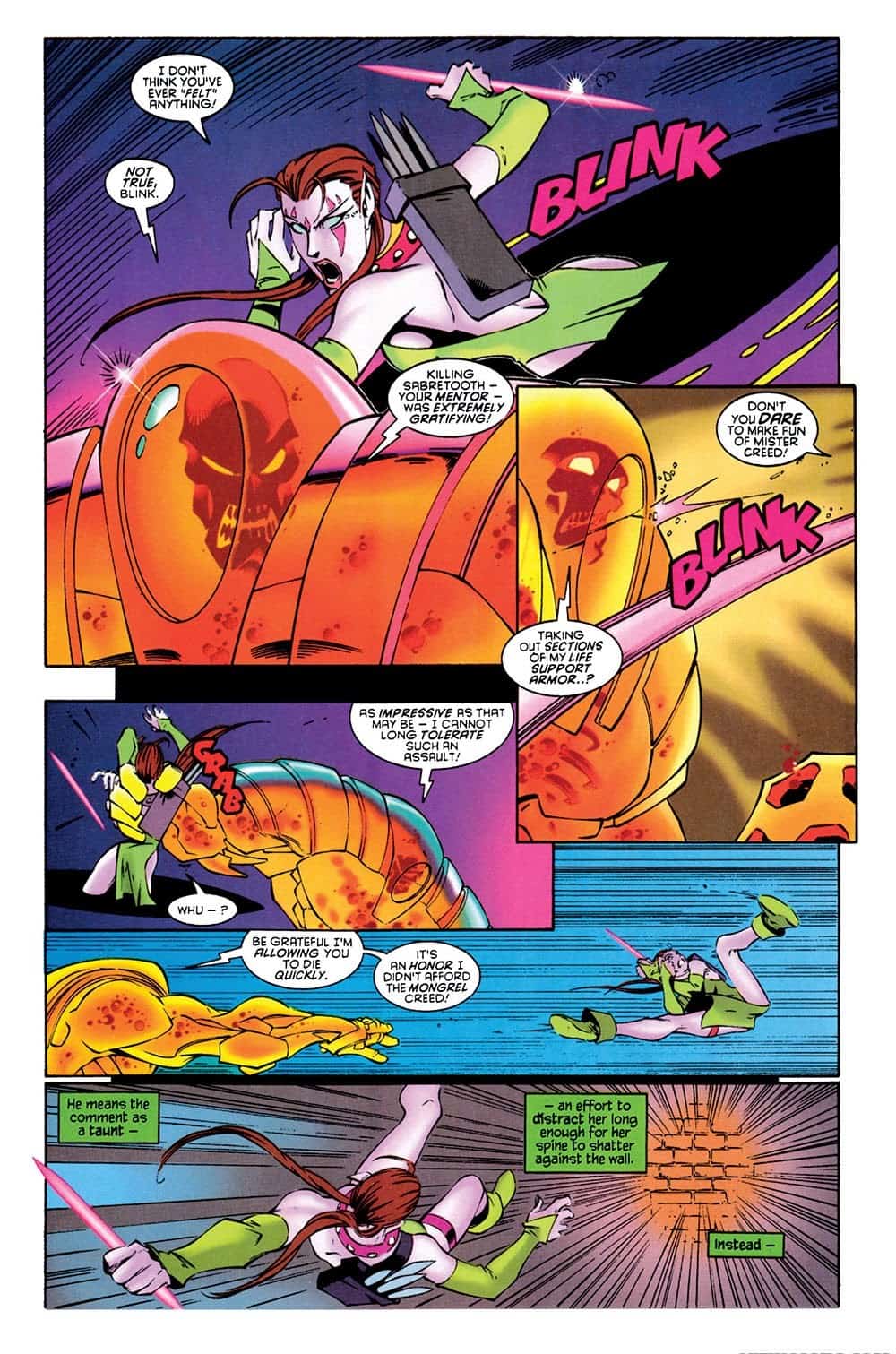 Sunfire doesn’t really get revenge, but there is a nice sequence where he kills a whole bunch of Holocaust’s Infinites and frees the trapped humans. And the issue ends well with Rogue kicking Holocaust’s flaming backside when he reveals to her that Magneto has been captured. All of this definitely justifies the argument that Astonishing X-Men is one of the emotional cores of the event. That makes it a worthwhile and arguably essential read despite having no bearing on the larger plots of the impending attack on Apocalypse or fixing the past.
Sabretooth being alive feels like a cheat–Lobdell wanting to have his cake and eat it too. He all but declares in giant font in Astonishing X-Men #3 that Sabretooth is dead. This sends Blink after Holocaust in a rage. She doesn’t defeat Holocaust, but it makes for good storytelling–especially when the rest of the team is able to join in. But then Sabretooth turns out to be alive and Blink can feel better while seeing Holocaust nearly defeated. It feels cheap and manipulative in an event that generally has no problem killing off its main characters. Lobdell himself wiped out almost the entire Generation Next cast. And it’s not like readers have really formed much of a bond with Sabretooth. Half of his appearances were centered around him being “killed” and being “dead.” There wasn’t a lot of depth there.
In the end, though, Astonishing X-Men #4 still hits the emotional beats that the series has been delivering since the first issue. Lobdell gives Morph and Rogue an excellent moment . After writing Morph mostly as comic relief, Lobdell uses him to give Rogue the emotional strength to continue the fight. The sequence is made all the more effective because Morph hasn’t really shown the capacity for this kind interaction.
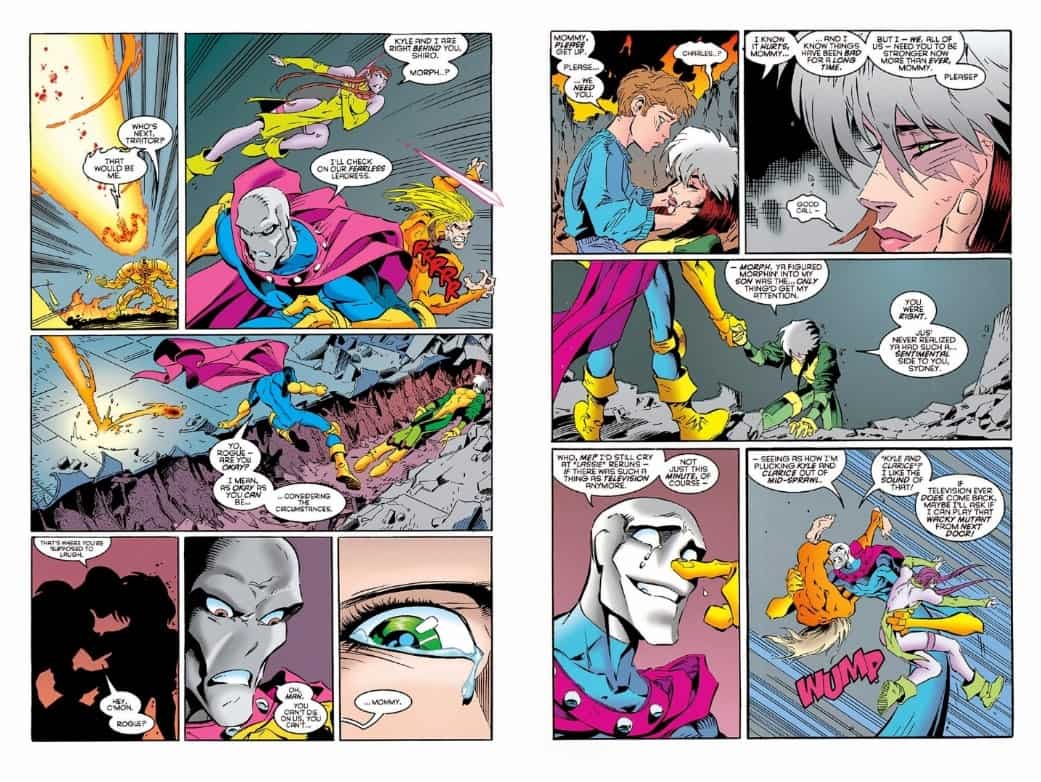 Astonishing X-Men has nothing to do with Age of Apocalypse’s larger storylines. It’s not as disconnected as X-Man which keeps Nate and company entirely divorced from every other series, character, and storyline of consequence. What makes the series important is how much emotion Lobdell is able to squeeze out of these four issues. Madureira’s expressive art elevates that still further. Astonishing X-Men won’t clue readers into the larger Age of Apocalypse storylines, but it’s a must read alongside all the issues labeled as essential here.
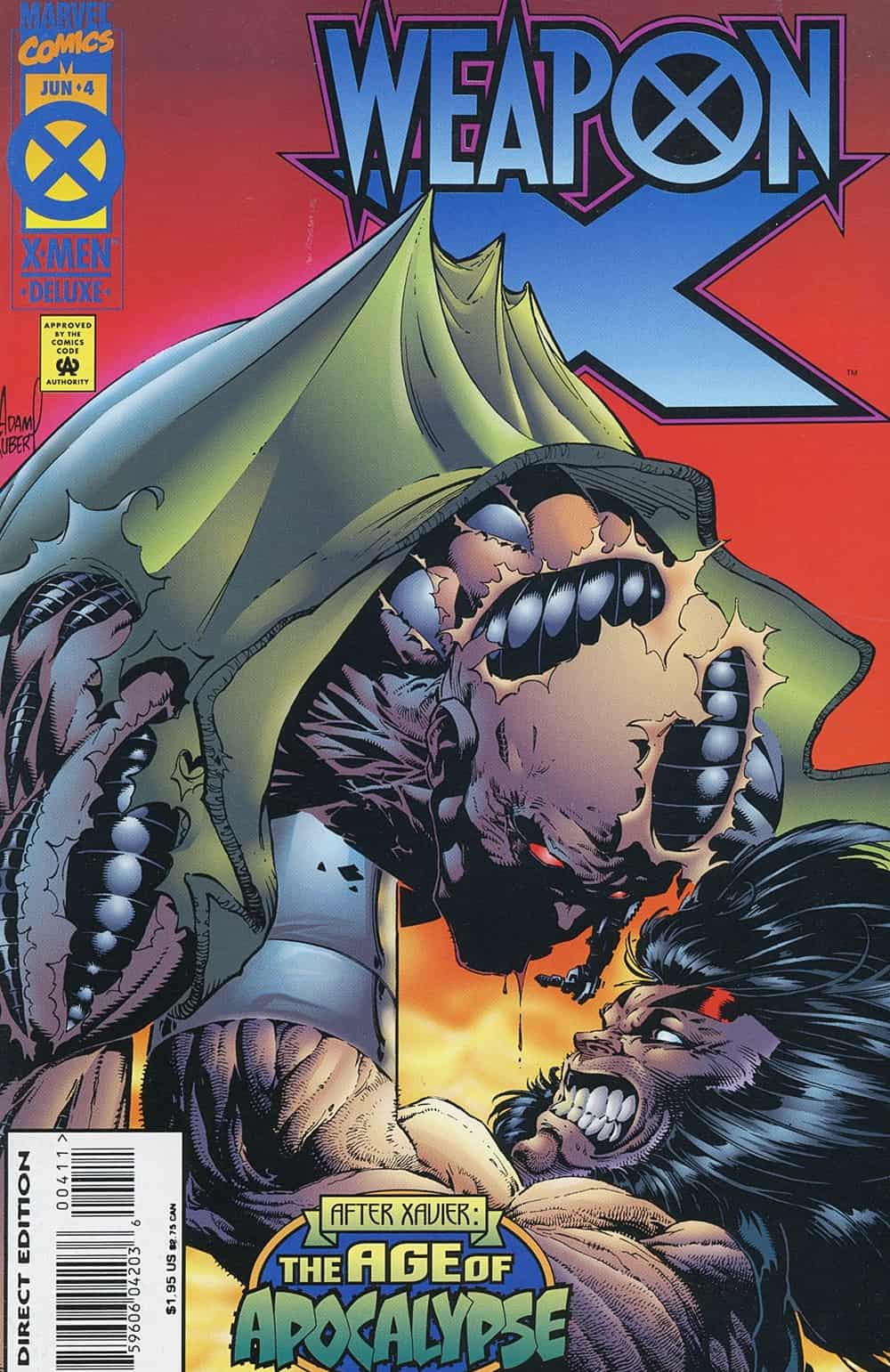 Weapon X #4
W: Larry Hama | P: Adam Kubert | I: Dan Green | C: Joe Rosas & Digital Chameleon | L: Pat Brosseau
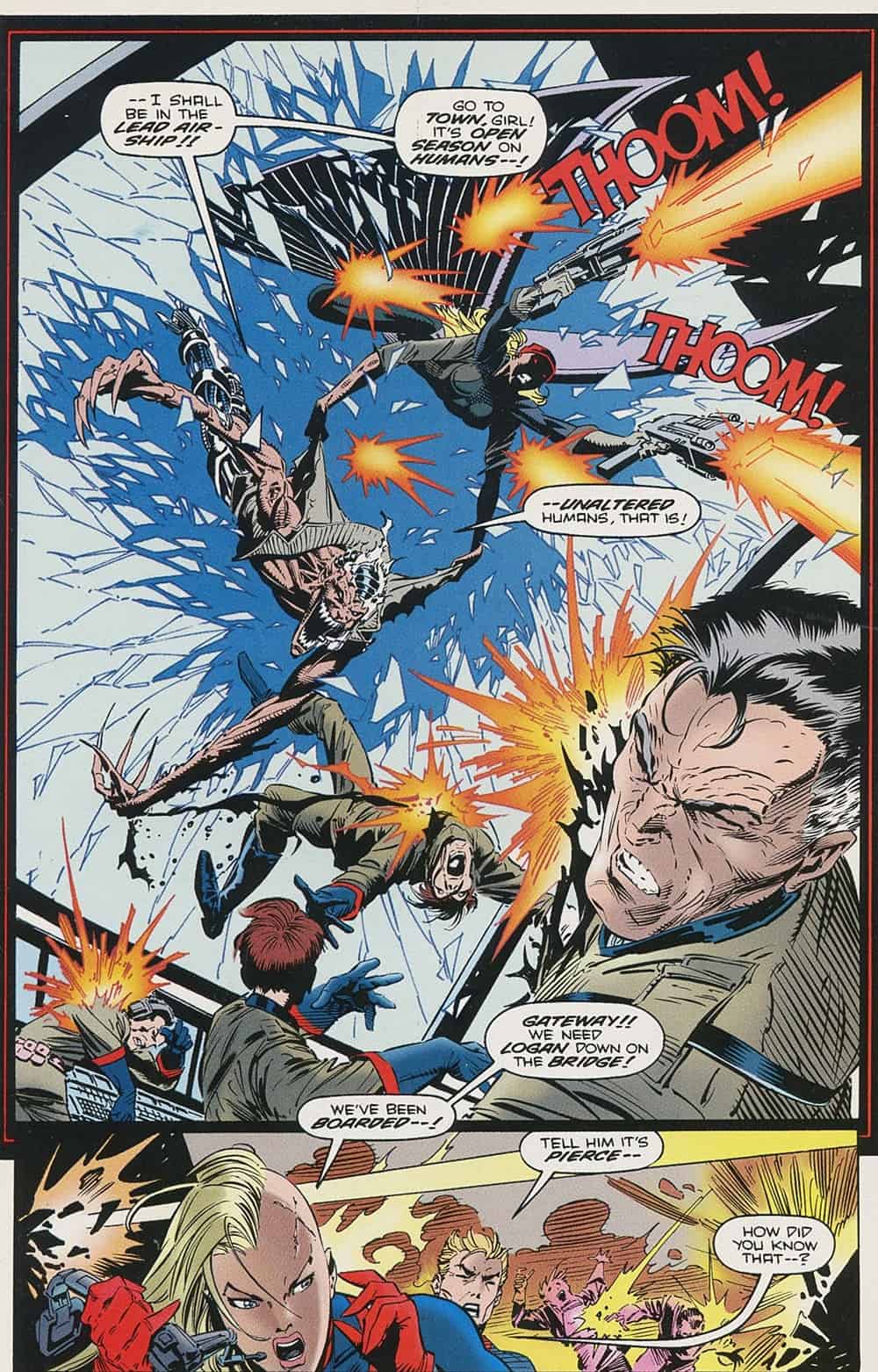
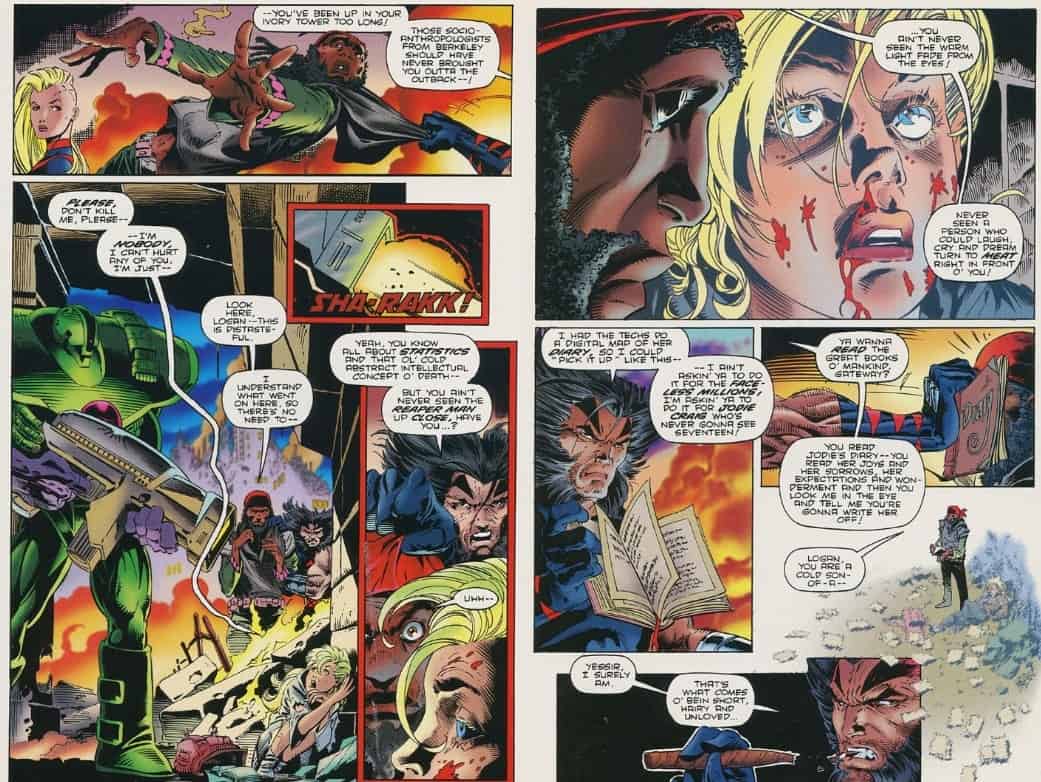
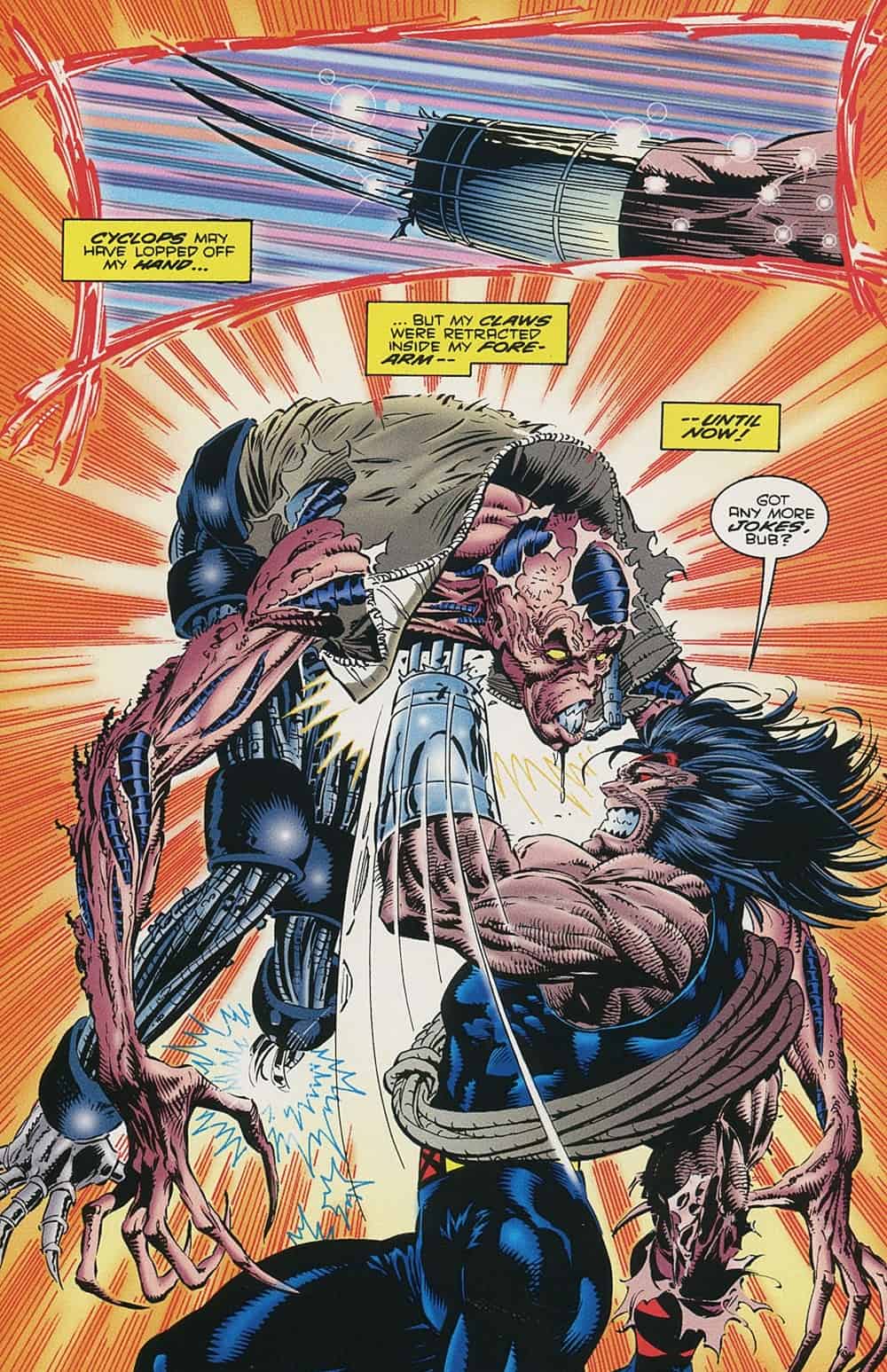
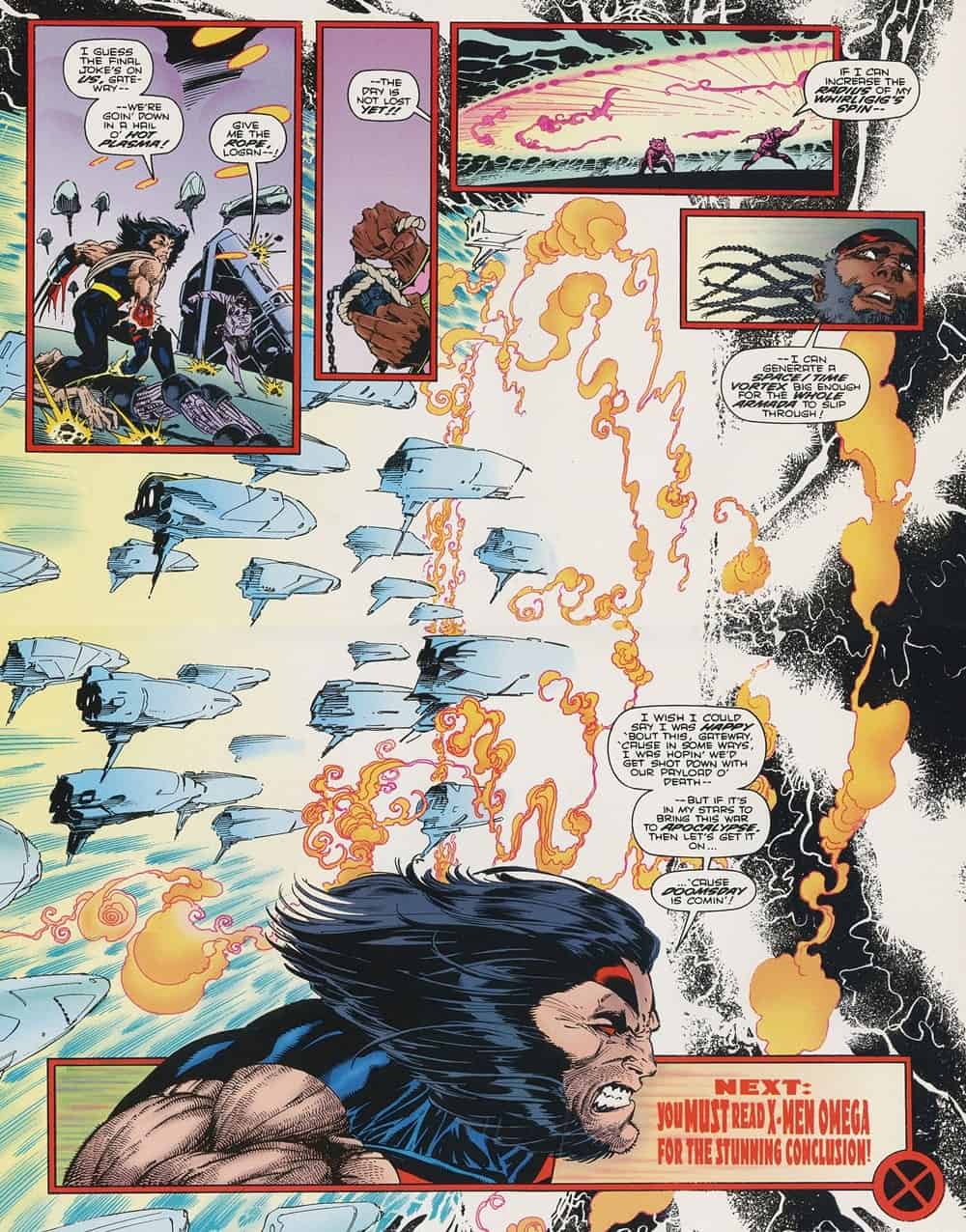
ESSENTIAL – Gateway stands alongside Logan and among the Human High Council watching video of the horrors of Apocalypse’s North American regime. Gateway is unresponsive until Logan shows him a video of a young girl named Jodie being killed and then, in the spirit of Gateway’s desire to preserve as much of the world’s knowledge and culture as possible, forces Gateway to read Jodie’s diary. Gateway agrees to guide the Human High Council’s armada on their assault. In Apocalypse’s citadel, Apocalypse is warned that the Human High Council’s attack is imminent. He is unconcerned, focused only on the idea of whether humans or mutants will prove genetically superior in the end. Back in Europe, the armada departs with Gateway atop the airship in the lead. Shortly after, Pierce’s altered humans, including an altered and assimilated Carol Danvers, attack the lead ship. At the same time, Brian Braddock, brainwashed by Apocalypse’s forces, takes the helm and brings the armada to a dead stop. The brainwashing isn’t effective for long, though; Braddock is able to shoot Pierce out the front of the airship. Atop the ship, Logan kills Danvers at her request. He then saves Gateway from Pierce. All of the altered humans have been dispatched but the Armada is in danger of being shot down by Apocalypse’s coastal defenses. Gateway grabs a rope, spins his whirligig around in a huge radius, and opens a portal for the entire armada to get to New York.
Pierce and his altered humans are very tiresome at this point. They just won’t go away no matter how many times Logan seems to kill them. In Weapon X #4 they are slightly elevated as villains by the presence of the altered Carol Danvers who we got to know in the previous issue. Carol’s presence adds emotional weight behind Pierce’s attacks that hasn’t otherwise been present. For the most part the altered humans are just providing cheap and easy fight sequences. But having gotten to know Carol in the previous issue, however briefly, there are finally personal stakes whereas until now every attack by Pierce has simply been a big picture, stop the attack affair.
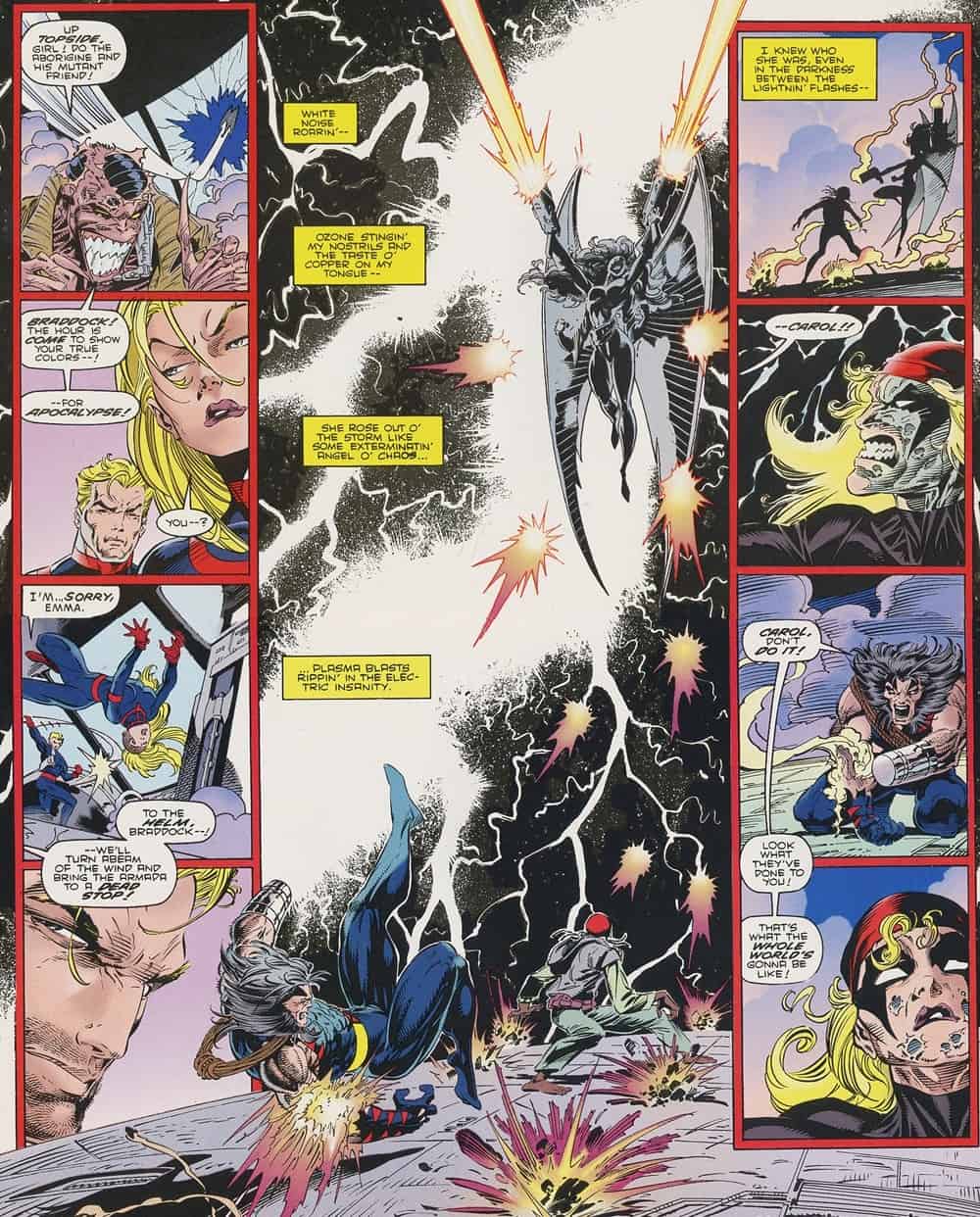
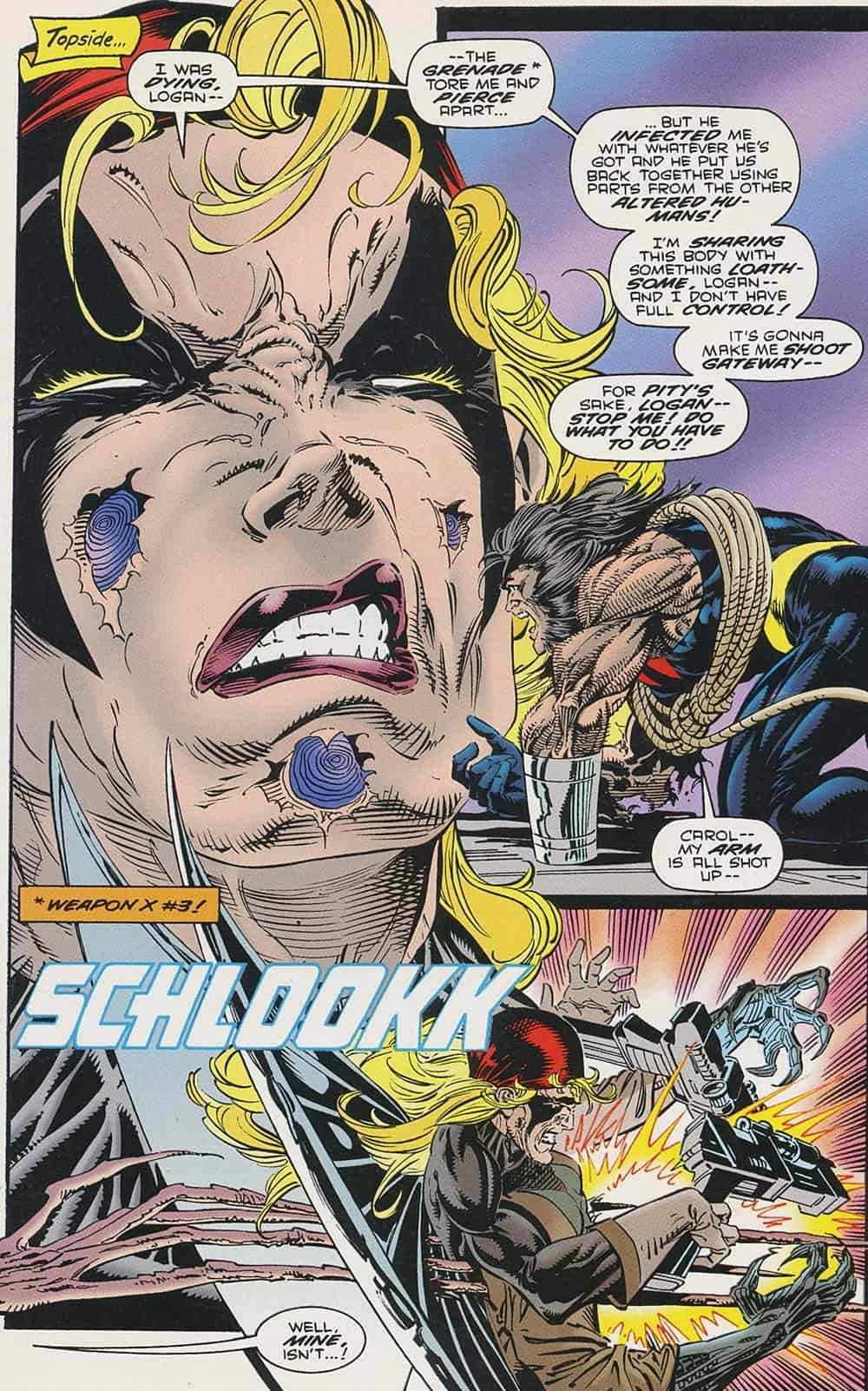 It’s the same when Logan forces Gateway to look at Jodie and read her diary. Finally there are smaller scale human stakes involved. This is something that Weapon X has been missing to this point–at least in relation to the Human High Council plot. Logan’s actions have been more procedural, advancing the plot. The only character oriented moment with any emotional weight to this point was Jean’s departure for North America. These are very satisfying moments.
 The panel where Logan extends his claws from his stump is practically cheer worthy. It makes Pierce’s death all the more satisfying. And Kubert’s art, already highly energized during the action sequences, adds considerable intensity to the moment. Almost as impressive is the final page where Gateway opens a portal big enough for the entire armada. Between these spectacles and the earlier mentioned emotional beats, Weapon X #4 goes out in a big way.
 The never ending fight with Pierce and his altered humans notwithstanding, Weapon X works well as a series. The first two issues and the last two issues seem divorced from each other, but the Human High Council’s preparation for the attack provides a solid storyline that links it all together. Logan’s assorted missions open up the world outside Apocalypse’s domain and shows that humans are trying to fight back–something that isn’t present in any of the series that take place or originate in Apocalypse’s North America.
 Gambit and the X-Ternals #4
W: Fabian Nicieza | P: Salvador Larroca | I: Al Milgrom | C: Marie Javins | L: Chris Eliopoulos
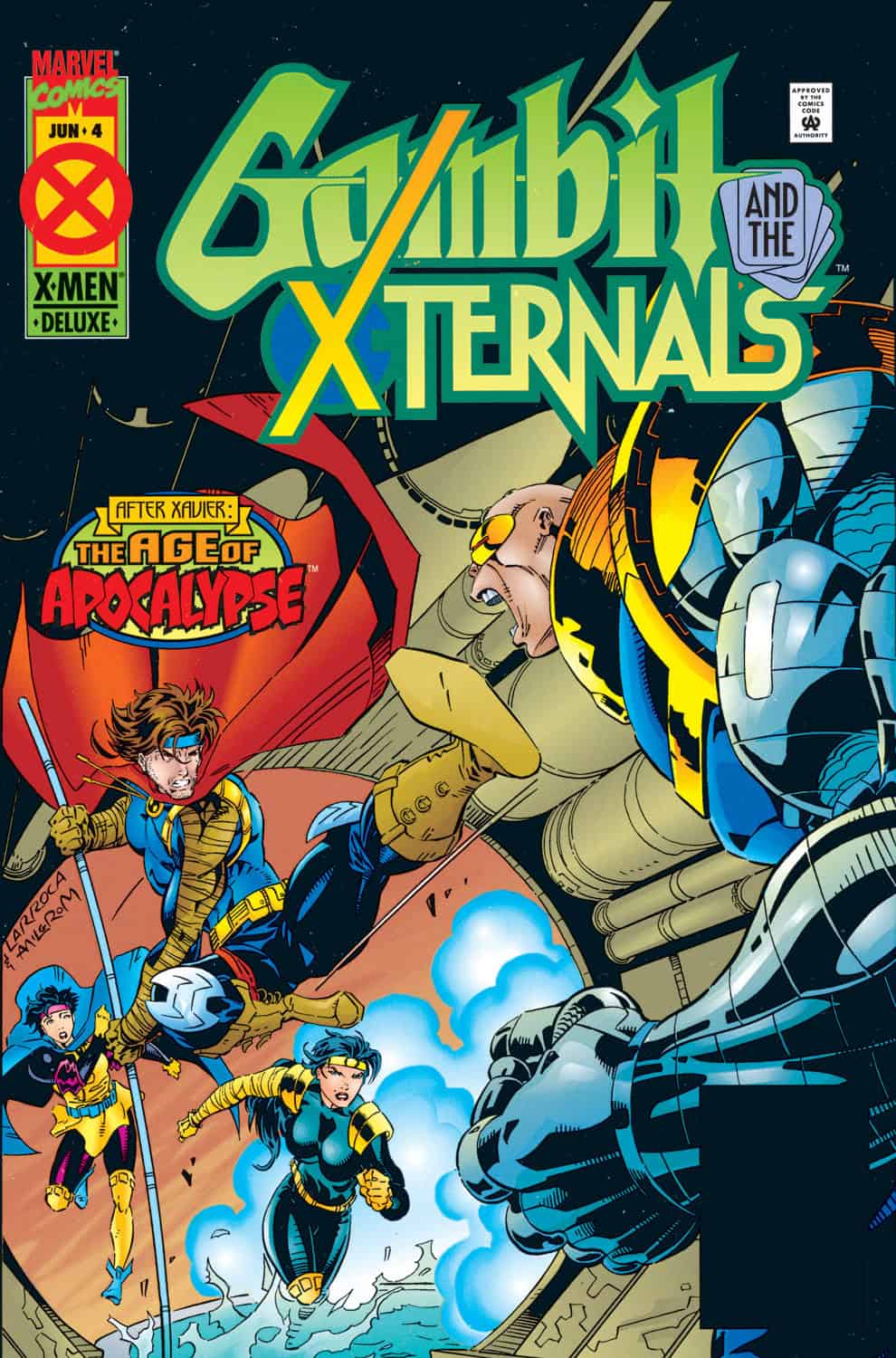
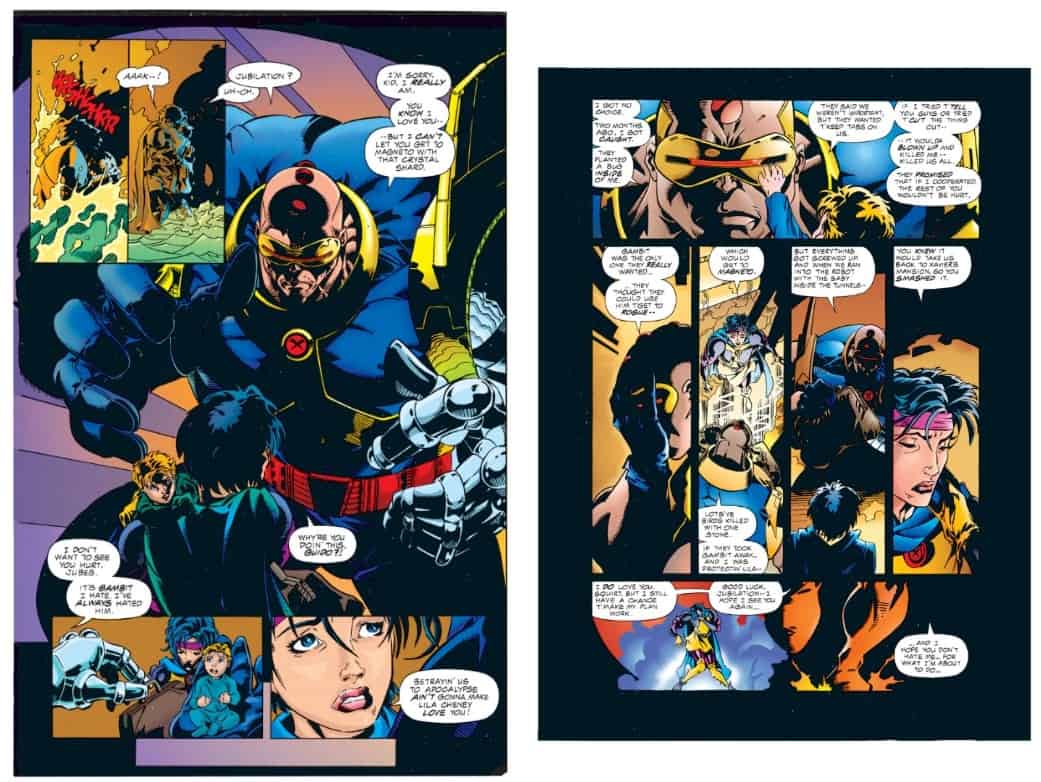
ESSENTIAL – (Continued in part from Amazing X-Men #3) Julio Richter sits in an interrogation room being questioned by Apocalypse. The story flashes back as Richter recounts what happened after he and the X-Ternals returned to Earth… Earlier, Alison and Paris move through the sewer system beneath Manhattan, looking for Magneto and Rogue’s son. They come across the wreckage of Nanny, the robot entrusted with Charles’ survival. Elsewhere, Gambit and Lila Cheney move through the sewer system, fleeing Richter. Following their return to Earth, Gambit split his team up, knowing that Richter would chase him. What Richter doesn’t know is that elsewhere in the sewer system, Jubilee has found little Charles and is running for her life. She is being chased by Guido who is intent on taking the M’Kraan Crystal shard and Charles to Apocalypse. Guido had been captured two months earlier, and a bomb was implanted in his chest. Apocalypse assured him that he and the X-Ternals would be free to go if he delivered Gambit. Guido believes that with Gambit dead, Lila will finally return his love. Gambit and Lila run into Guido in the sewer, seeing him with the crystal shard and Charles. Richter, able to track Guido, catches up to him and Gambit. When Richter brings down the top of the sewer system and Guido grabs the debris to hold it up, Gambit is faced with a choice: save Lila or save Charles and the crystal. Gambit chooses Lila, and Guido delivers the crystal and Charles to Apocalypse who then kills Richter.
Gambit’s arc with regard to Rogue is one of the richest in all of Age of Apocalypse when it comes to character development. Introduced in Astonishing X-Men #1 and fleshed out considerably in X-Men Chronicles #2, the Gambit/Rogue relationship has been central to Gambit for almost the length of this series. The power of Gambit’s love for Rogue was even enough to get him a piece of the M’Kraan Crystal. But when the chips are down, Gambit chooses saving Lila over rescuing Rogue’s son Charles. I’d argue this represents tremendous growth on Gambit’s part. Rogue is the champion of mixed signals in X-Men Chronicles #2 and Astonishing X-Men #1, but at the end of the day, there’s nothing in either issue to suggest that Gambit is going to truly win her affections.
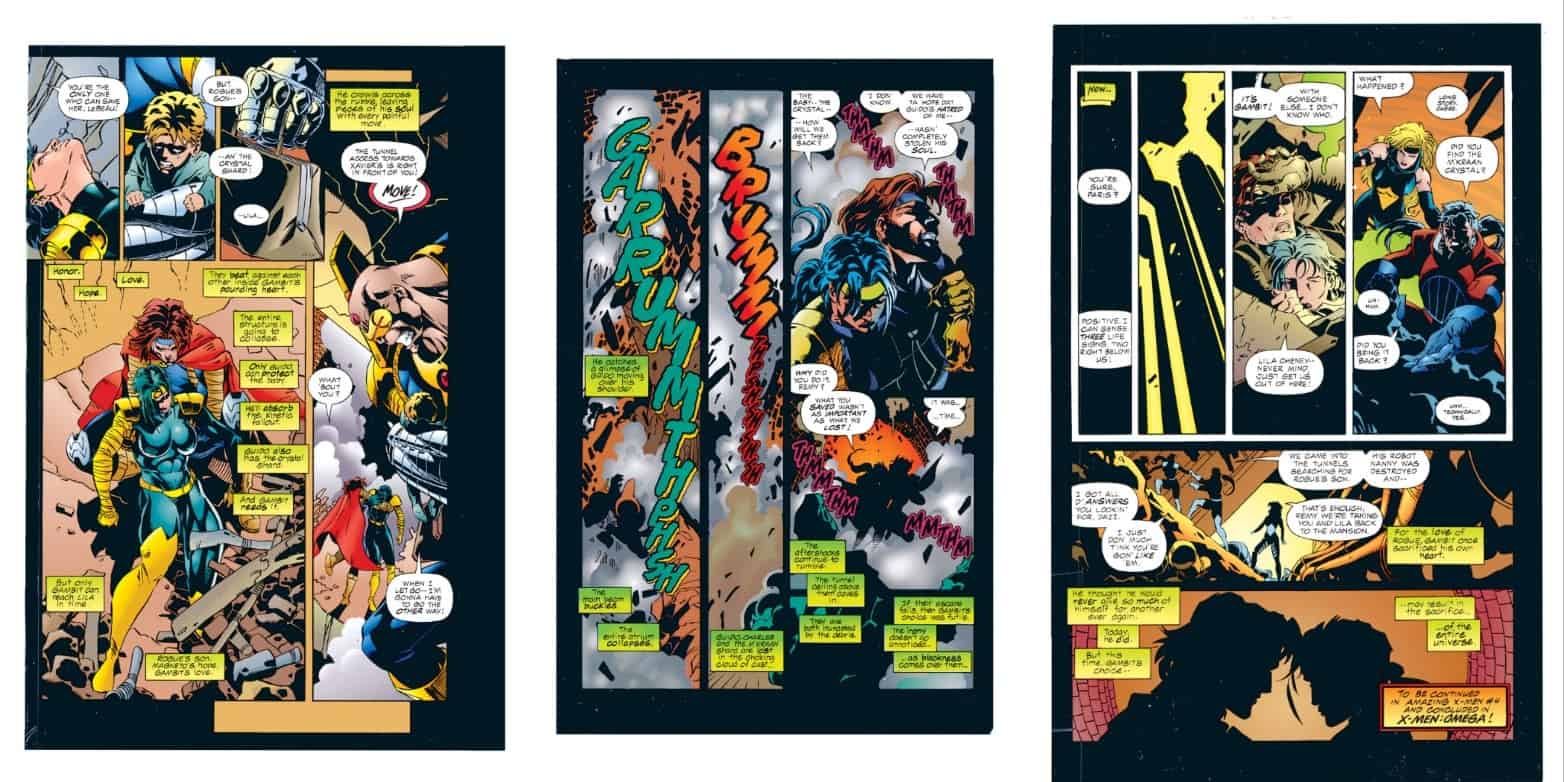 This resolution to Gambit’s arc is also an interesting contrast to the correct timeline where Gambit won’t stop pursuing Rogue despite her mixed signals and periodic ambivalence. Following Age of Apocalypse, Rogue is going to learn a little about Gambit’s past that causes a rift between them, choose to not get the full story from Gambit when he offers, have a will-they-won’t-they thing with Joseph, and then leave Gambit for dead in Antarctica. And even so, Gambit will end up resuming the chase. Eventual happily ever after notwithstanding, at this point in time I think Age of Apocalypse Gambit has the better deal.
More foreshadowing is paid off in the form of Guido’s betrayal and belief that Lila will love him afterward. I don’t think Guido’s excuse buys him any sympathy, nor do I think it’s supposed to. On top of putting all of reality in danger and kidnapping a toddler, Guido has extremely selfish motivations.
 Everyone loves it when the bad guy gets theirs, and it’s strangely satisfying to see Richter go out this way–passively sitting through an interrogation on the way to his eventual and very casual execution.
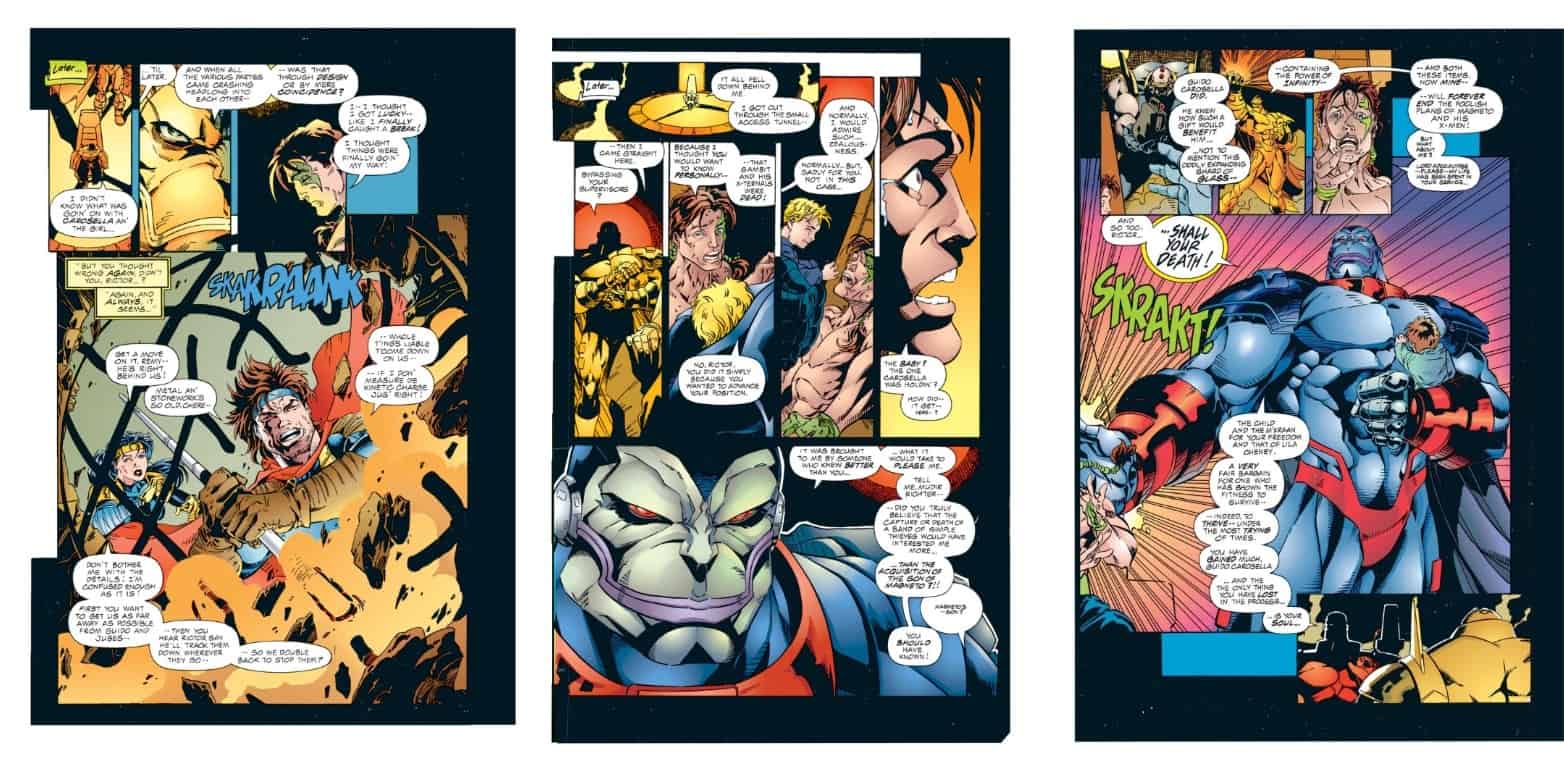 It makes perfect sense, too, when you see Guido’s success. Distrust and pettiness seem to be hallmarks of Apocalypse’s regime at every level–it’s practically the central theme of Factor X. Everyone serving Apocalypse is serving themselves, pretty much by design thanks to the overall philosophy of Apocalypse’s reign. So there’s logic in Apocalypse happily executing poorly performing underlings; although, it does beg the question of how Apocalypse’s empire has endured with any stability.
Gambit and the X-Ternals ends as one of the strongest Age of Apocalypse series. It has an engaging story that delivers a very compelling character arc in Gambit. The art feels consistent even with the penciler change. The visuals throughout are dynamic, pairing well with the fast paced narrative. It’s easily my favorite.
 Amazing X-Men #4
W: Fabian Nicieza | P: Andy Kubert | I: Matt Ryan | C: Kevin Somers & Digital Chameleon | L: Richard Starkings & Comicraft
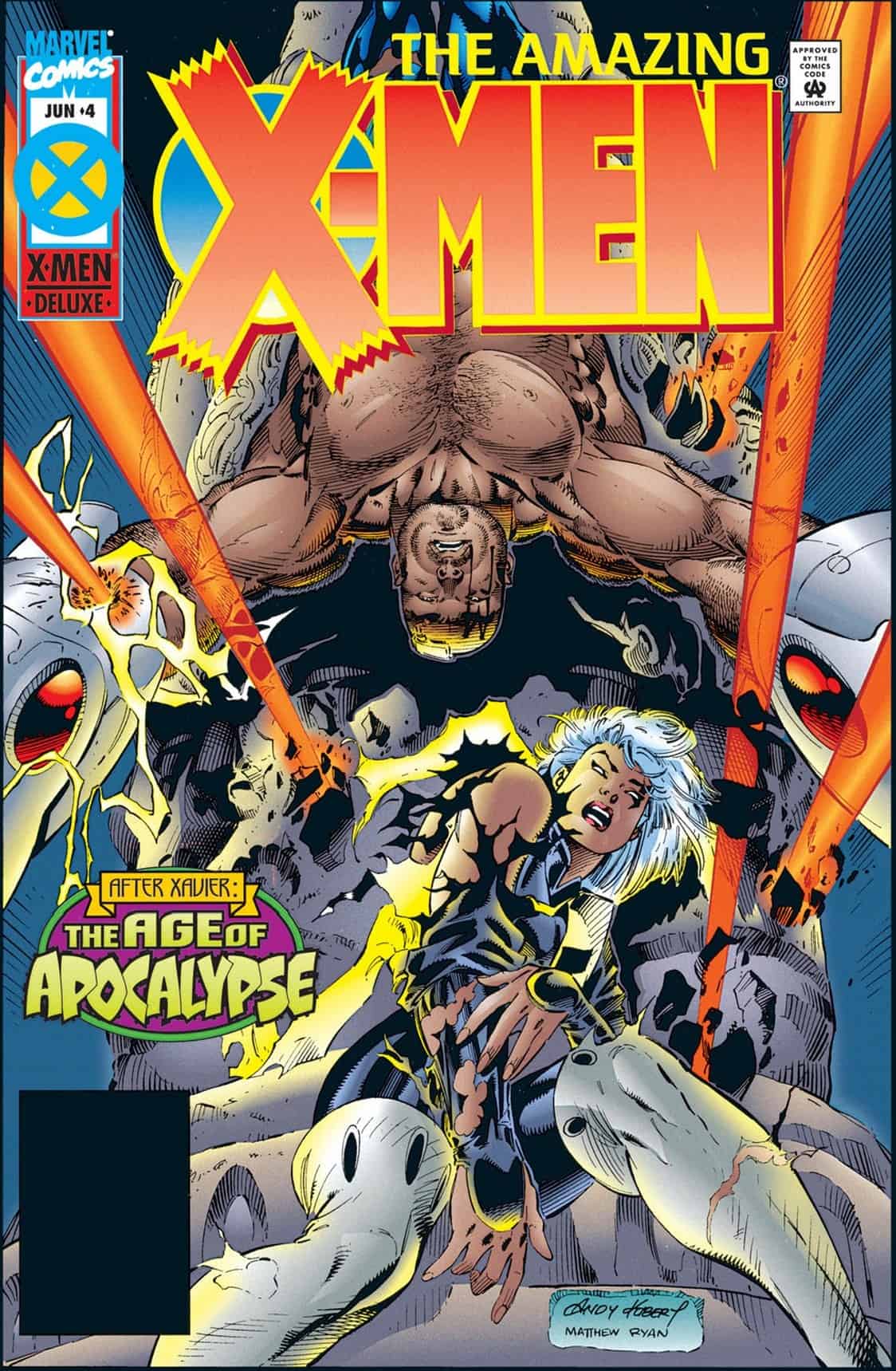
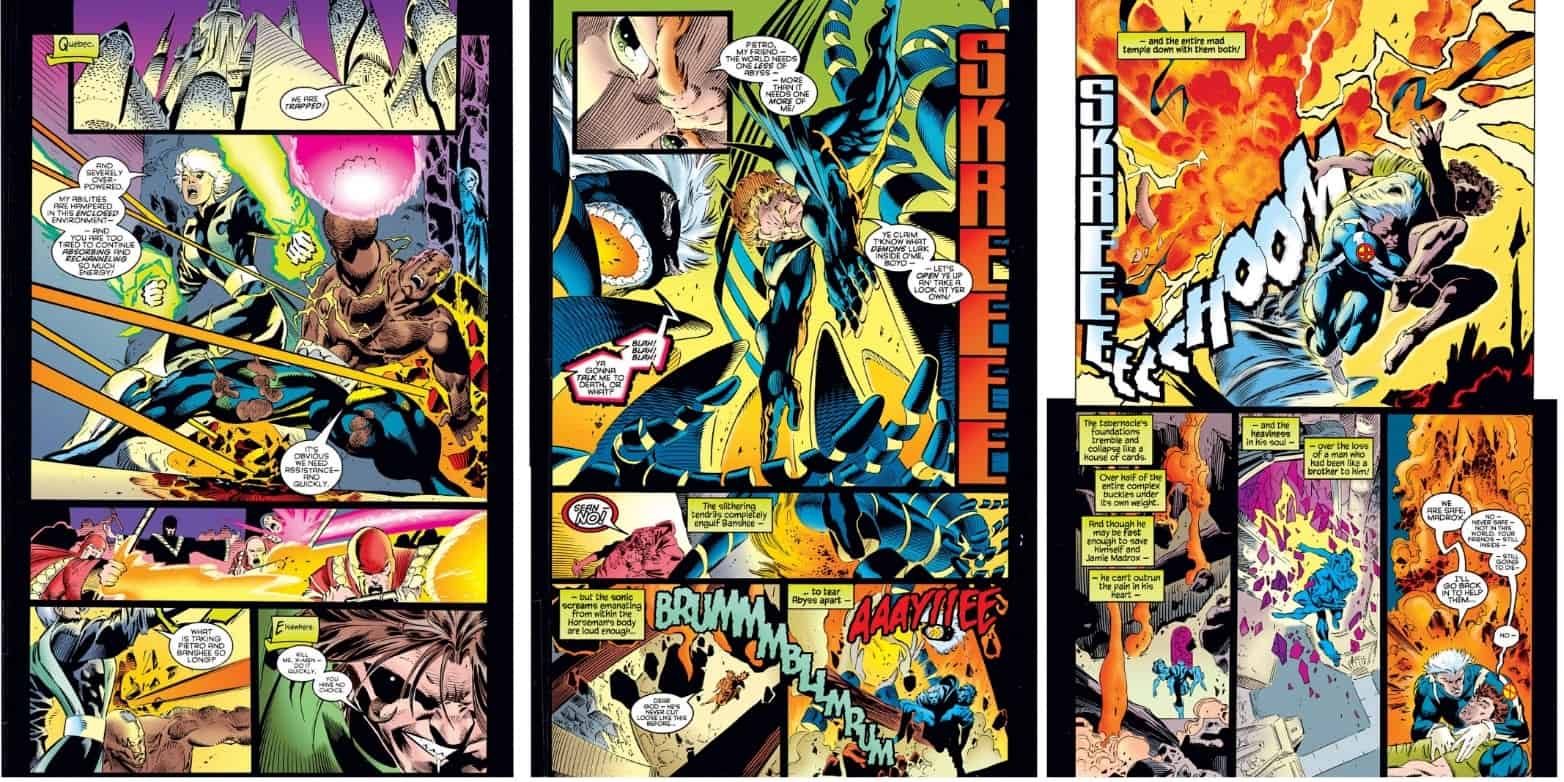
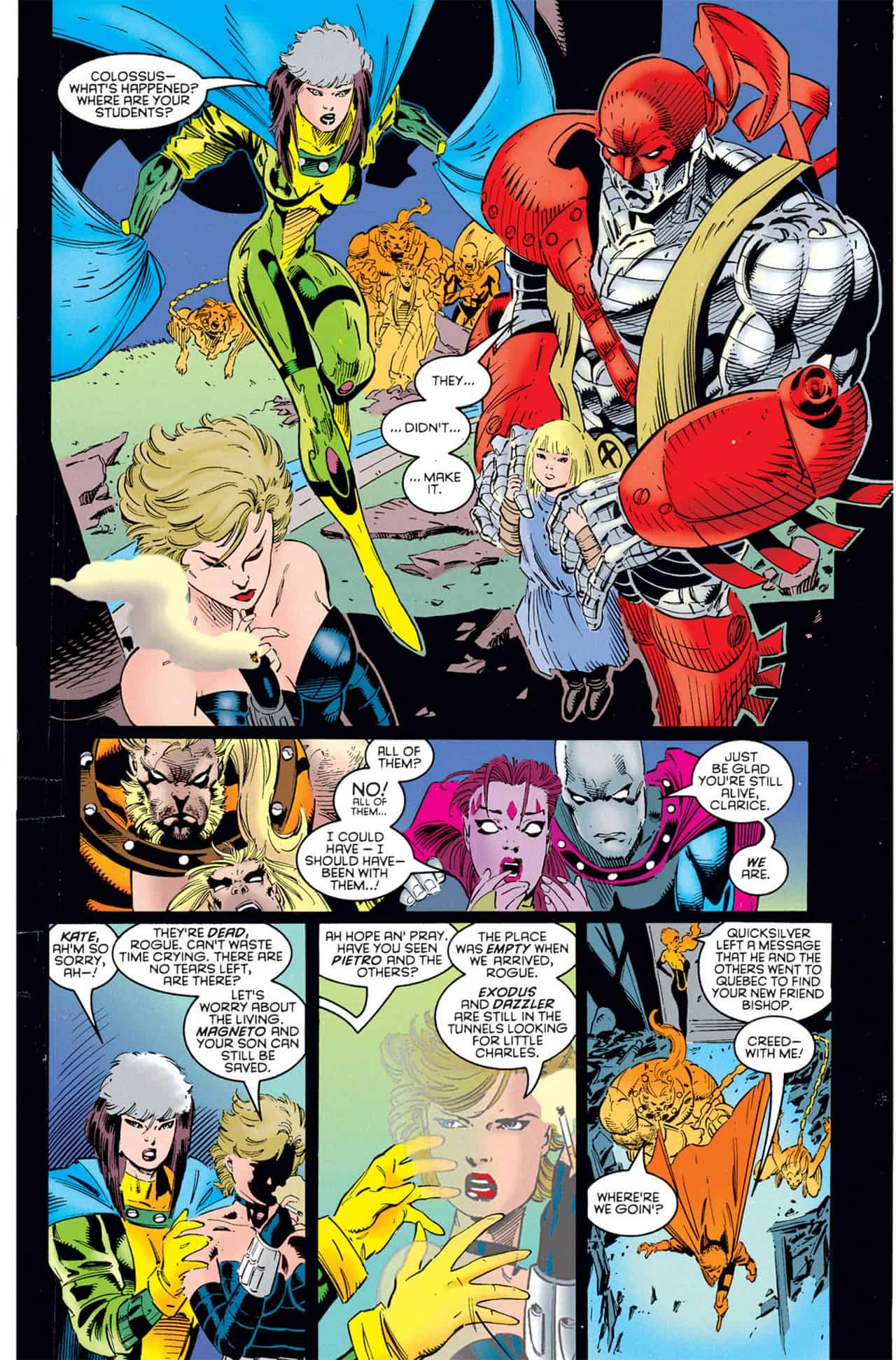
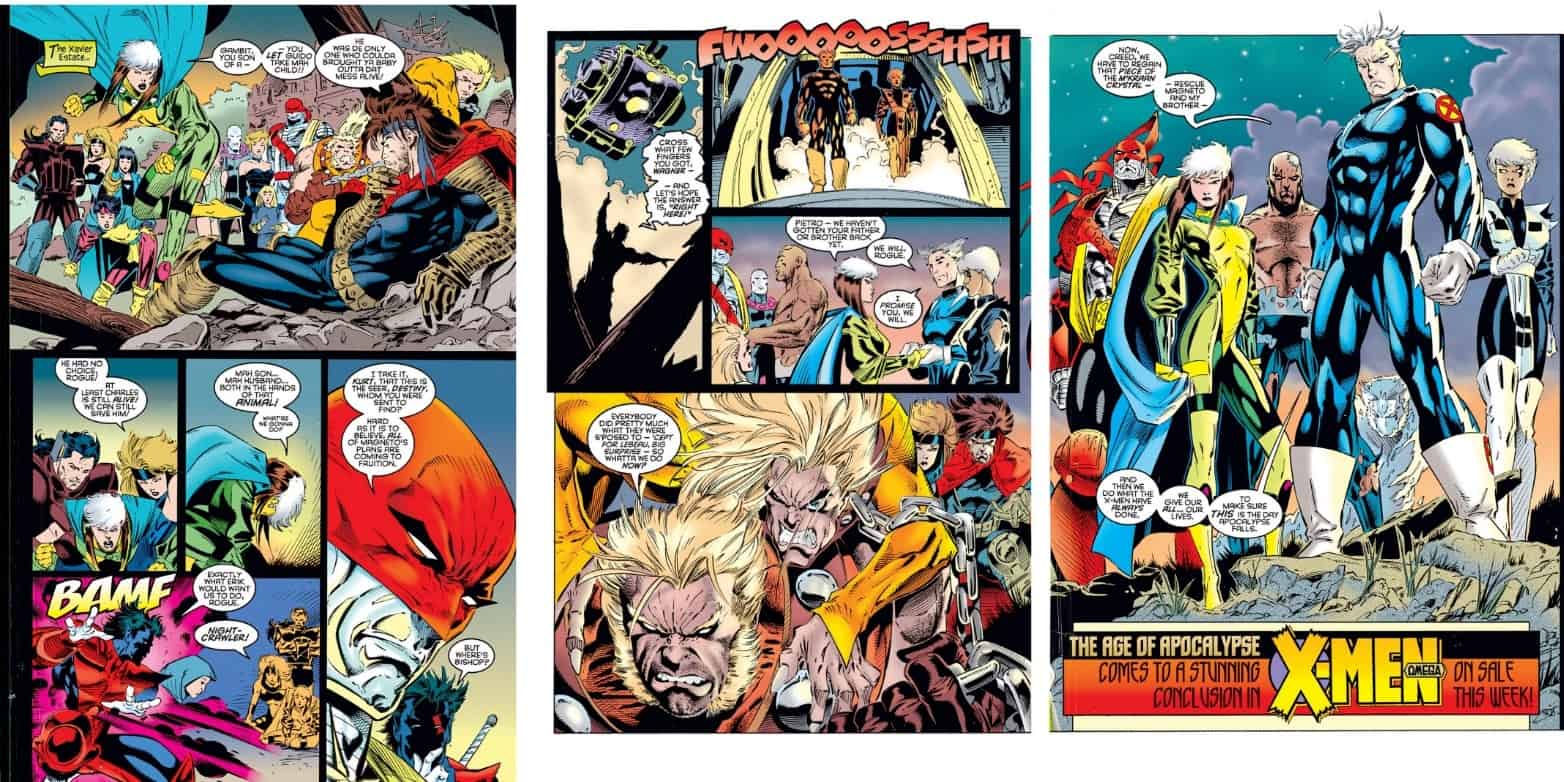
ESSENTIAL – (Continued in part from Astonishing X-Men #4, Generation Next #4, Gambit and the X-Ternals #4, X-Calibre #4) The Madri cut Bishop, let him bleed into a chalice, and pass it around for all to drink from. They then declare that they will kill Bishop so that Apocalypse’s reign can not be undone. Storm attacks at that moment, unleashing hurricane force winds on the Madri and rescuing Bishop. Elsewhere, Banshee and Pietro sneak through the complex in disguise, looking for the person from which all Madri come: Jaime Madrox. They find a ruined, crippled Madrox who begs them to kill him. Back in Westchester, Rogue’s team arrives to find Colossus, Shadowcat, and Illyana. Shadowcat revealed that all of their students were killed. Rogue, Sabretooth, and Wild Child go into the sewers, looking for Charles. The trio come upon Allison, Paris, Gambit, Lila, and Jubilee. Finding out that Gambit didn’t save Charles. Rogue punches him up through the ground, threatening his life if he won’t tell her where Charles is. Meanwhile, in the Madri complex in Quebec, Storm and Bishop fight for their lives against the Madri. Elsewhere in the complex, Abyss confronts Banshee and Pietro. Banshee flies into Abyss, screaming as he does so and tearing Abyss’s body apart. Free from captivity, Madrox uses all the energy he has left to shut down his dupes, dying in the process. Pietro catches up with Storm and Bishop. Back in Westchester, Kurt arrives with Destiny. Moments later, Pietro, Storm and Bishop land. Everyone prepares to storm Apocalypse’s citadel, rescue Magneto and Charles, find the the M’Kraan Crystal, and make sure Apocalypse falls.
Amazing X-Men #4 packs in a lot. Most of the Age of Apocalypse issues do, but this one is practically overflowing. Pietro, Banshee, and Storm’s rescue takes up less room than it feels like it does. Nicieza’s story is fast paced to begin with. Kubert’s art juices it up even more.
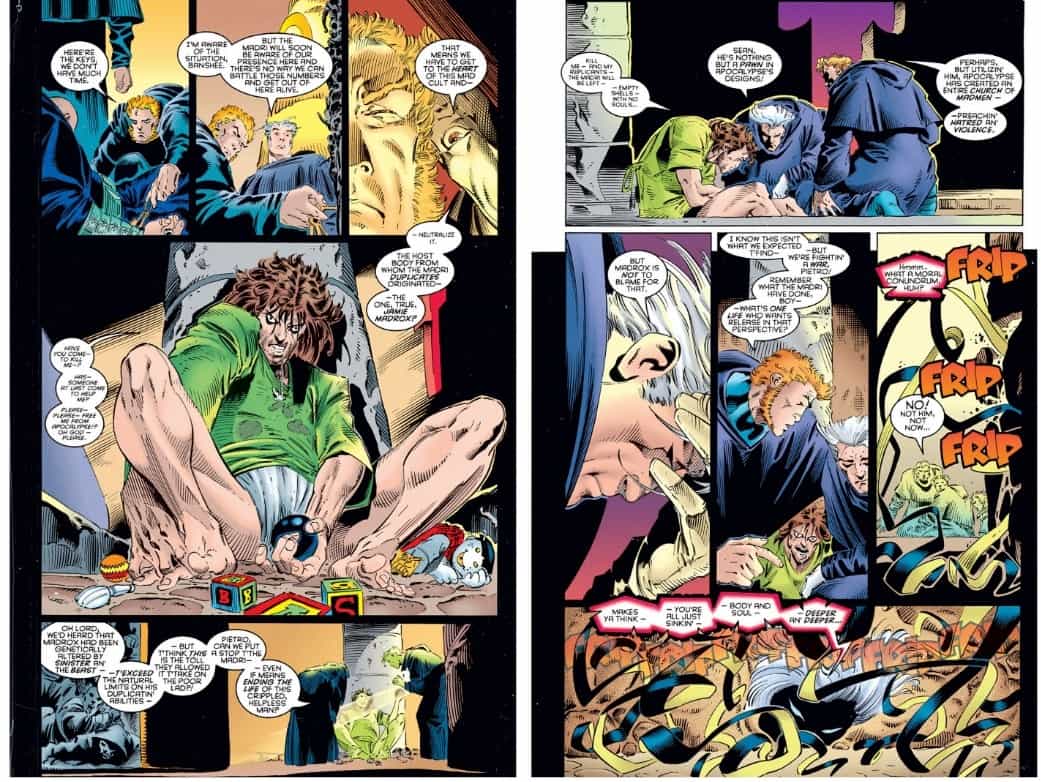
 The use of Jamie Madrox here is disturbing. Kept alive as a shell of himself, sitting in a diaper. It’s strange to say because there are so many examples of cruelty in this world, but Jamie’s treatment seems especially so. At least if Apocalypse’s forces kill you, you’re out of your misery. But how long has Jamie been kept like this, forced to create duplicates to satisfy this religious order?
 Nicieza includes a great moment where Shadowcat tells Rogue that all of her and Colossus’s students died. When she phases so that Rogue can’t put her hand on her shoulder to comfort her, you feel the weight of her grief and anger. X-Men Omega, as we’ll see, wouldn’t permit this sort of quiet moment.
 It’s a smart move to wrap up all the X team stories here rather than in X-Men Omega. There wouldn’t have been space to do a proper regroup.
 Amazing X-Men is the only Age of Apocalypse series that doesn’t have a single through line. Its first two issues have nothing to do with its last two. If anything, the series’ first two issues are more connected to Weapon X than the rest of Amazing X-Men. The various story threads are handled well, and the series never suffers for not having one ongoing plot. Nicieza develops his characters well. It never quite hits the emotional highs of Gambit and the X-Ternals or Astonishing X-Men, but it’s a strong series. And regardless of whether Lobdell or Nicieza is correct about there being a planned ending to get to in Amazing X-Men #4, Lobdell stuck that landing.
 Opening quotations: https://www.syfy.com/syfy-wire/x-men-age-of-apocalypse-oral-marvel-history-25-years-later