The 30th anniversary look at Age of Apocalypse concludes (even if it’s now technically 31).

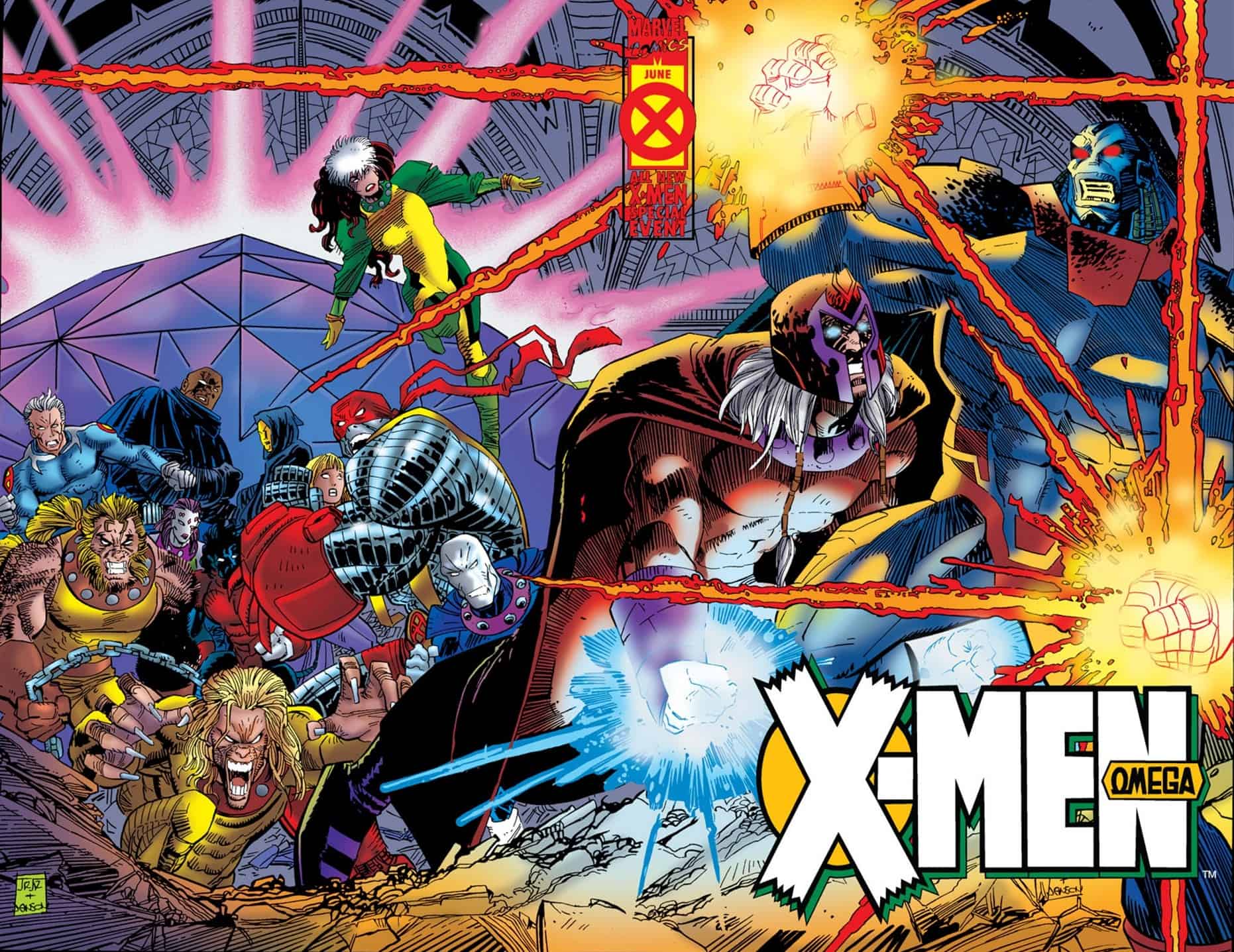

X-Men Omega #1
Story: Scott Lobdell | Dialogue: Mark Waid | P: Roger Cruz | I:Bud LaRosa, Tim Townsend, Karl Kesel, Harry Candelario, Scott Hanna & Al Milgrom | C: Steve Buccellato with Electric Crayons | L: Richard Starkings with Comicraft
ESSENTIAL – Apocalypse and Holocaust torture Magneto as Apocalypse gloats that he is in possession of the M’Kraan Crystal and will not allow Magneto’s plan to succeed. Elsewhere in Manhattan, Warren finds Karma who dies shortly after. In the pens below Apocalypse’s citadel, Blink brings in all of the X characters gathered in Westchester shortly before. They immediately come across a beaten McCoy. Far outside the citadel, Cyclops and Jean lead the mutant escapees from the pens to freedom. Above them, Warren, loaded with explosives, flies into the forcefield generator that protects Apocalypse’s citadel. The failed forcefield allows Nate to make it to the top of Apocalypse’s citadel. As Apocalypse listens to a report that the Human High Council has bypassed coastal defense and already nuked the midwest, Nate busts into the Citadel and rescues Magneto. The X-Men arrive in the crystal chamber just below Apocalypse and Magneto. Destiny makes contact with the M’Kraan Crystal and discovers that everything Bishop has said is true. At that moment, Nate, Holocaust, and Magneto bust through from above. Magneto meets Illyana and he and Bishop convince her that she can help create a world free from monsters like the Sugar Man and where prejudice may some day be eliminated.
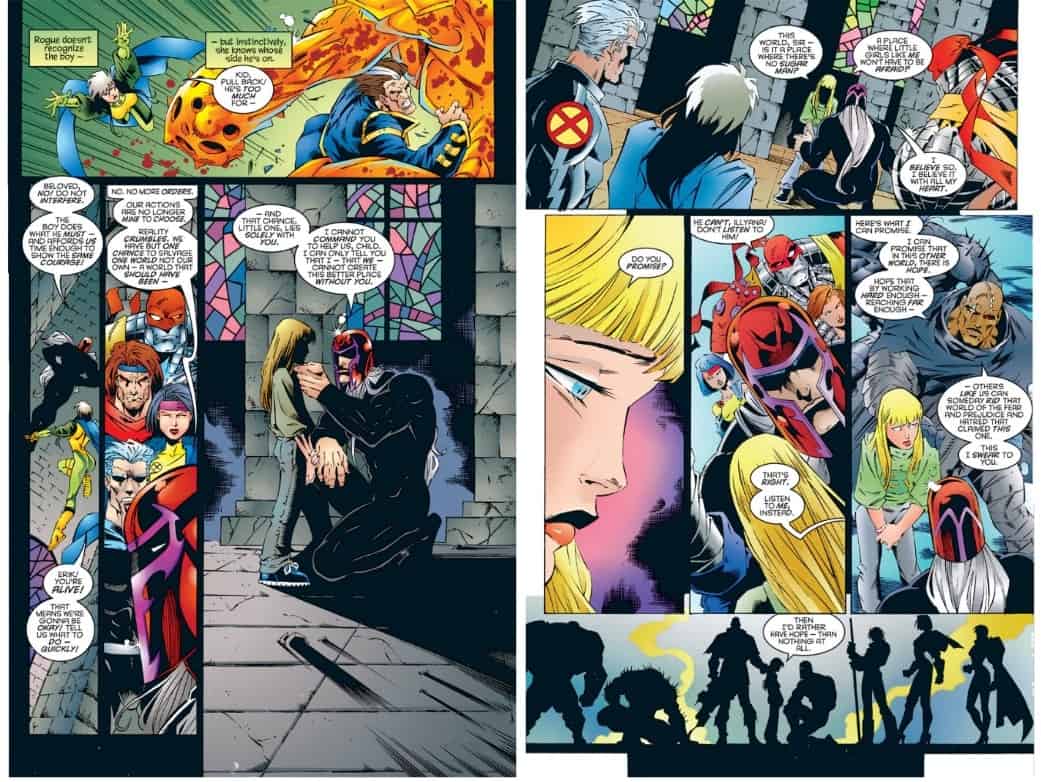

Bishop arrives years in the past, moments before Xavier sacrifices himself to save Magneto from Legion. In the present, McCoy beams himself into the Crystal to escape. Nearby, Colossus’s rampage continues. Shadowcat, convinced Colossus would never hurt her, stands unphased before him. Colossus runs her over, killing her. Gambit kills him immediately after. Pietro rescues Illyana from the Crystal, leaving Colossus to die alone. Elsewhere, Rogue has found Guido. She steals his strength and punches him through the citadel’s exterior wall. Nearby, Apocalypse momentarily escapes Magneto. Carrying a Crystal shard, he intends to travel to the original timeline. Nate catches up with him and steals the Crystal shard. Back in the past Bishop tackles Legion just before the fatal strike. He stabs Legion’s psionic blade into himself. The feedback loop reveals to Legion the horrific future he created. Both Bishop and Legion fade away. The timeline resets as though Legion and the X-Men had never traveled back in time. In the present, two minutes from armageddon, Nate and Magneto unleash all their power on Apocalypse. Holocaust intervenes. Nate stabs Holocaust with the Crystal shard, meaning to smash his suit. Instead, the two vanish. With Apocalypse weakened, Magneto is able to rip Apocalypse’s body apart. Magneto finds Rogue and Charles, and they stand together as their world ends in the bright bursts of the armada’s bombs.
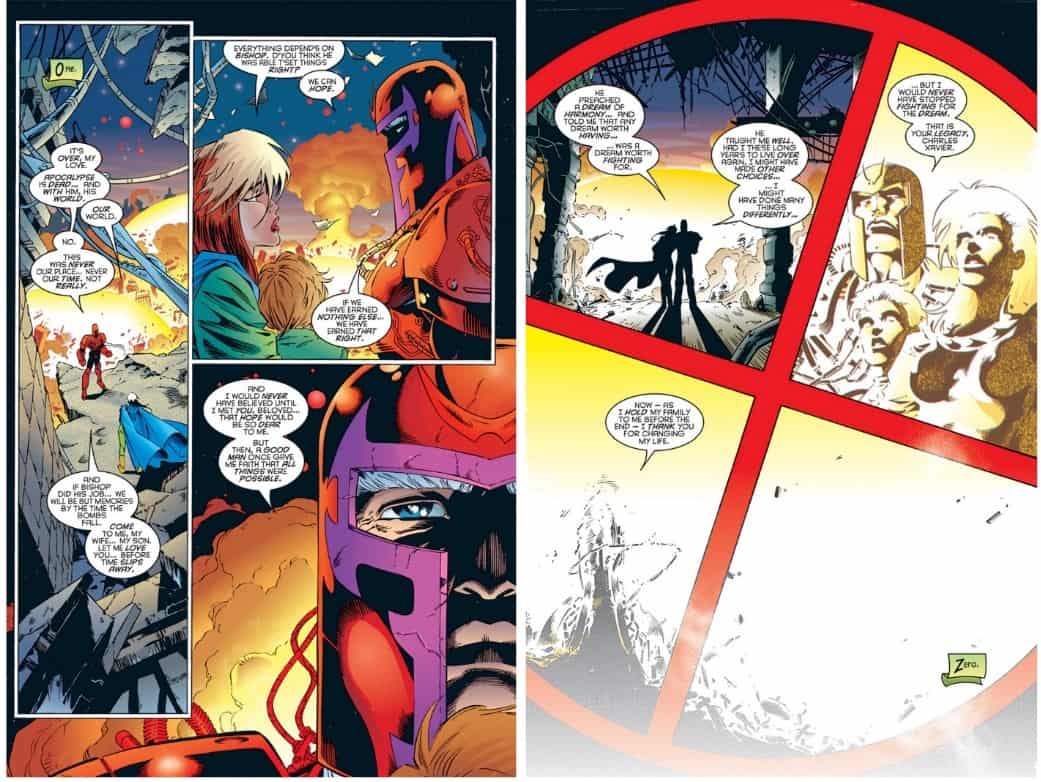
This attempt to faithfully summarize X-Men Omega’s story beat by story beat hopefully communicates the non-stop rush to the finish line pace of Age of Apocalypse‘s final issue. The issue intercuts constantly, frequently jumping from one page scene to one page scene to one page scene.
A lot of this very fast pacing owes X-Men Omega’s utter lack of explanation for anything. Lobdell and Waid assume you know everything about everything going into this issue. Indeed, X-Men Omega is probably the best argument for reading every series in the event. Why is everyone already back together again when this issue begins? Hopefully you read Amazing X-Men #4. If you don’t read X-Man, the first time you ever see Nate is when he’s climbing the side of Apocalypse’s citadel. Why is Jean Grey in Manhattan with a traitor Cyclops who is being chased by Havok while Logan parachutes from above? You better have read Weapon X and Factor X. After all, their ending here doesn’t resemble at all their beginning in X-Men Alpha.
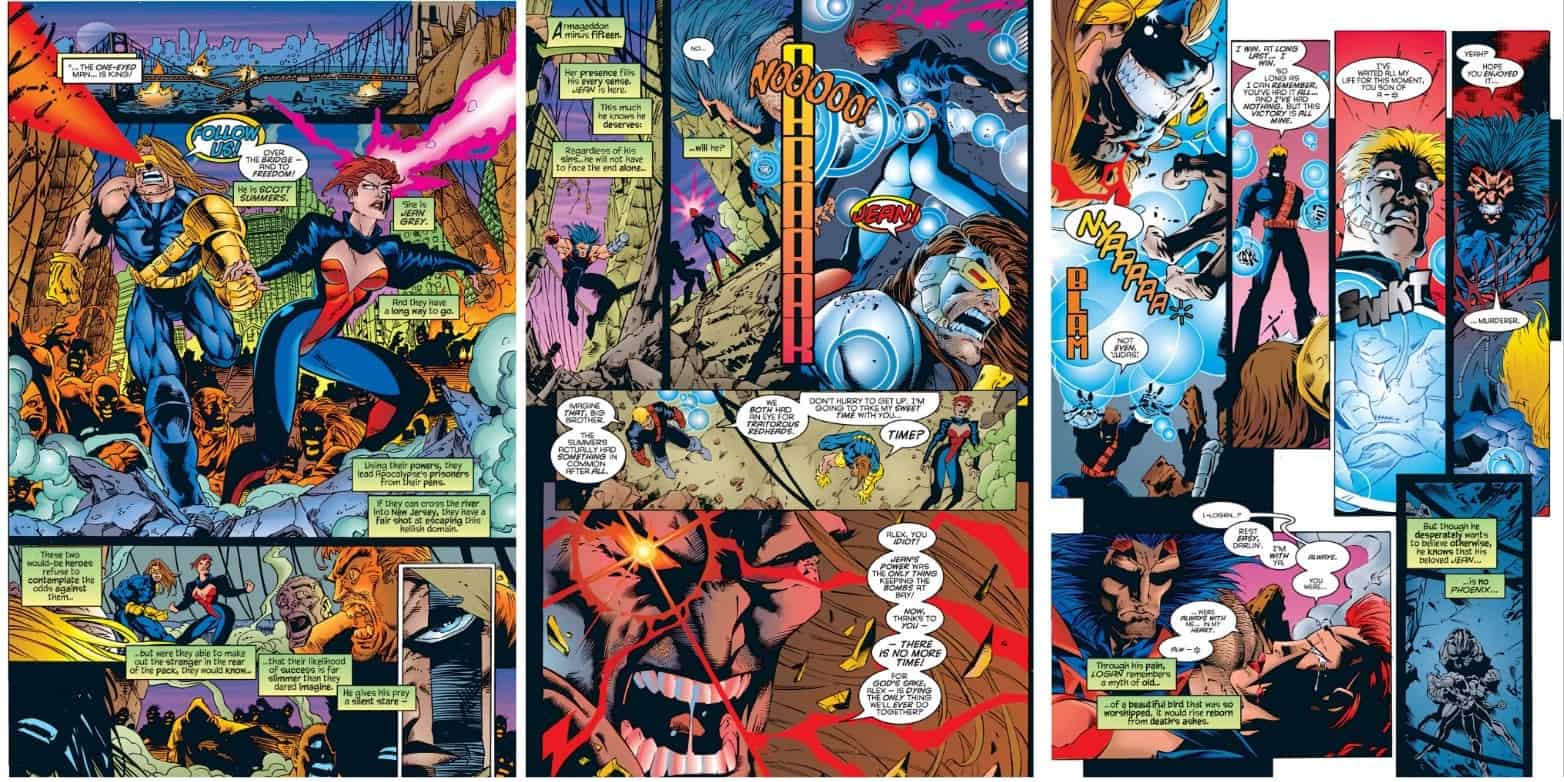
Weapon X and Factor X are the only two series that don’t come together in the plotlines involving the fight against Apocalypse or the attempt to fix the past. Indeed, Lobdell’s story delivers what might be the best possible outcome for Havok, Cyclops, Jean, and Logan. The connection between these four characters is a personal one–a smaller scale conflict than what is unfolding in the rest of X-Men Omega. Havok gets his win, apparently killing both Jean and Scott. This is one of the issue’s most surprising moments. You expect Jean and Cyclops to prevail (in as much as anyone can with nuclear armageddon just around the corner). There is a discrepancy here, though. As was pointed out in dialogue in Factor X #4, Havok and Cyclops’s mutant powers can’t hurt each other. But this scene plays out so quickly that the reader is unlikely to get caught up on that detail.

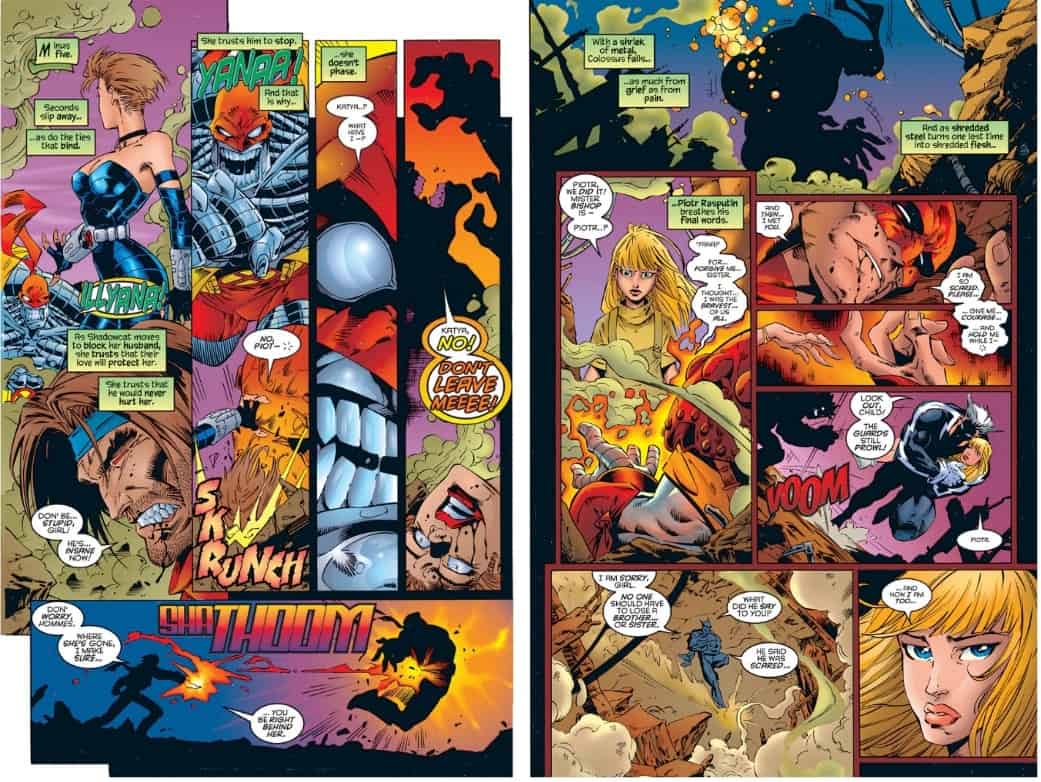
Almost as poignant (in a very strange way) is Colossus’s rage over not being able to be with Illyana in the M’Kraan Crystal for what he thinks will be her “death.” It’s essentially a continuation of his arc in Generation Next–a morphing of the selfish devotion to his sister that comes at the expense of everything else. X-Men Omega doesn’t pay off many character arcs. Even the wrap up of Havok, Cyclops, Jean, and Logan is more plot than character, primarily wrapping up the events of Factor X. This is probably a direct result of Lobdell having written Generation Next. Also being at the helm of X-Men Omega, he was in a position to continue the storyline. There’s a dual heartbreak as it unfolds–Colossus killing Shadowkat and then Illyana coming upon Colossus as he’s dying but being unable to comfort him because Pietro pulls her away. Colossus dies alone.
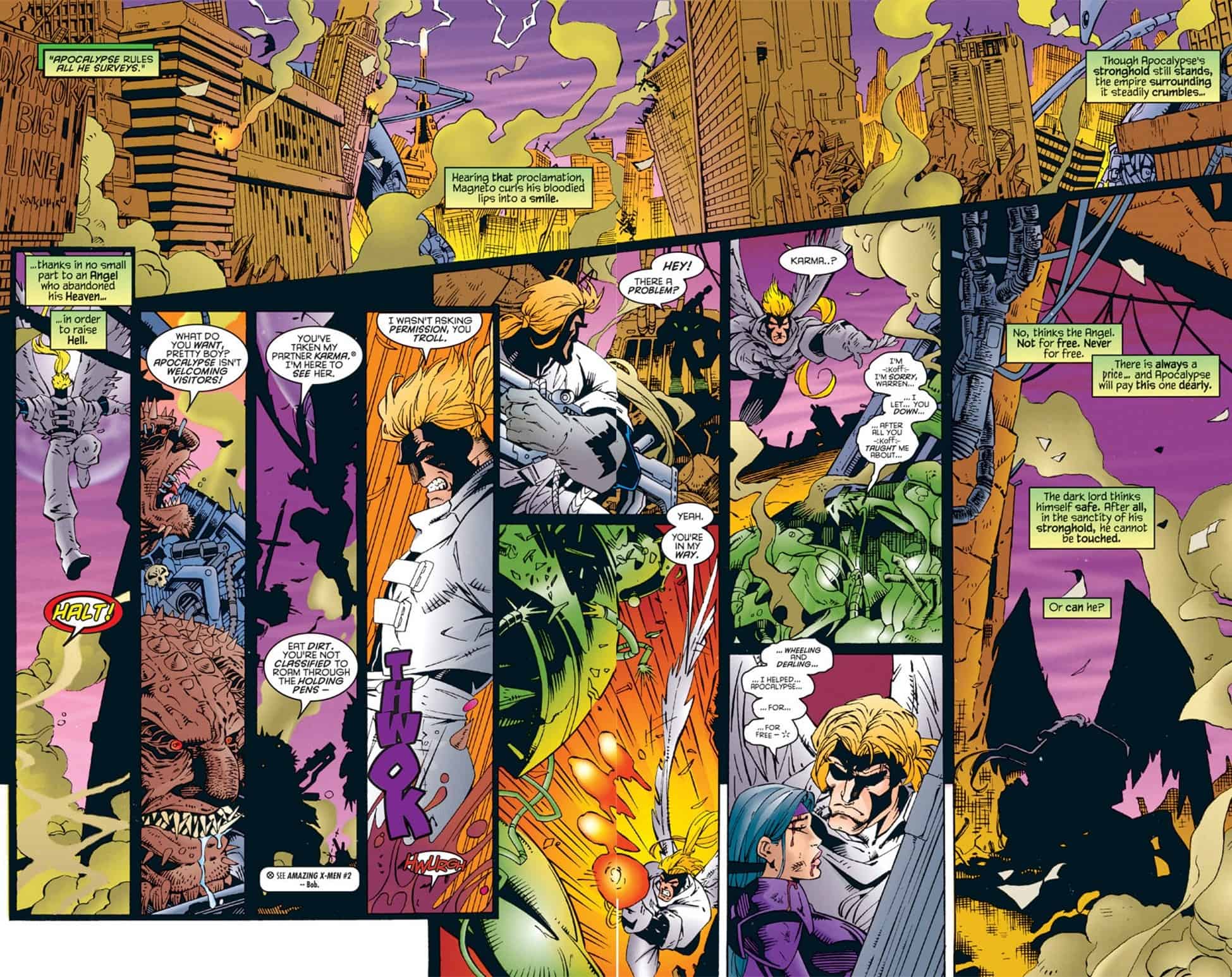

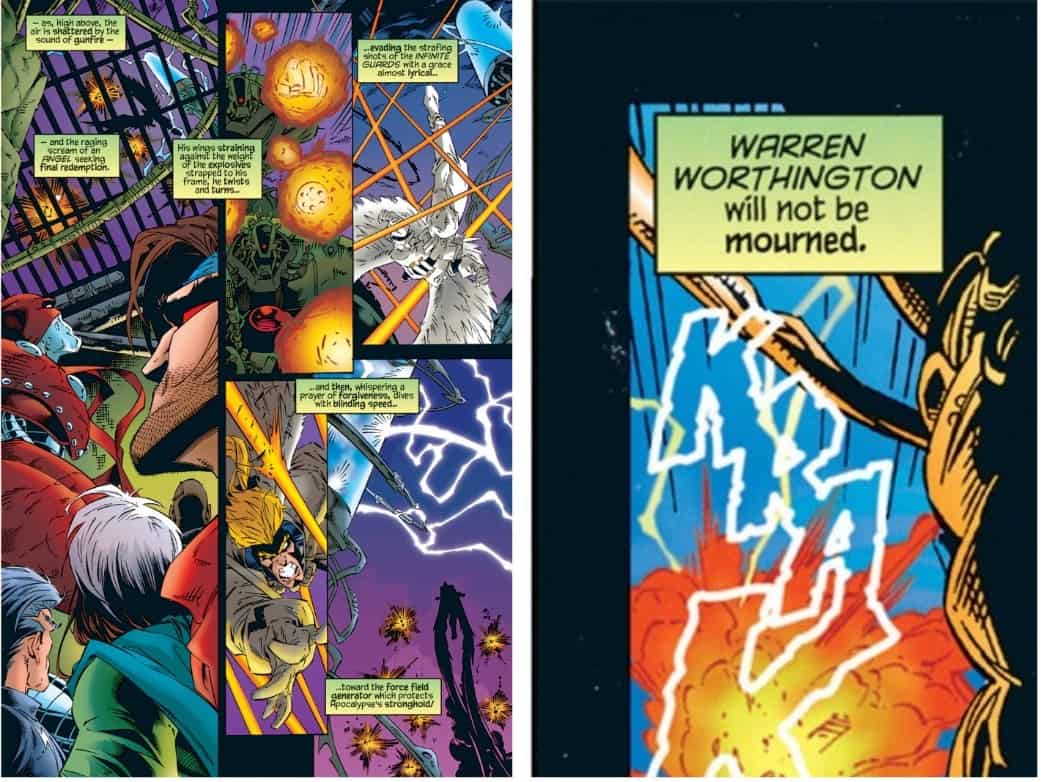
Lobdell and Waid could have written dialogue for a character marveling at Warren’s actions. They could have waxed poetic about a valiant sacrifice. They don’t do that. Moore did the same in Factor X #4 when the Bedlam Brothers switched sides. Even Cyclops wasn’t really redeemed in Moore’s writing. The Age of Apocalypse doesn’t forgive characters their sins, and it feels right. These people did horrible things–far worse than anything that ever had ever happened in the main continuity. Just because they’re heroes in one universe doesn’t mean they should be let off the hook in this one.
The main event: Magneto versus Apocalypse.
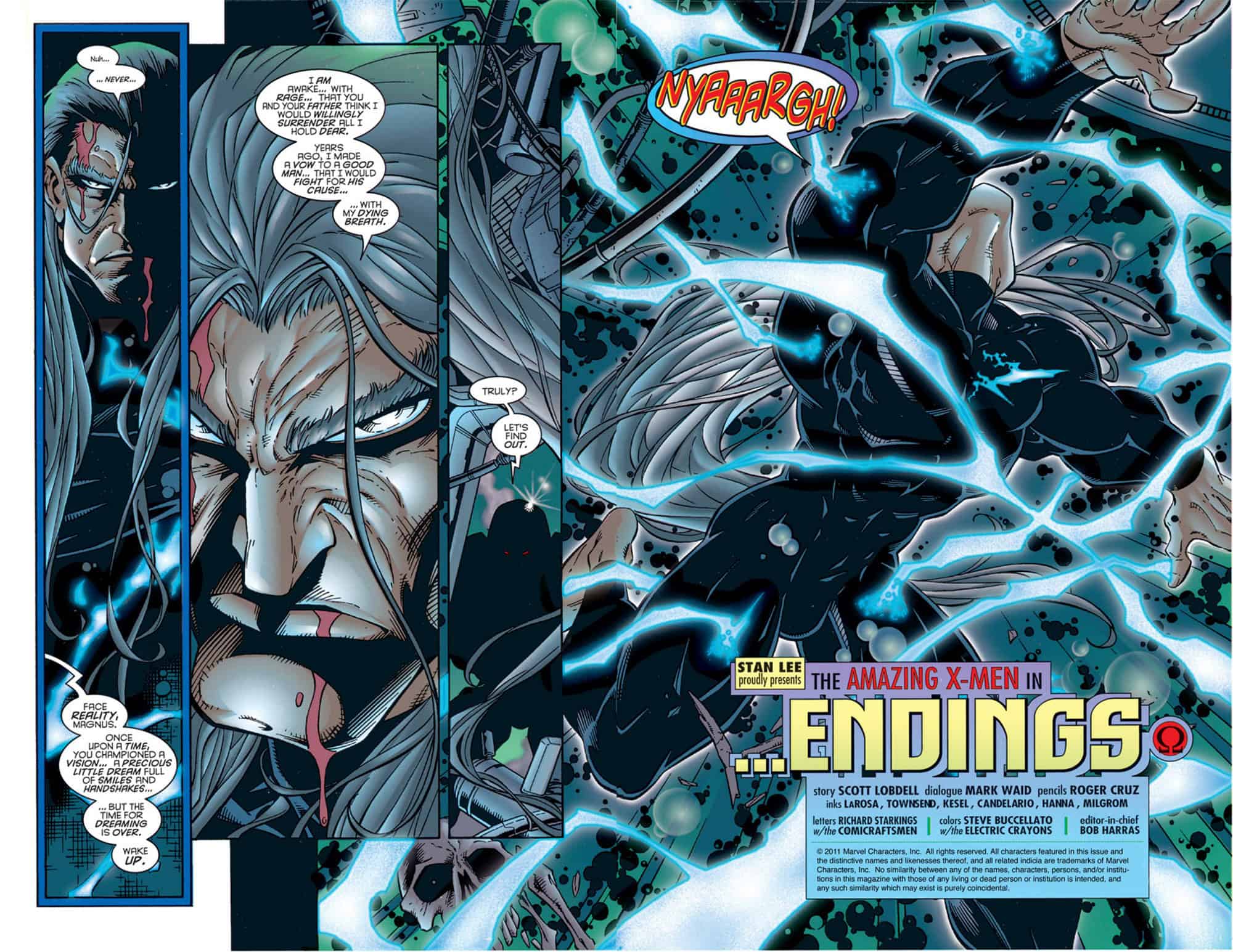

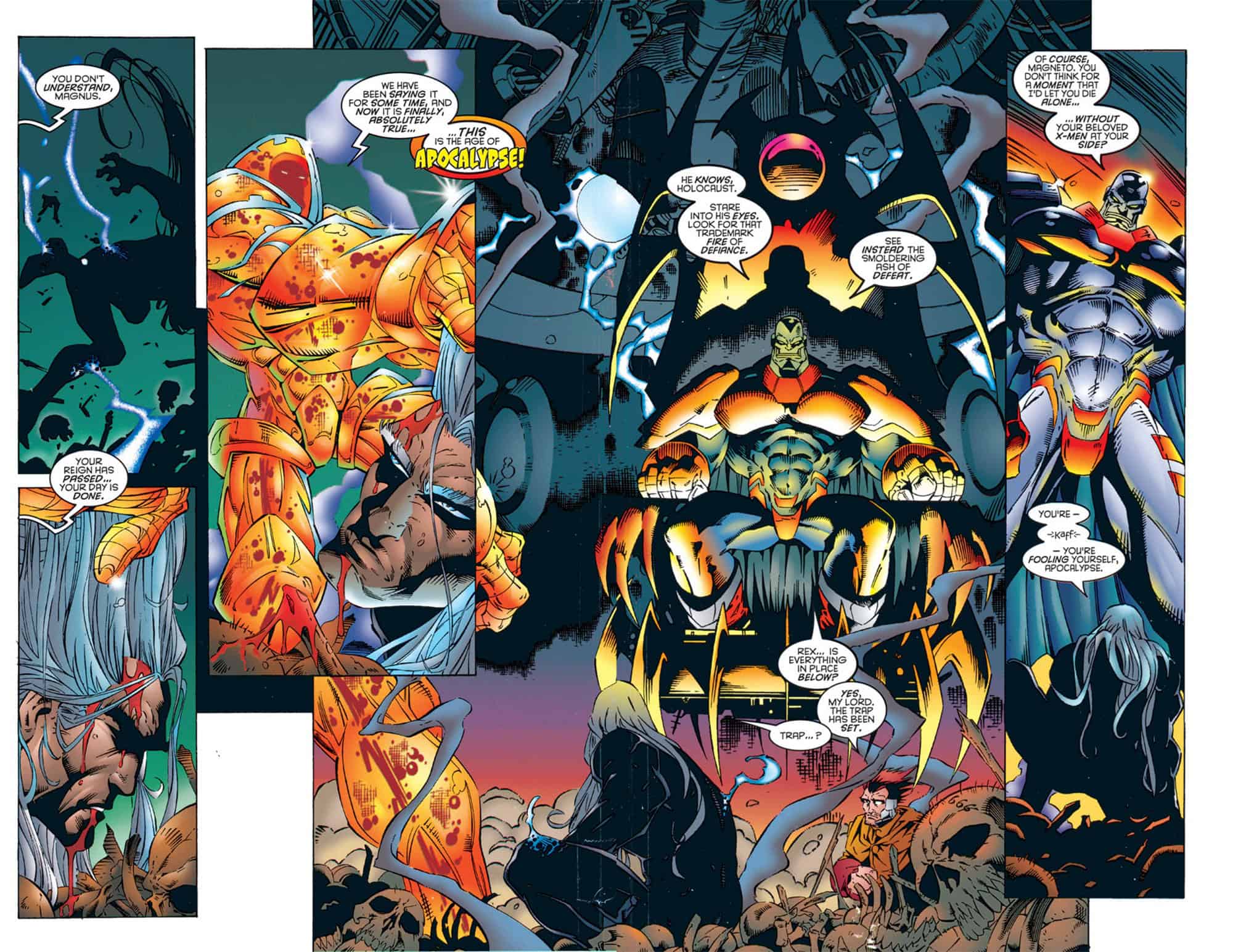
Nate Grey is basically the first card for this event. He does his best against Apocalypse but spends a lot of time fighting Holocaust. The whole thing is a little underwhelming given how powerful Sinister said he is. But his participation in the fight works, giving Magneto just enough of an opportunity to get himself in a proper final battle with Apocalypse.
Lobdell and Waid do what is perhaps very obvious and compare Apocalypse and his twisted Darwinian ideas to Hitler and his regime. Hitler comparisons get thrown around a lot. Magneto is always good for a few with regard to how humans treat mutants thanks to his character’s background. This might be the most apt ever, though. Apocalypse is exterminating those he finds less than, and his efforts serve as a unifying force for mutants to support him and his ideals. Additionally, Apocalypse’s chief lieutenant and his servants busy themselves with literally engineering the perfect mutant. When Magneto says this to Apocalypse in their final battle, it has the ring of truth.
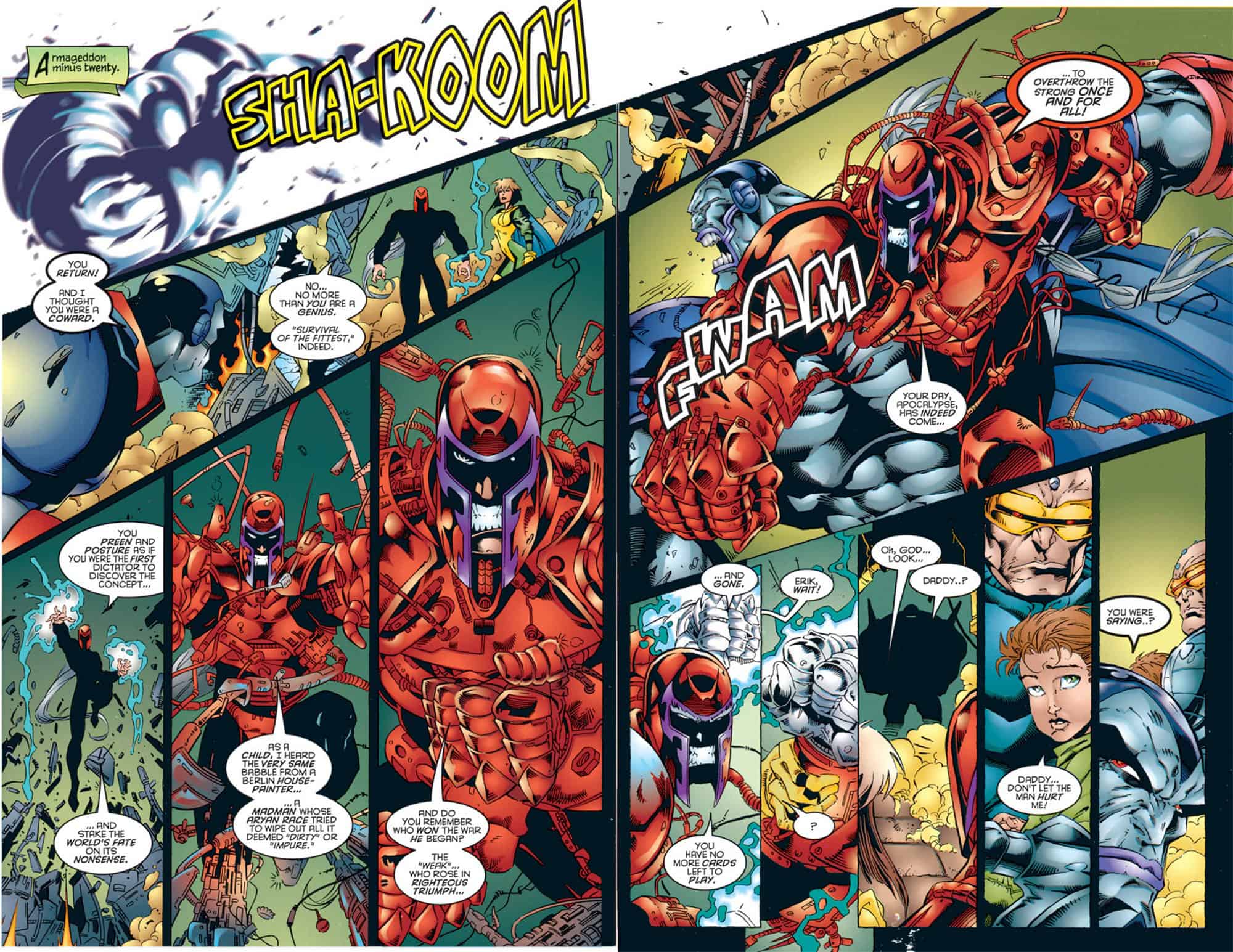
Plus, that makeshift armor is pretty cool.
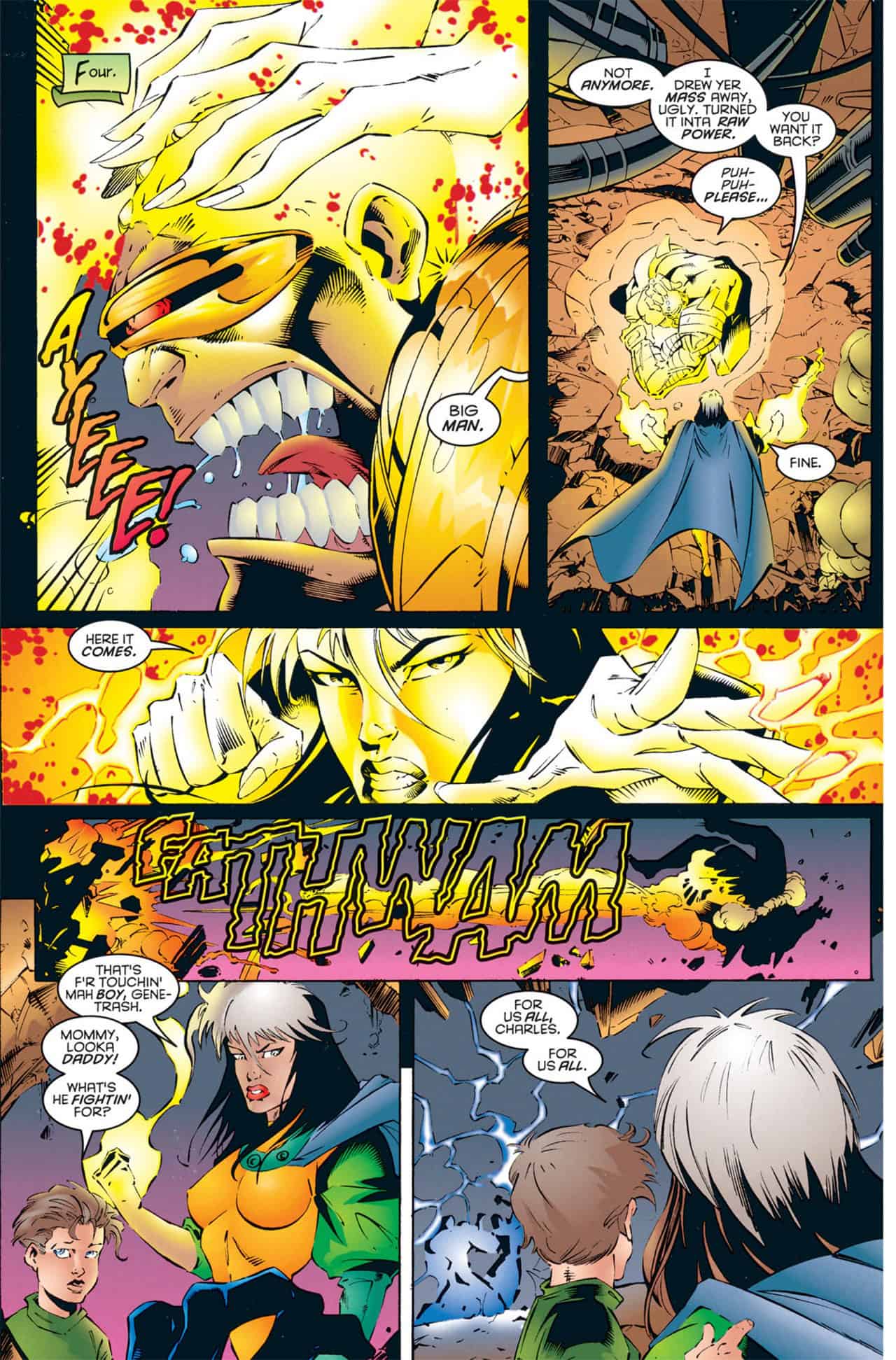
Also, hell hath no fury like a mother pissed off.

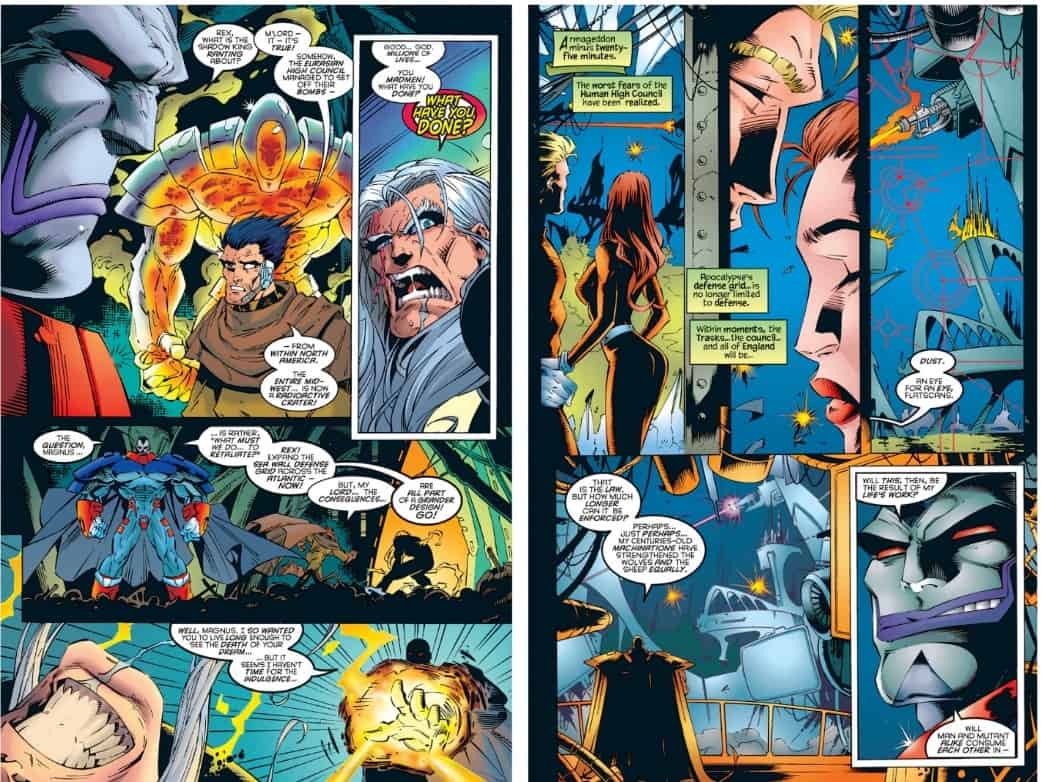
In the end, Apocalypse talks a good game…
But he is perfectly happy to get out of dodge when his Darwinian ideas came home to roost:
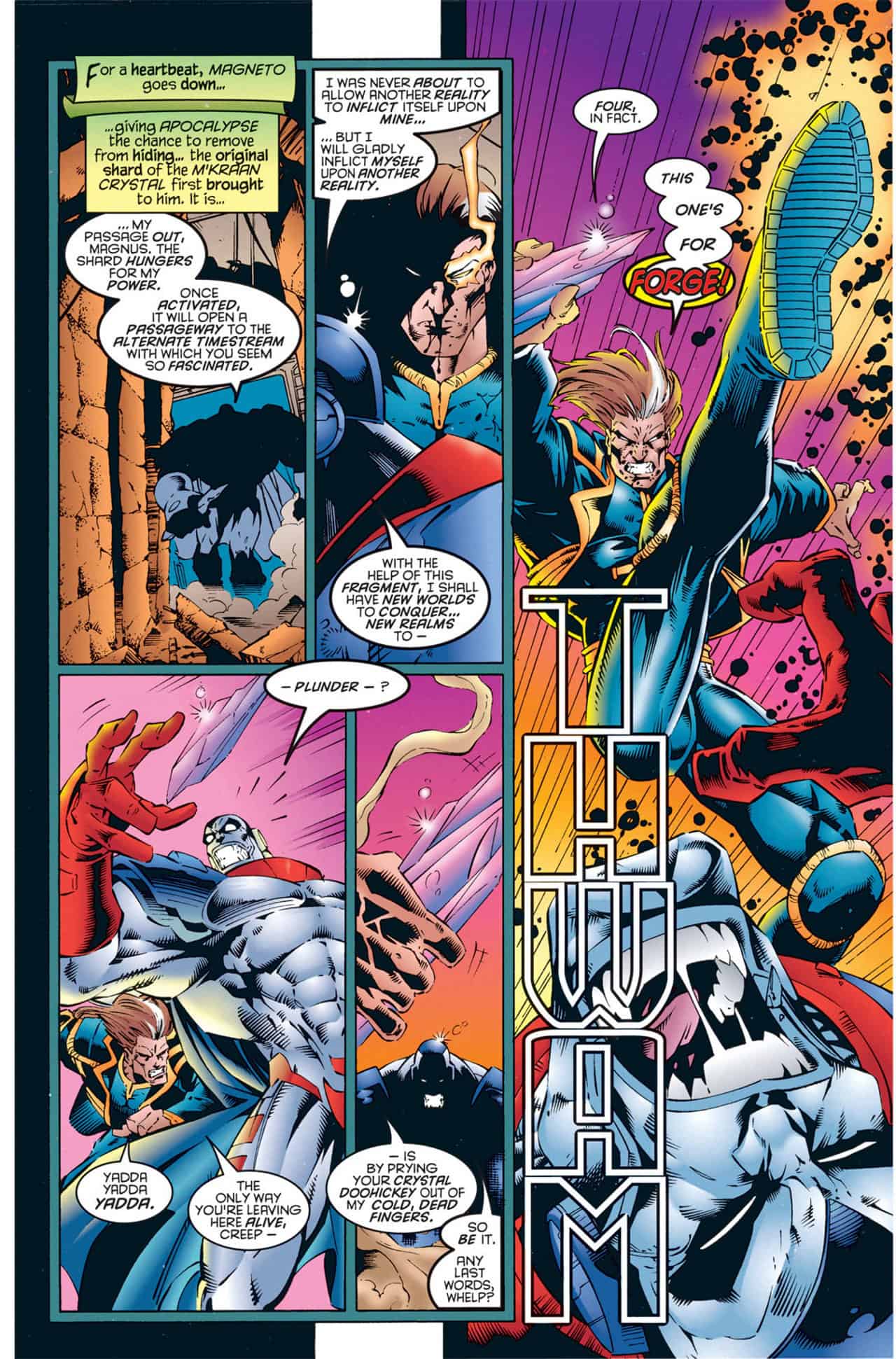

Ultimately, though, in a show of power that somehow is never brought to bear against Apocalypse in the original timeline, he turns out to be unfit.
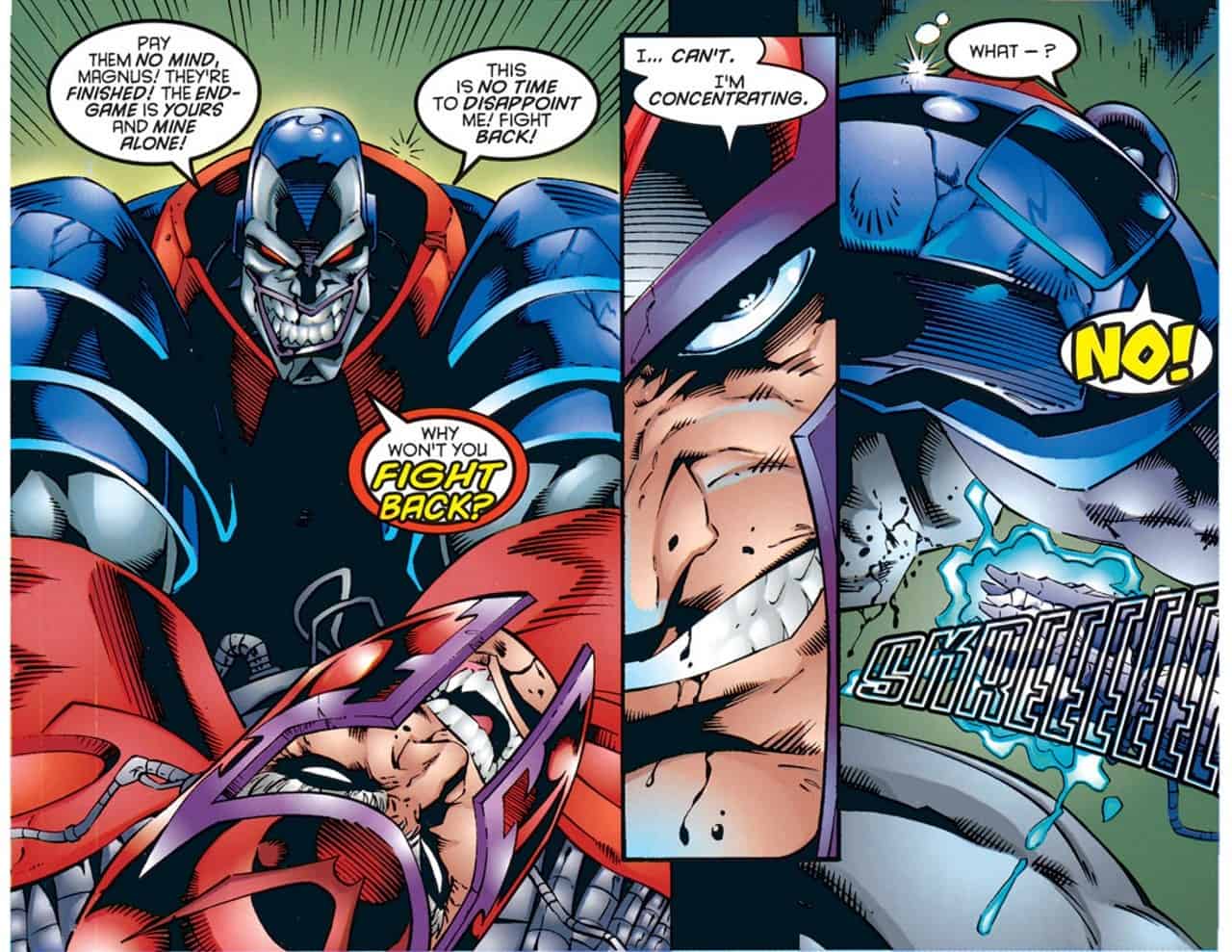

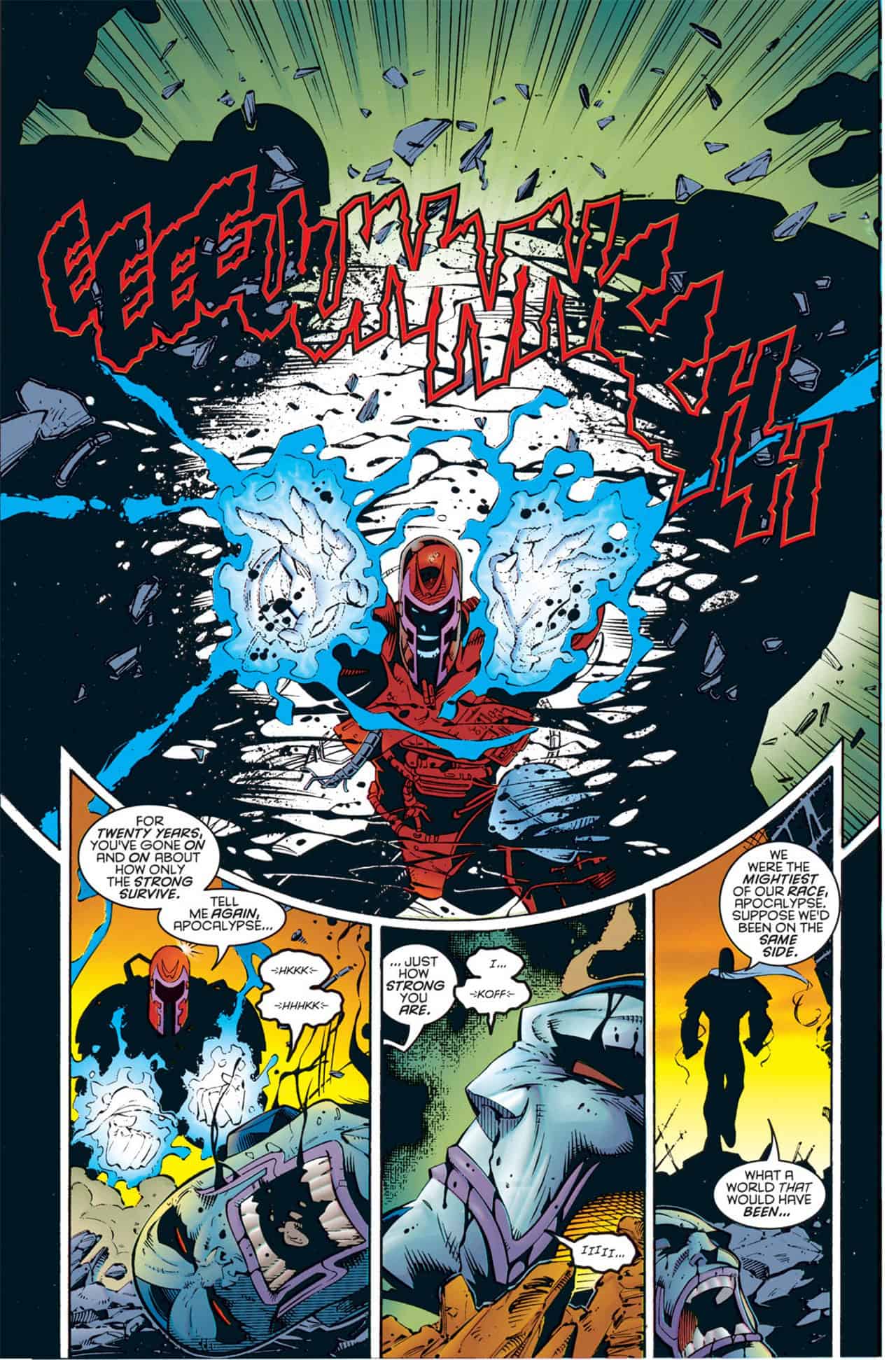
X-Men Omega is constructed in an interesting way. Bishop changing the past is the main goal, but it’s arguable whether that is actually the A story. The fight against Apocalypse is by far the bigger spectacle. It’s a coin flip over which story is ultimately the more emotionally powerful. What’s most telling, though, is that X-Men Omega does not end with Bishop fixing the past. Apocalypse isn’t killed until three pages later (during which the very important plot point of Nate Grey stabbing Holocaust with the crystal shard happens). And then the issue continues for another two pages after that. Bishop wiped the Age of Apocalypse timeline out of existence, but it’s the death of Apocalypse and the nuclear armageddon that ends the issue and the event.
The M’Kraan Crystal stowaways were an interesting idea.
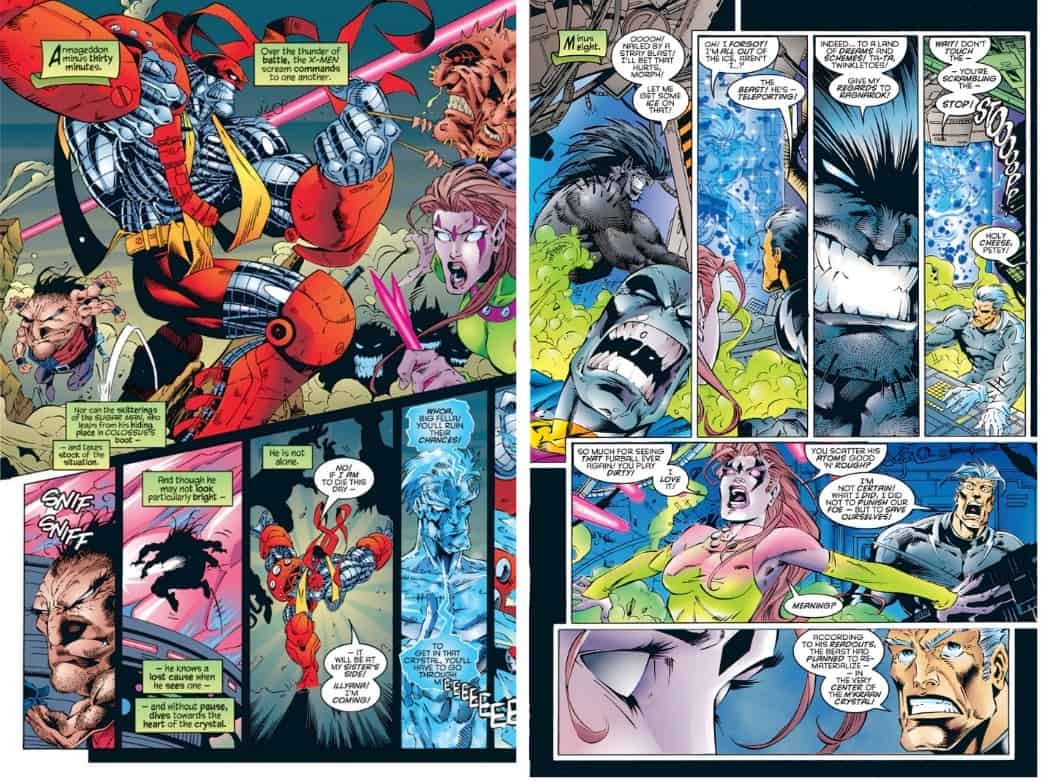
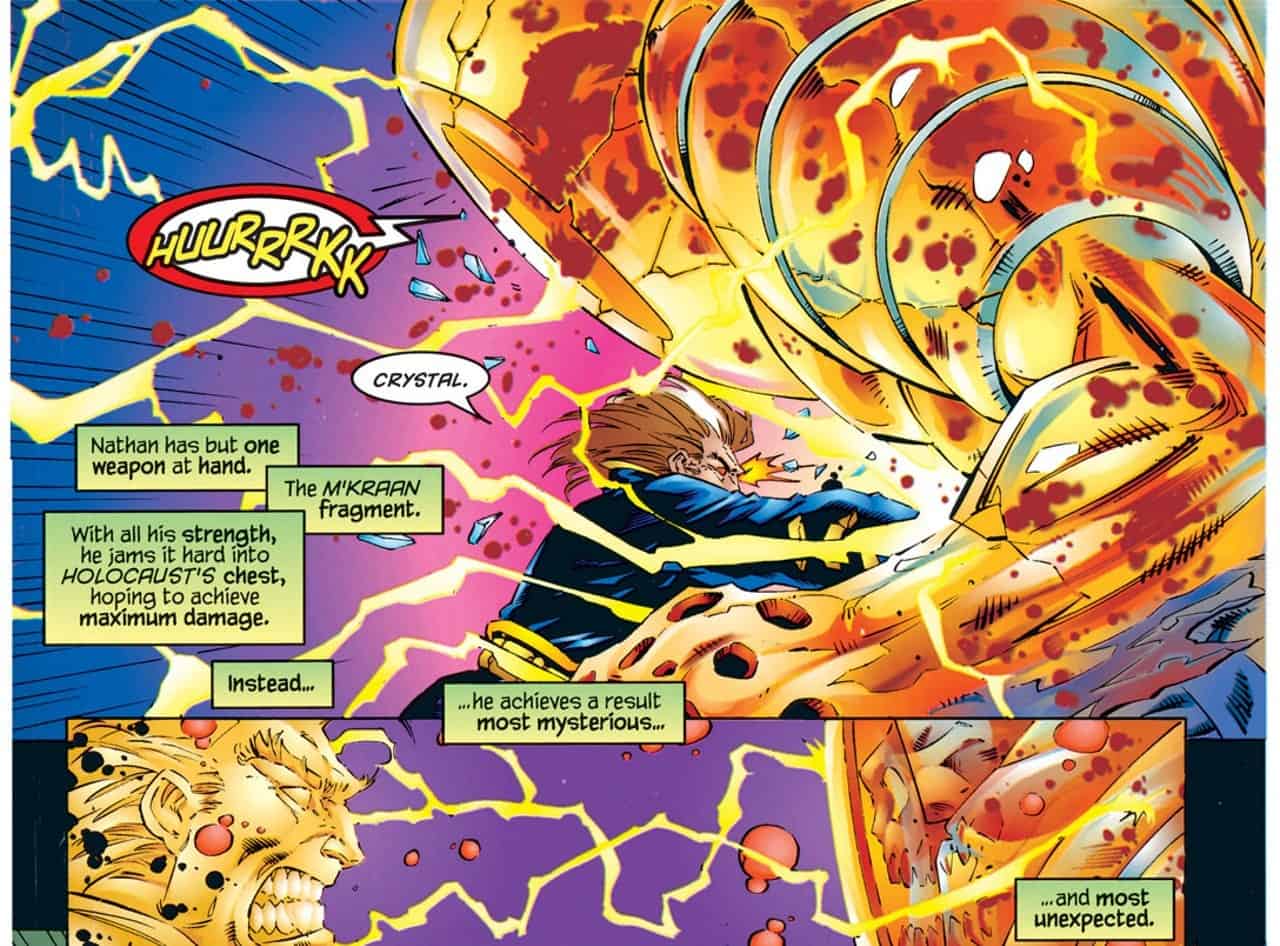

In the case of Nate Grey it was a success. The character was an angry, petulant brat for a while, but he had a successful series with some interesting ideas. The villains were less successful. McCoy and Sugar Man were part of very unnecessary retcons involving the Morlocks and Genosha mutates respectively. Sugar Man doesn’t do much of consequence, even in his early appearances. He eventually hops between the 616 universe and the Age of Apocalypse. He basically becomes a bad penny that just keeps turning up. Holocaust was introduced in a very exciting two part story that saw the destruction of Magneto’s Avalon space station. Shortly after he fell in with Onslaught. Holocaust wasn’t much of a concern after that, ultimately ending up with the Exiles during which time he was killed. McCoy has been the best used of the villains. He initially participated in the lead up to Onslaught before working for the titular villain. Following that he became a major antagonist in X-Factor. He popped up in several Marvel events, with a brief stint back in the Age of Apocalypse along the way.
Bishop’s return to the past in his quest to prevent Legion from killing his father takes place over only a few pages. It happens fast, ultimately wrapping up before the final moments of the Age of Apocalypse are depicted. Legion is seemingly killed in the process.
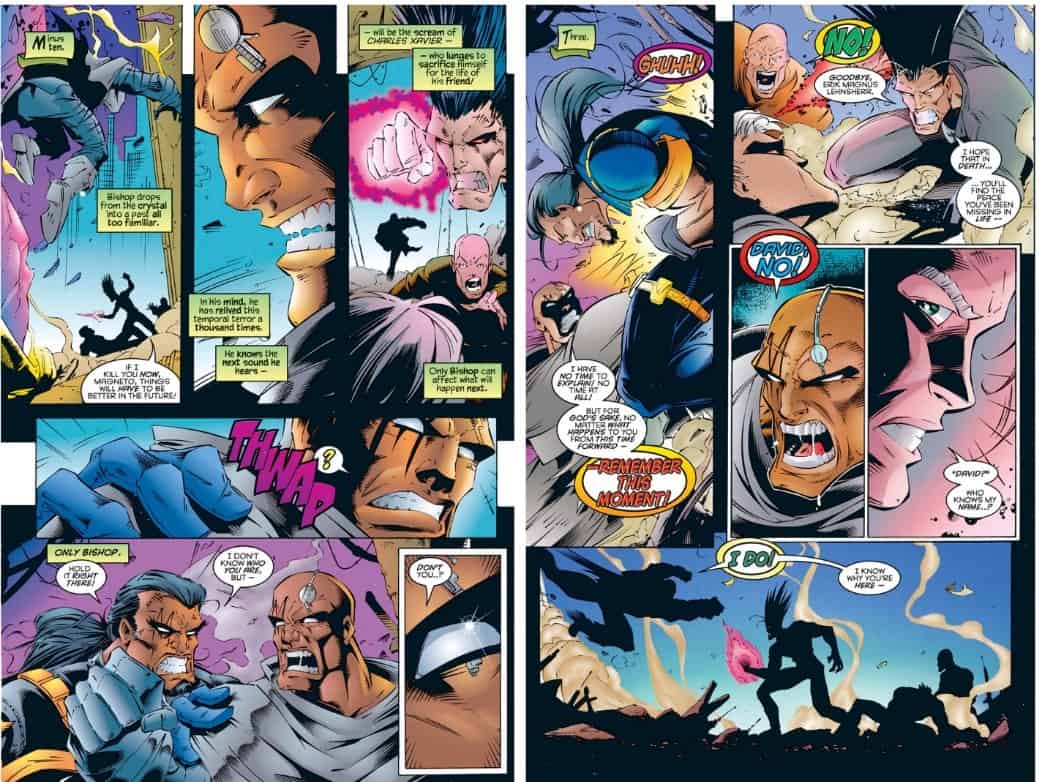
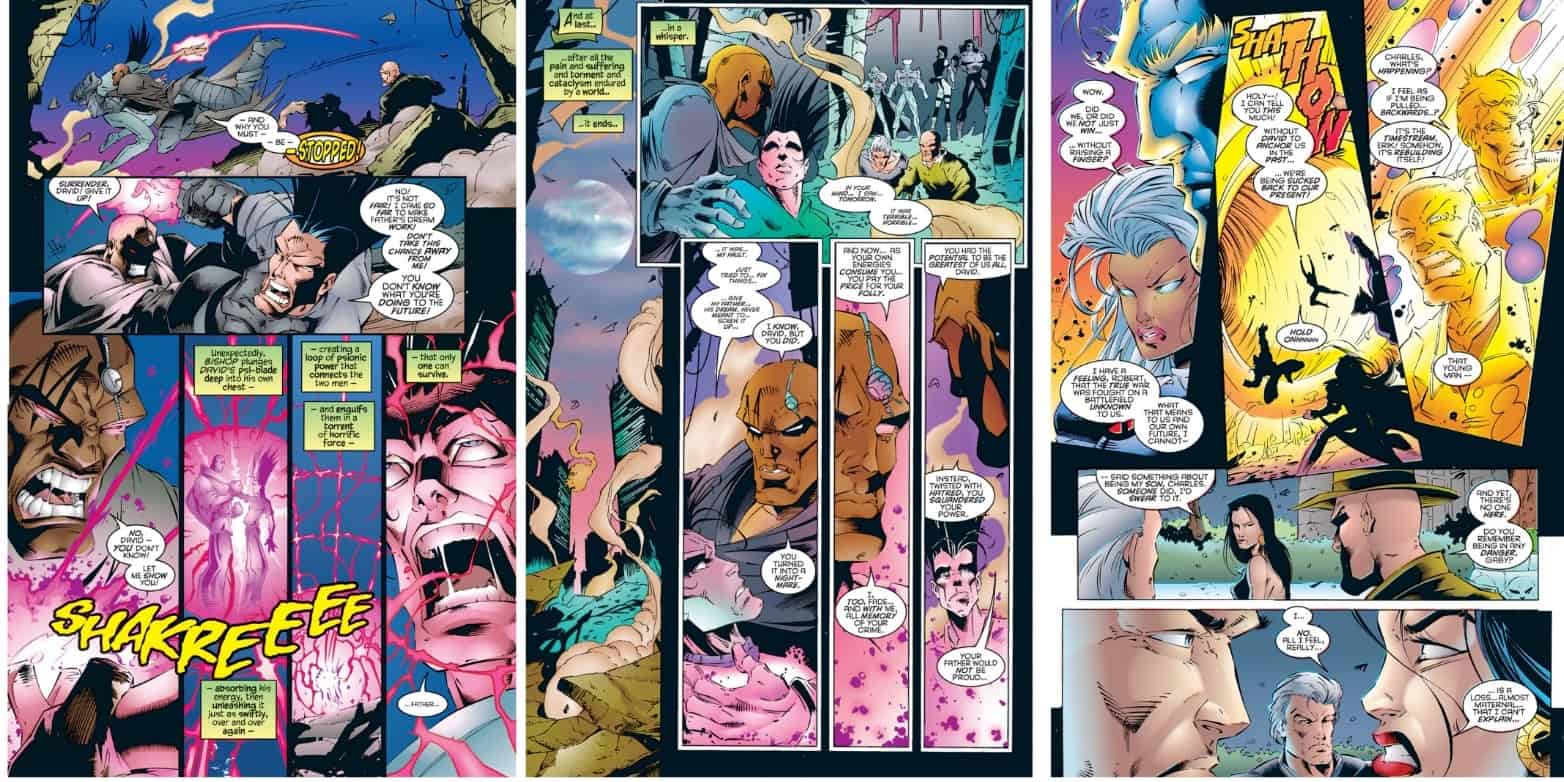
Legion’s death is ultimately tragic. His actions created a truly horrible timeline and nearly ended all of existence in the process. But certainly that was never his intention. Yes, what he did was terribly misguided. But as discussed in the Legion Quest entry, it was an attempt to please a father who really never had much time for him. The character comes to a very bad end, and for better or worse, his father doesn’t even know what he tried to do.
Age of Apocalypse remains the gold standard against which I measure every comic book crossover and event I read. Few of them approach its heights in my opinion. To start with, it’s incredibly accessible. Strictly speaking, it’s even possible to skip Legion Quest because Bishop delivers the absolutely necessary backstory in X-Men Alpha. Further, M’Kraan Crystal stowaways notwithstanding, it’s not designed to kick off the build-up for a following event. Age of Apocalypse is completely self-contained. Indeed, once it’s concluded, no one remembers anything about it.
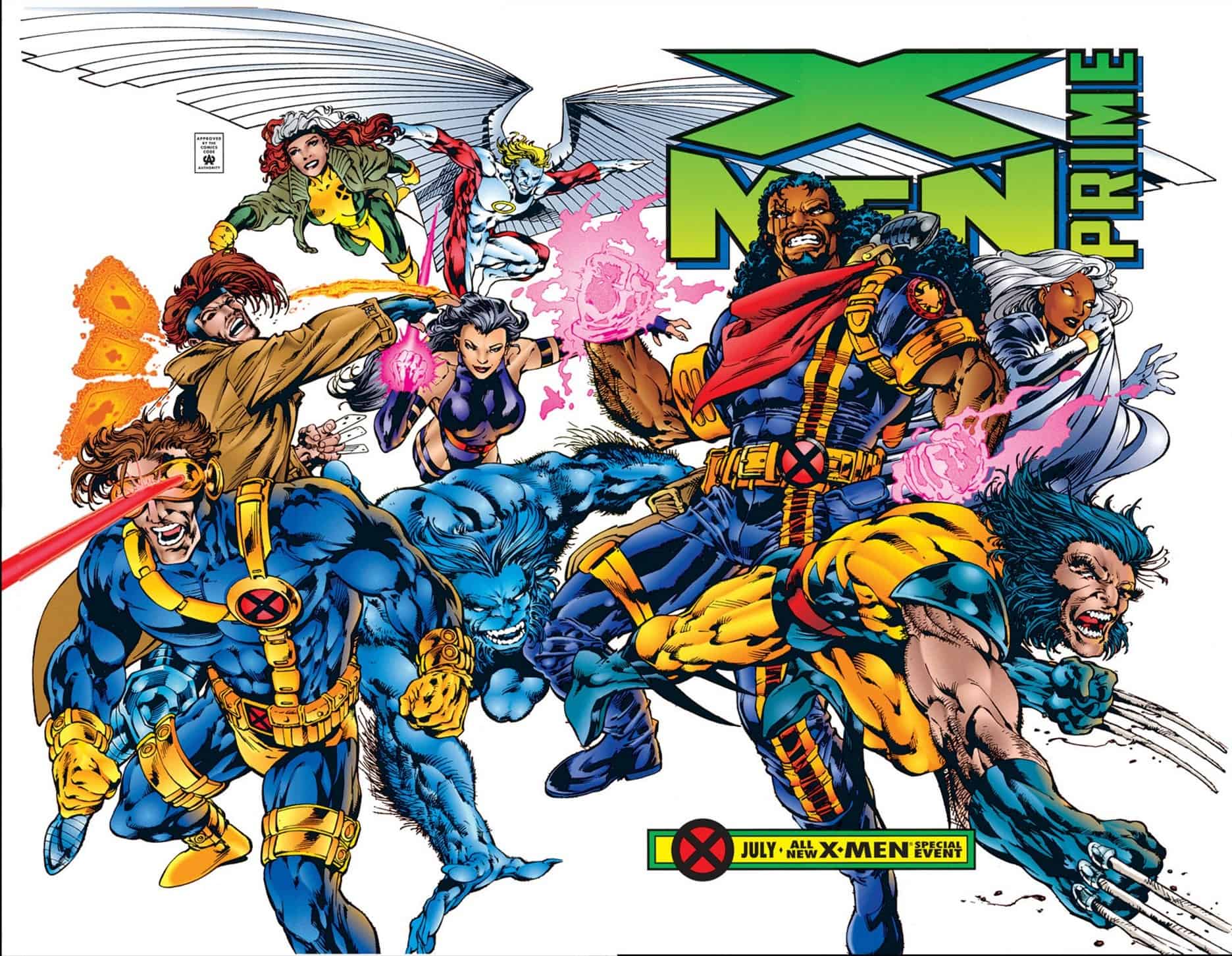

Next, no alternate timeline story has ever matched it in my eyes. The writers did an excellent job extrapolating and justifying many of the changes, most importantly, the major divergences that allowed Apocalypse to rise to power in the first place. Contrast this with Flashpoint, probably the only alternate universe to rival Age of Apocalypse in size–indeed, in terms of series that are involved, it far outstrips it.
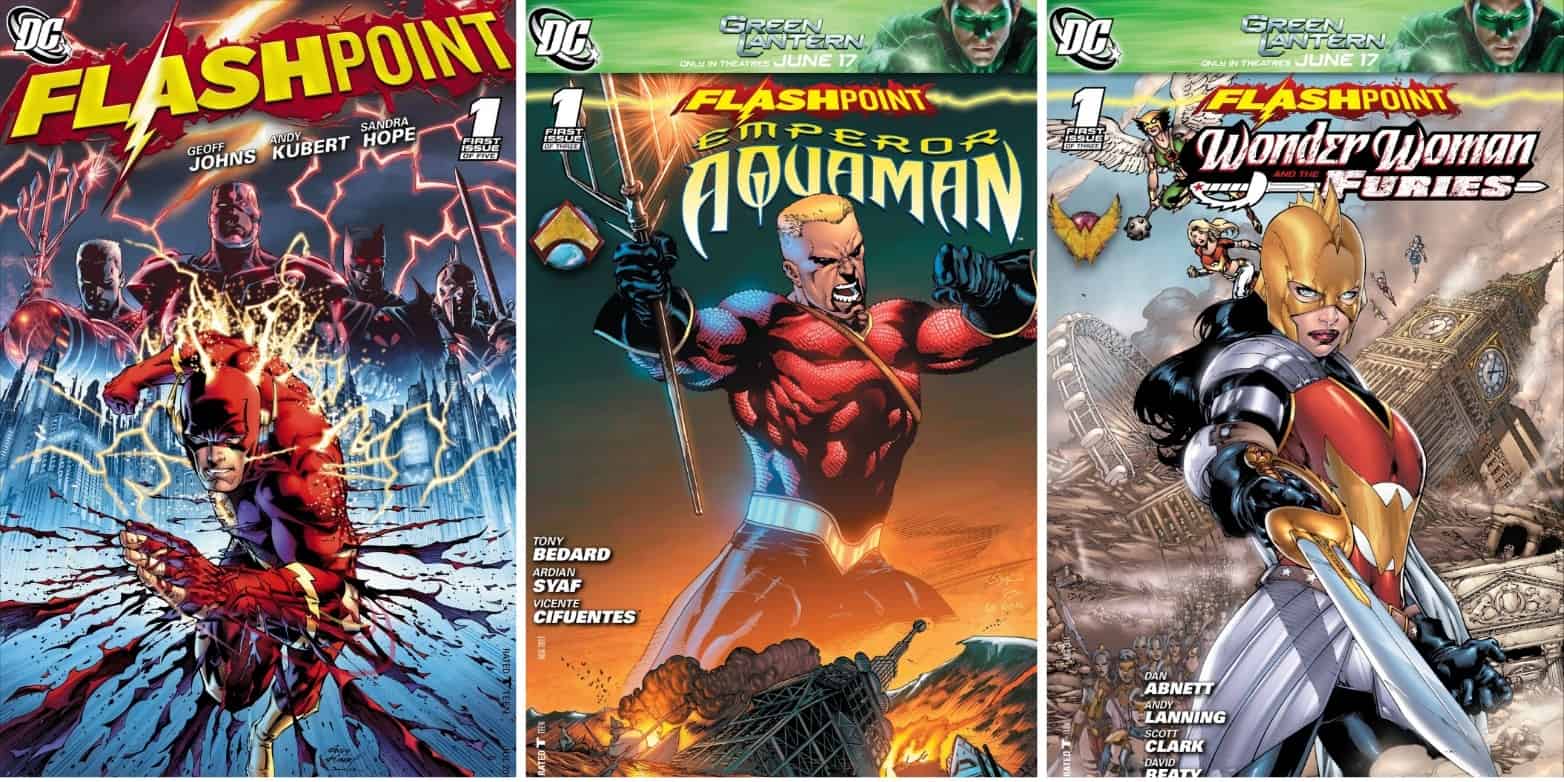
Flashpoint’s writers make no attempt to explain how Barry’s mother being alive could change the world in the way that it does. Trying to justify it in a “head cannon” sense defies logic. That is not the case here.
My appreciation for Age of Apocalypse goes far beyond its accessibility and strength as an alternate universe story, though. None of the series are filler, merely existing to exist. Regardless of my views on what is essential and what isn’t when it comes to understanding the storylines, there are quality, consequential storylines in all of them. They also cover a lot of ground quickly. There is very little wasted space in any of the issues.
The only real offender when it comes to uneven storytelling and bad use of space is Generation Next, but even that series delivers a very strong character arc in Colossus. That’s another area where Age of Apocalypse succeeds–character development. We learn a surprising amount about all of the main characters in a very short period of time. The writers squeeze a surprising amount of backstory into series that are concerned largely with very urgent, quickly advancing plots. Nate Grey, Jean, Gambit, Guido, and Colossus–just to name a few–get fully realized, very satisfying character arcs.
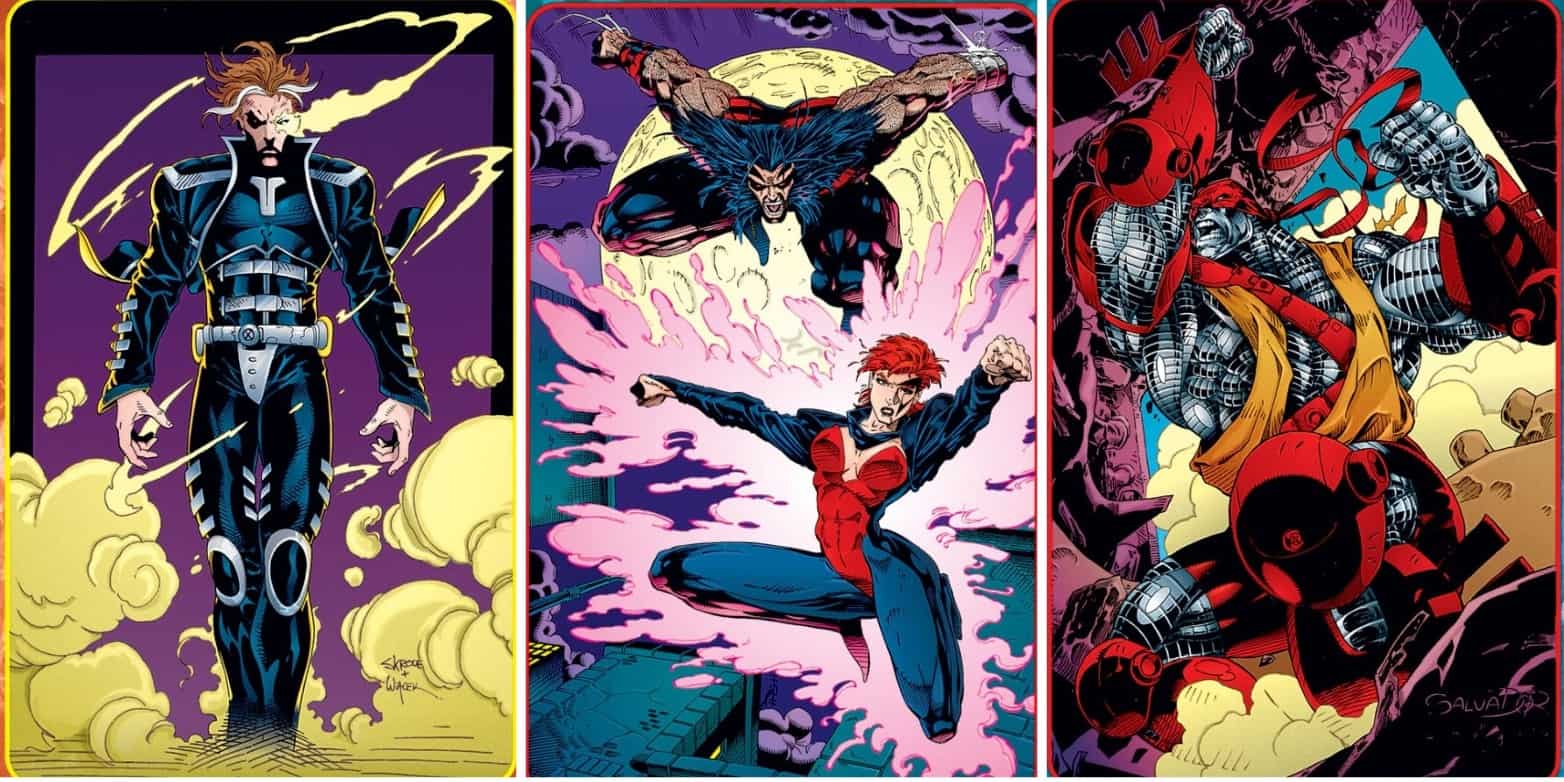
Visually, the entire event is stunning. In my opinion, the weakest art is in X-Men Chronicles #1, but even there we’re getting very expressive characters–something especially critical given Wanda’s death and its brief aftermath.
But for the most part, every issue delivers dynamic action and rich, emotional characters. In some cases we even see hints of how artists’ styles will evolve over the next few years, most noticeably in the cases of Madureira, Skroce, and Bachalo.
This series of articles, incredibly late though they have been, is probably the most I have ever discussed Age of Apocalypse. I revisit the event probably once a year, and I always enjoy it. This contrasts with the assorted spin-offs which I’ve checked out here and there but have never found particularly compelling. Age of Apocalypse has a clear beginning and ending with a lot of rich and affecting storytelling along the way. I’m fine leaving it at that.