Theron Couch
The 30th anniversary look at Age of Apocalypse continues (even if it’s now technically 31)…
 These five issues are the least consequential of all Age of Apocalypse entries. None of them connect to the modern day storylines.
X-Men Unlimited became X-Men Chronicles for the duration of Age of Apocalypse. It remained an oversize book with a bi-monthly schedule during the event. The series depicted events from the past, adding context and answering some questions raised in the various main series. In a chronological reading, both issues of X-Men Chronicles come before X-Men Alpha.
X-Universe is a mini-series that checks in with a variety of Age of Apocalypse versions of human characters. It’s a completely isolated story. In a chronological reading, it is best read after the set of #3s and before the set of #4s.
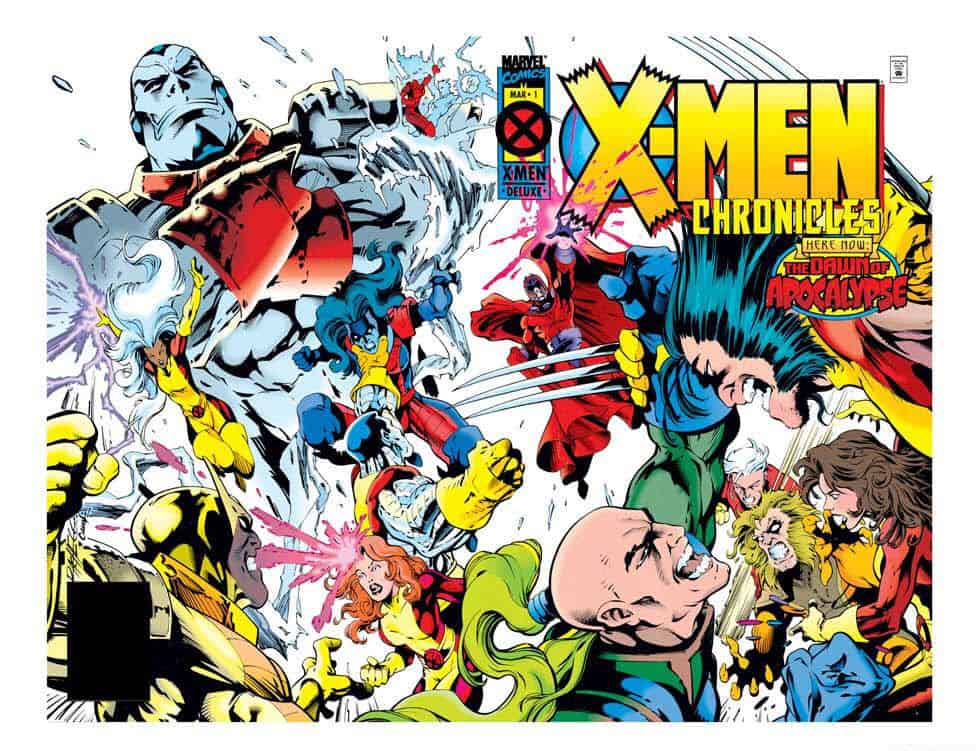 X-Men Chronicles #1
W: Howard Mackie | P: Terry Dodson | I: Klaus Janson | C: Matt Webb | L: Richard Starkings & Comicraft
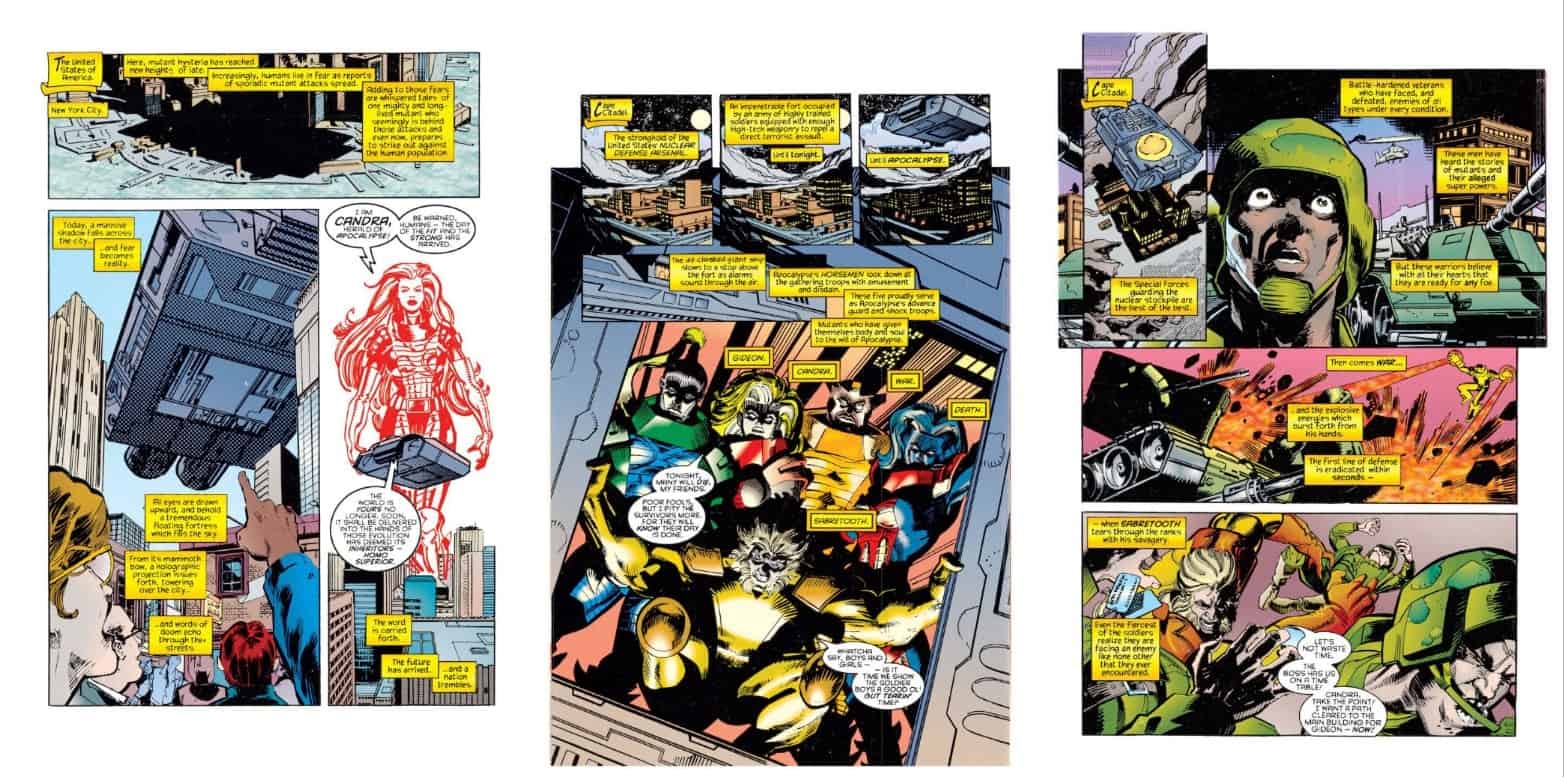
Years after Charles Xavier sacrificed himself to save Erik Lehnsherr, fear and hatred of mutants has begun to turn into hysteria. Erik, now calling himself Magneto, has gathered a group of mutants at an isolated base at Wundagore Mountain. Calling them X-Men, Magneto trains them in the use of their powers with the hope that they can help protect mutants from those who would destroy them and the wider world from mutants like Apocalypse. During a training session in the base’s Killing Zone, Magneto introduces the newest team member: a ferocious mutant named Logan. Following the training session, Magneto meets with Mystique who has brought a young woman named Rogue to be taught by Magneto to better use her powers. Meanwhile in North America, Apocalypse’s ship descends over New York City and his horseman Candra announces the end of human domination of the planet.
Apocalypse’s first target is the nuclear arsenal at Cape Citadel. Apocalypse dispatches Gideon, Candra, War, Death, and Sabretooth to seize control of the base and launch the missiles. Back at Wundagore, Magneto gathers the X-Men for their first mission. He leaves his daughter Wanda in charge at the base and the younger mutants in his charge including Rogue. The X-Men attack Apocalypse’s horseman at Cape Citadel. The X-Men prevail at Cape Citadel, and Apocalypse’s forces leave Cape Citadel, a defeated Sabretooth getting left behind. Meanwhile, Wundagore Mountain is attacked by another of Apocalypse’s horsemen: Nemesis. Rogue and Wanda fight back, eventually driving Nemesis off. Unfortunately the pitched battle results in Wanda’s death. By the time Magneto and the team return, she is already gone.
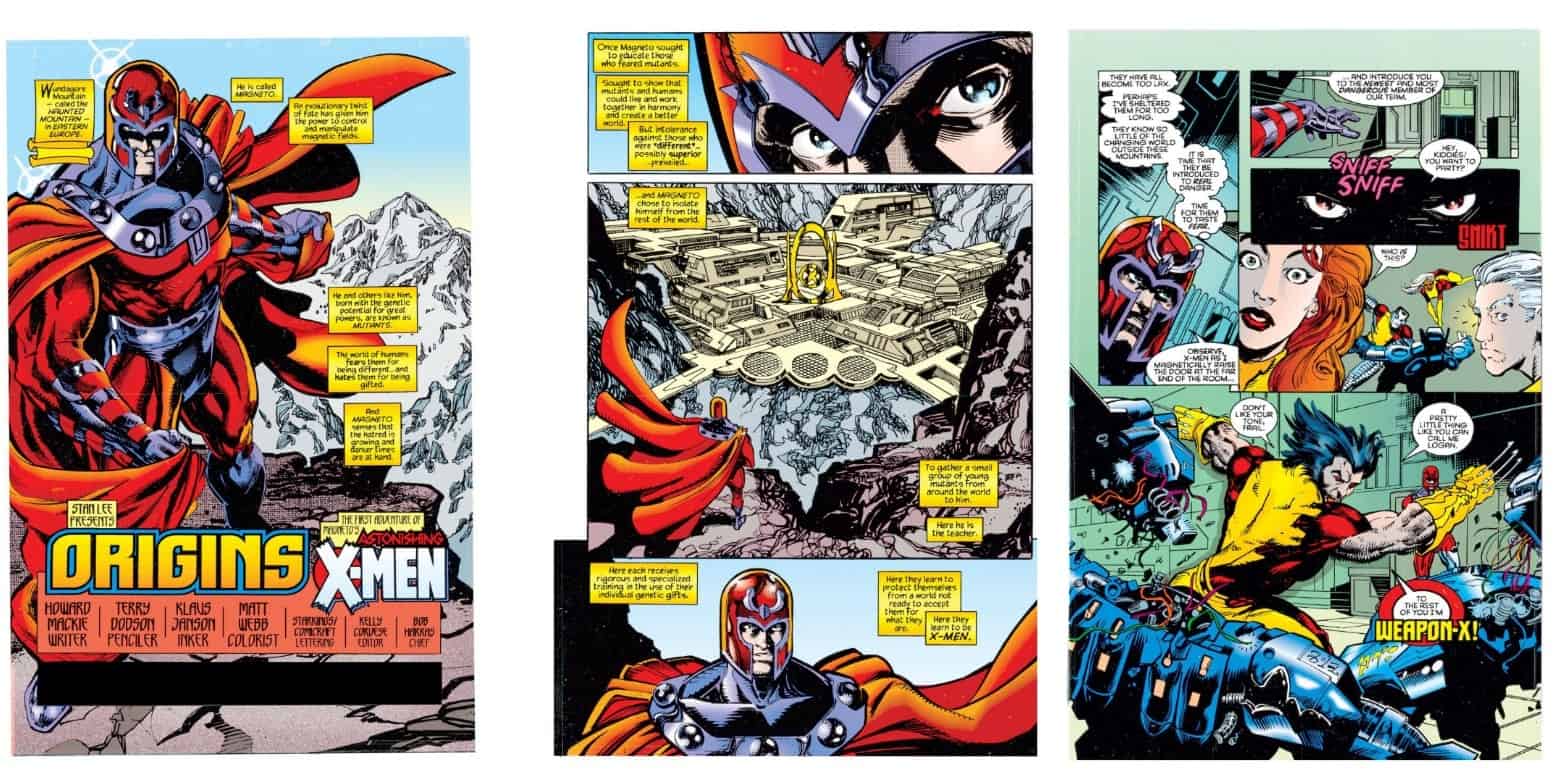
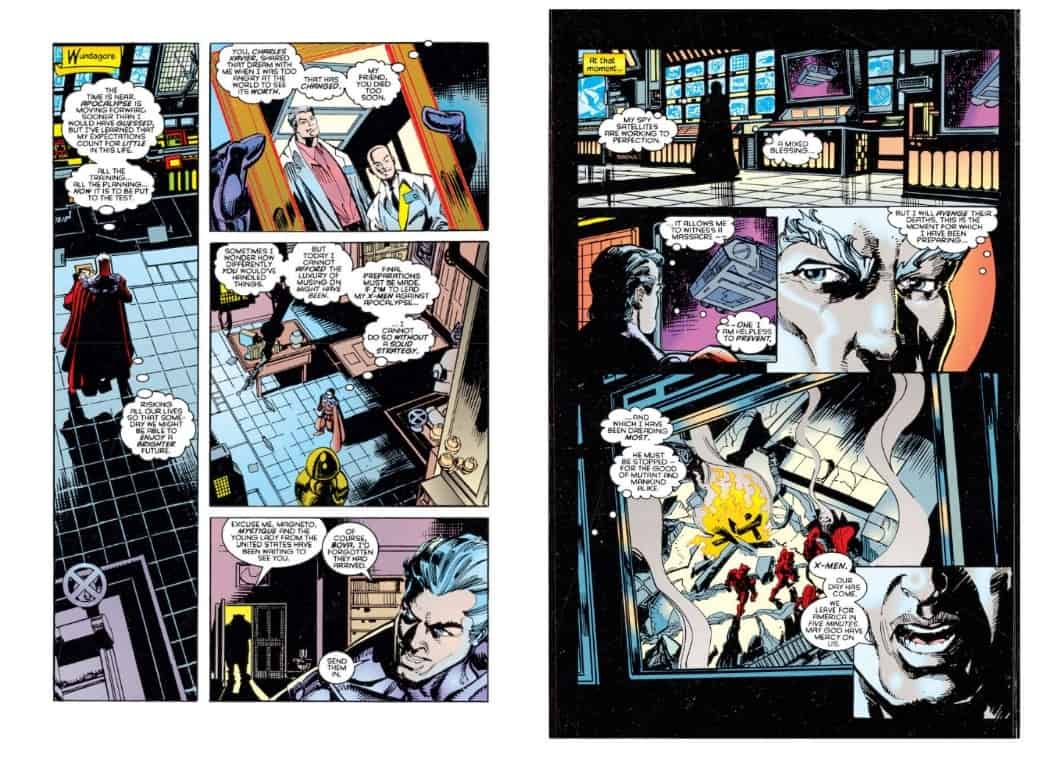 X-Men Chronicles #1 doesn’t entirely answer the question of how Apocalypse took over North America, but it certainly puts forth some possibilities. Magneto chose to shelter the X-Men in Wundagore to the point that few of them were aware of what was going on in the outside world. The lack of a good mutant team out in the world, combined with the decision of Apocalypse to move early as a result of seeing the battle with Legion in the past, almost certainly contributed. Magneto was already aware of Apocalypse but was doing nothing to preemptively intervene. He may have become a strong leader and effective strategist in the future, but in the beginning he committed a major blunder.
The choice to have Cape Citadel be the first place Apocalypse’s forces attack creates a nice bit of symmetry with Magneto’s first attack in X-Men #1.
 Mackie spends very little time on the fight between Wanda and Rogue and Nemesis. Wanda enters the fight, appearing for two panels, and then the next time she’s seen she is dying. Were Wanda’s injuries so bad because she was somehow left alone? Did Nemesis try to attack the younger mutants and Wanda stood her ground against that? Knowing more about how Wanda died could have informed the response of other characters–especially when she asks Rogue to be a friend to Magneto.
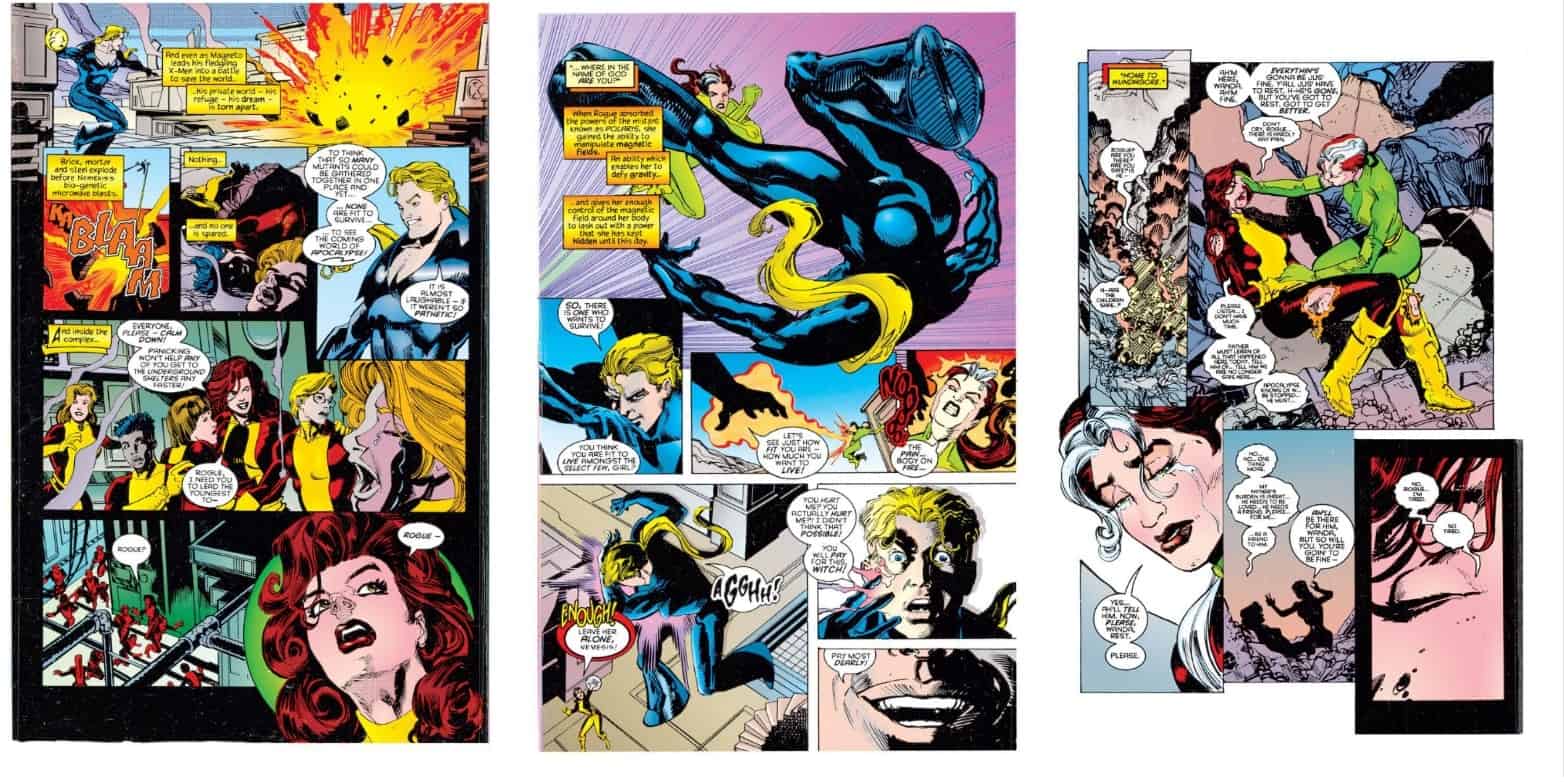 Wanda’s death is an often brought up touchstone in other Age of Apocalypse issues. Indeed, it plays a key role in the major emotional arc in the next issue. Between this and very little time spent with her before the X-men depart for Cape Citadel, there isn’t much material for Wanda. The reader doesn’t get to know her very well.
The little bit of the fight at Wundagore is the least of the action in X-Men Chronicles #1. Cape Citadel is almost a nonstop battle once the X-Men arrive. Dodson’s work on these action sequences is good enough. By far the best action features Logan and the best of that is the one on one fight between Logan and Sabretooth. There are no energy blasts and other such uses of powers. The result is more dynamic poses for the characters.
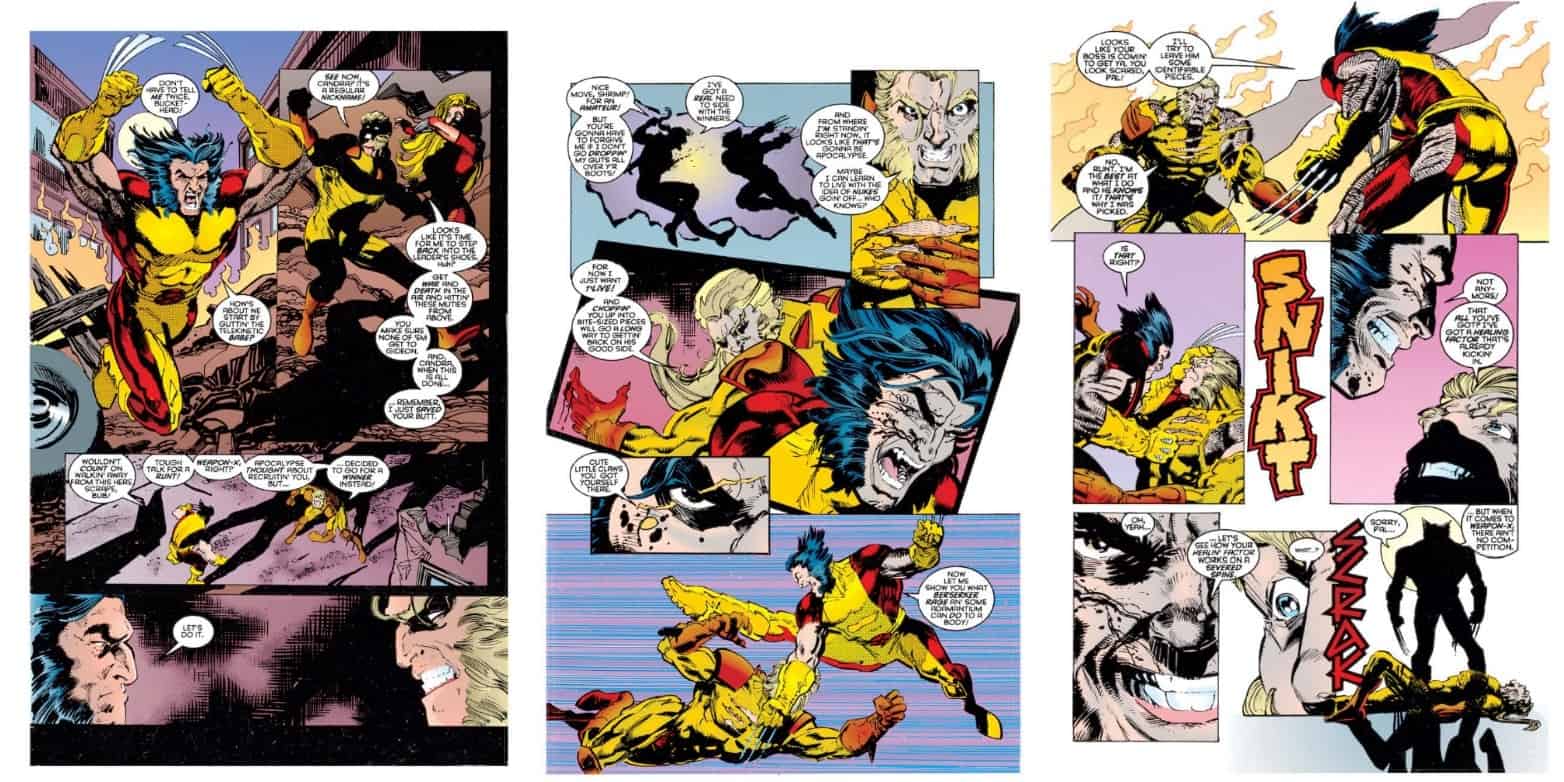 Dodson is more successful with character expressions in non-action sequences. They don’t always have the greatest range, but there is a sense of emotion most of the time.
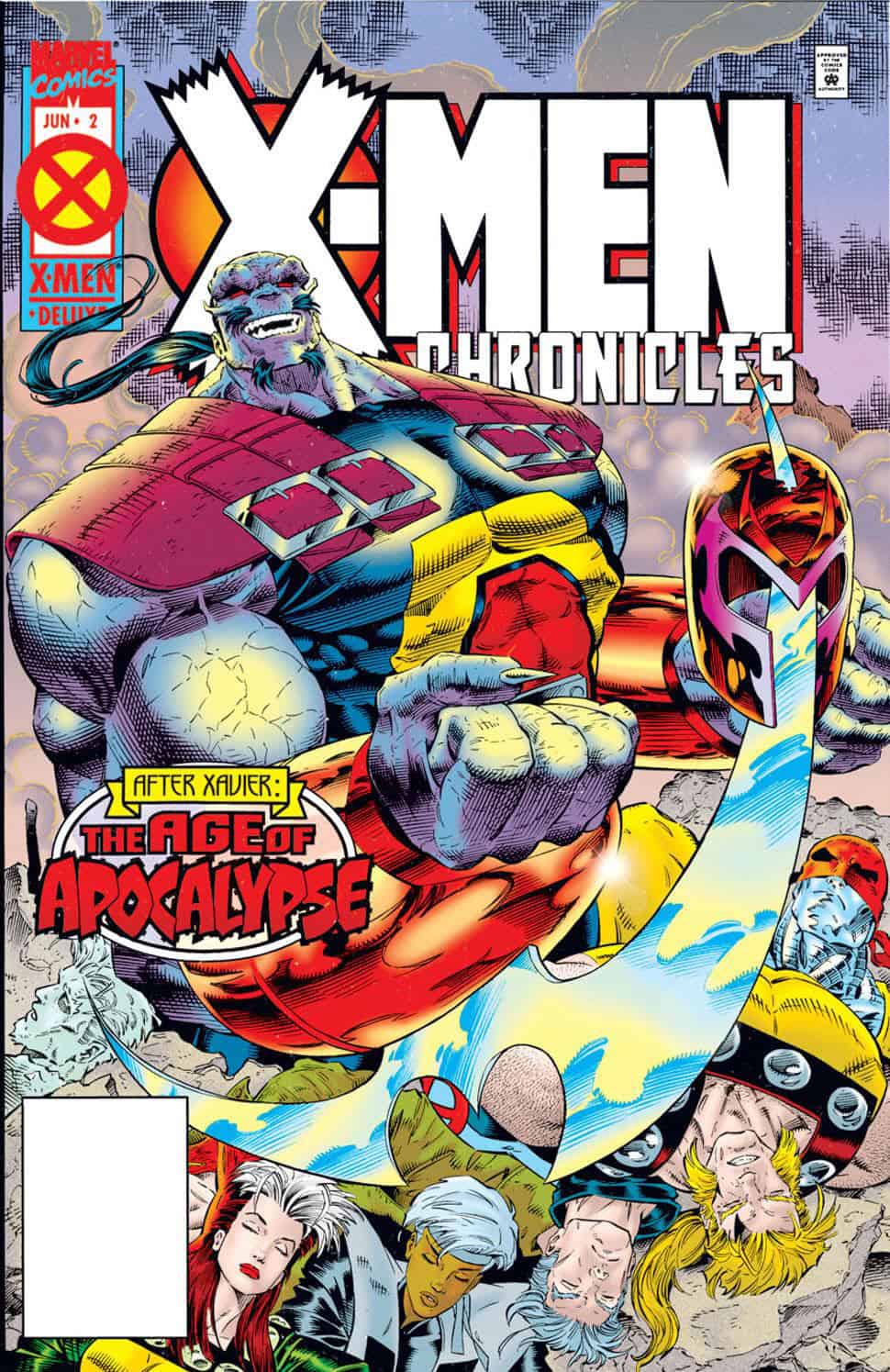 X-Men Chronicles #2
W: Howard Mackie | P: Ian Churchill | I: Scott Hanna, Al Vey, Bob Wiacek & Steve Moncuse | C: Matt Webb & Digital Chameleon | L: Richard Starkings & Comicraft
Logan is brandishing his claws at Magneto as X-Men Chronicles #2 begins. He recently returned from rescuing Jean Grey from Sinister’s pens. In the process, Logan lost his hand. Furious that Magneto wouldn’t act to save Jean, Logan has decided to leave the X-Men. Jean goes with him. Meanwhile in Spokane, Washington, Holocaust is leading a culling. Alongside him is the ferocious Wolverine, a mutant engineered by McCoy. Holocaust (previously Nemesis), still furious over the confrontation with Magneto that left him so grievously injured he now requires life support armor, sets Wolverine on the task of killing the person closest to Magneto. Holocaust assumes that it is his son, Quicksilver. Catching up with the X-Men in Denver, Wolverine uses his power to enhance and control humans to send a pair of them on a suicide mission so he can gather intel. He determines that the person closest to Magneto is not, in fact Quicksilver, but either Rogue or Magneto’s best friend, Gambit.
The relationship between those three is growing complicated, though. Gambit is in love with Rogue. Not only has he discussed that with Magneto, the two have also talked about the possibility of Rogue getting her powers under control enough to let her touch people. Rogue, however, is growing closer to Magneto. Gambit hasn’t caught on to that, but he has noticed Rogue acting strange around him. When Gambit does catch on, he attacks Magneto, furious over the perceived betrayal by his best friend. The disagreement is put on the back burner for the moment, and Rogue is not entirely sure what to do. Wolverine attacks shortly thereafter. Magneto is injured during the fight, and he and Gambit are cornered by Wolverine. Rogue flies down and retrieves Magneto, leaving Gambit alone and shortly after buried under a collapsed wall. The fight continues, but it is ultimately Gambit, after having dug himself out, who defeats Wolverine with a charged rock that explodes. Heartbroken, Gambit departs the X-Men immediately after.
A straight line runs from Wanda’s death in X-Men Chronicles #1 to Rogue and Magneto’s relationship in X-Men Chronicles #2. Readers don’t get to see the relationship between Rogue and Magneto develop over time, but Wanda did ask Rogue to be a friend to her father. Knowing that, the relationship between Rogue and Magneto takes on a different quality.
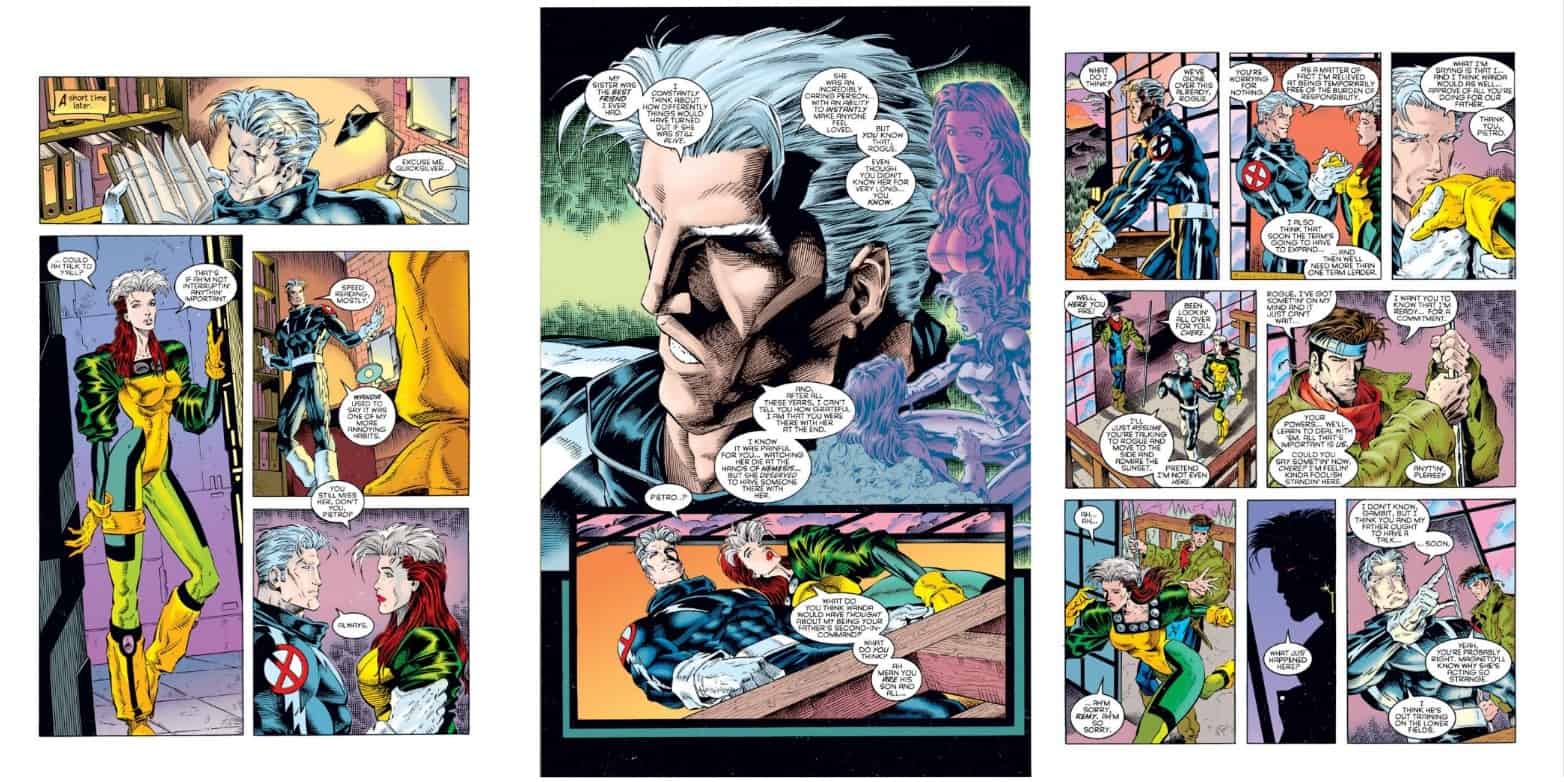 There is also a question of what Mackie and Lobdell intended with these relationships. Gambit and Rogue nearly share a kiss in Astonishing X-Men #1, and it comes across as something Rogue was completely on board with until they were interrupted by Blink.
This actually mirrors a love triangle (of sorts) that Lobdell eventually introduces in Uncanny X-Men. During Claremont’s run, a connection was established between Rogue and Magneto. Lobdell did something similar with Rogue and Joseph, playing up the love triangle aspect.
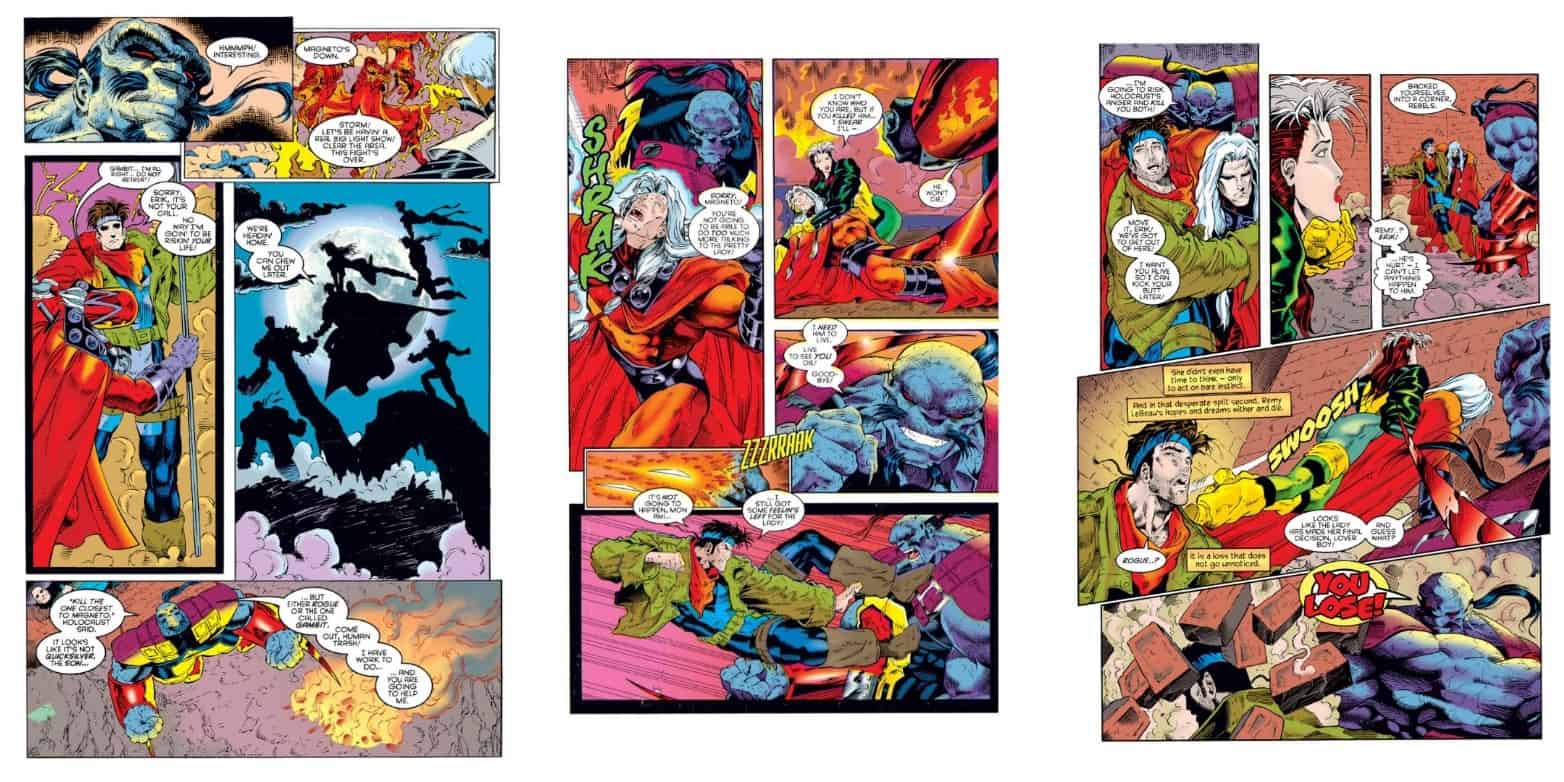 The encounter with Wolverine itself isn’t especially noteworthy in a plot sense. It certainly doesn’t have the import of the confrontation at Cape Citadel in X-Men Chronicles #1. To the extent that there is an overall Age of Apocalypse plot advancement, X-Men Chronicles #2 depicts a fracturing of the X-Men. This is primarily a character-centric outing. Wolverine’s attacks merely serve to push the character development of Rogue, Magneto, and Gambit forward.
And in both cases it happens as the result of love (or something like it).
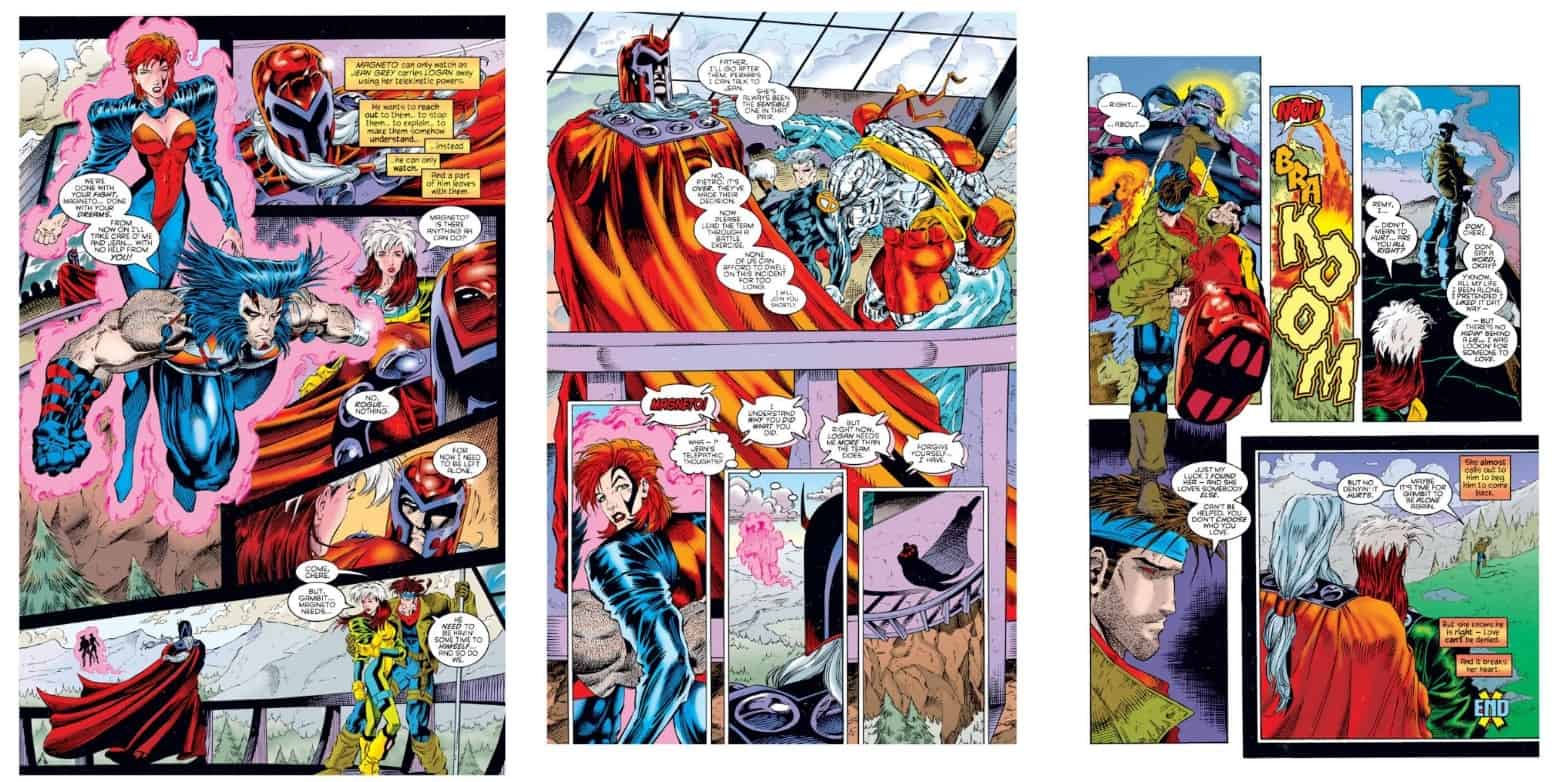 That said, Mackie seems to lean into the internal monologue Hama writes for Logan in Weapon X. Logan wonders if Jean actually loves him in that book. Certainly Jean isn’t gushing over Logan here.
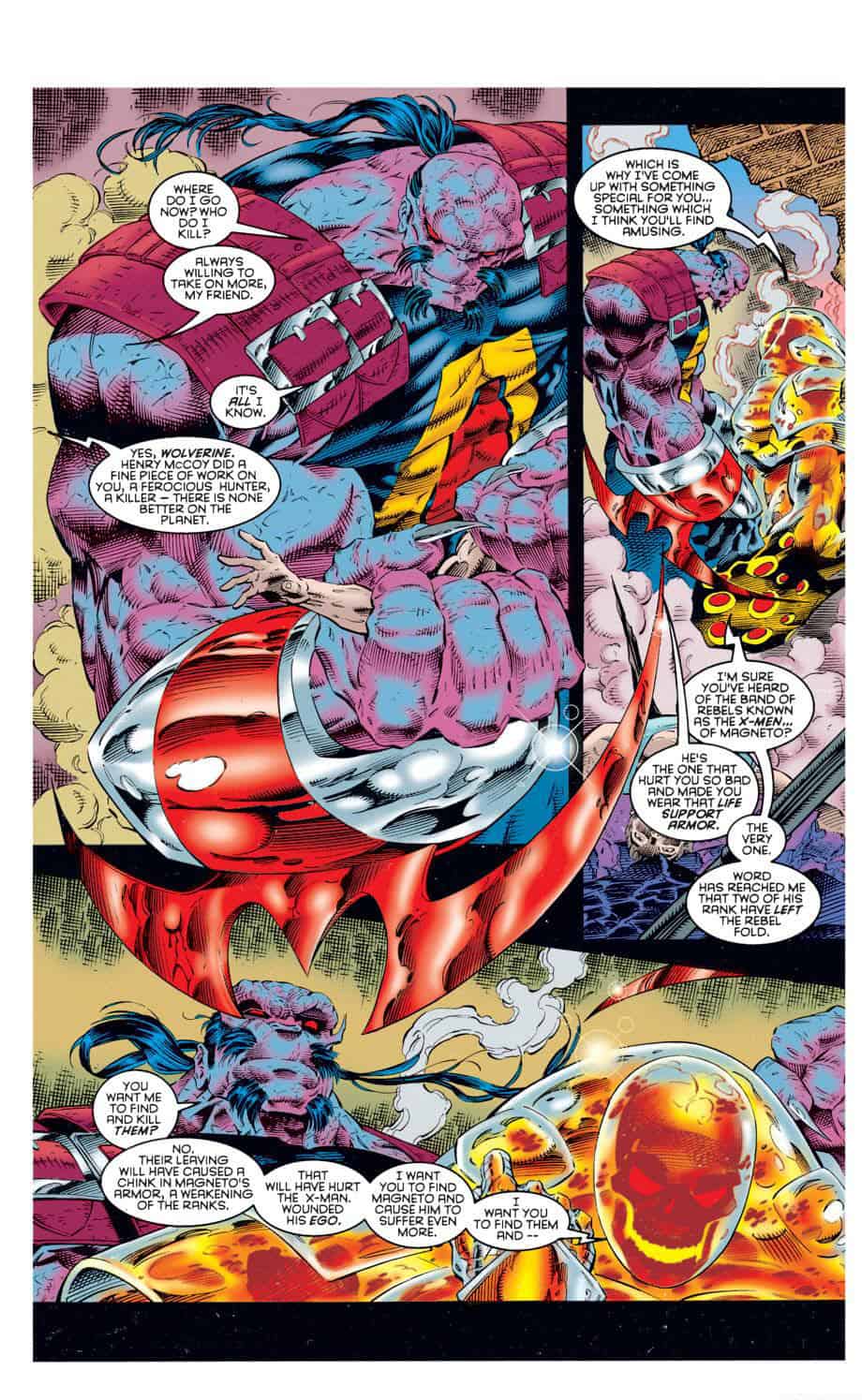 There is never an explanation for the injury that turned Nemesis into Holocaust.
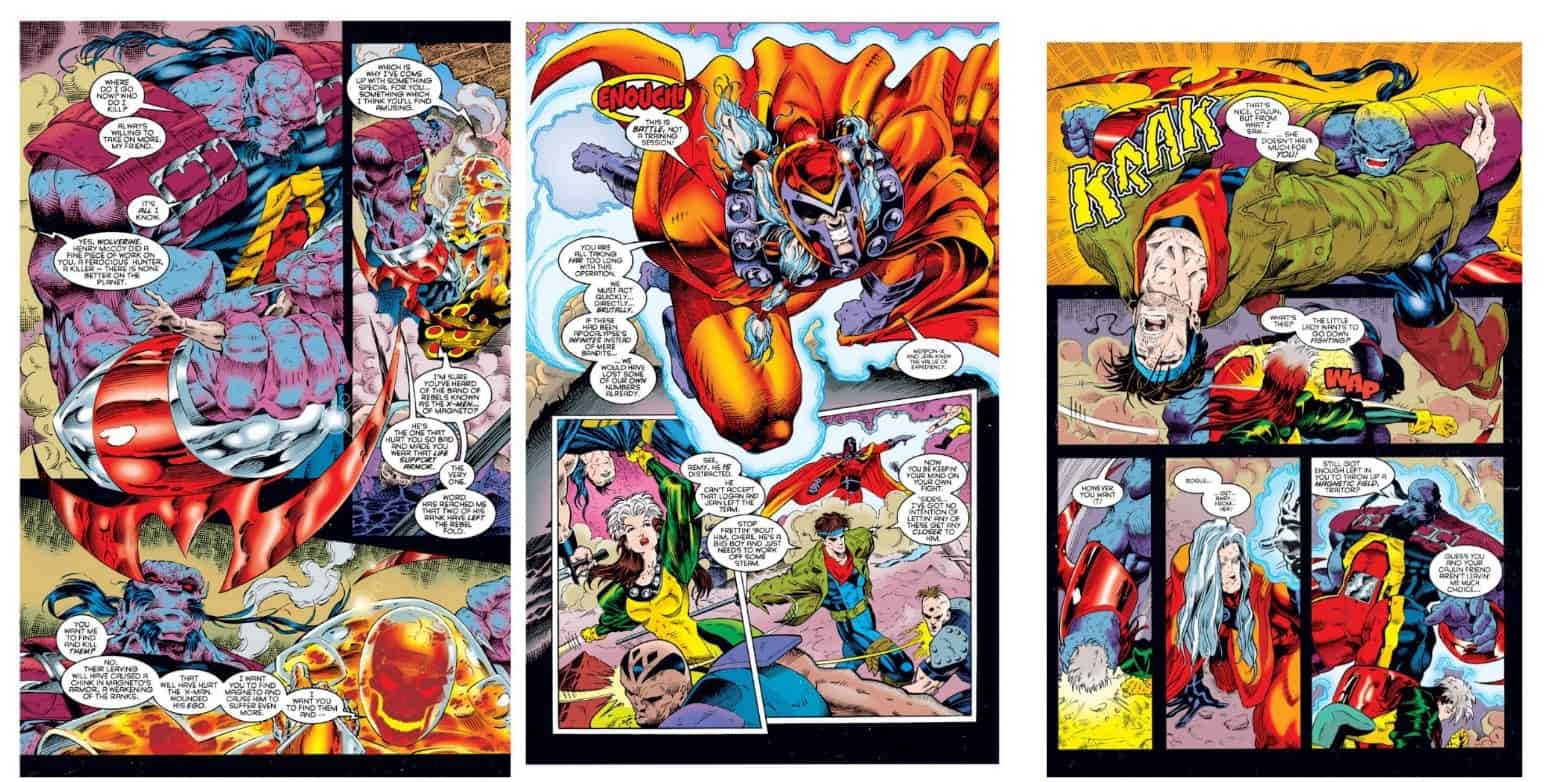
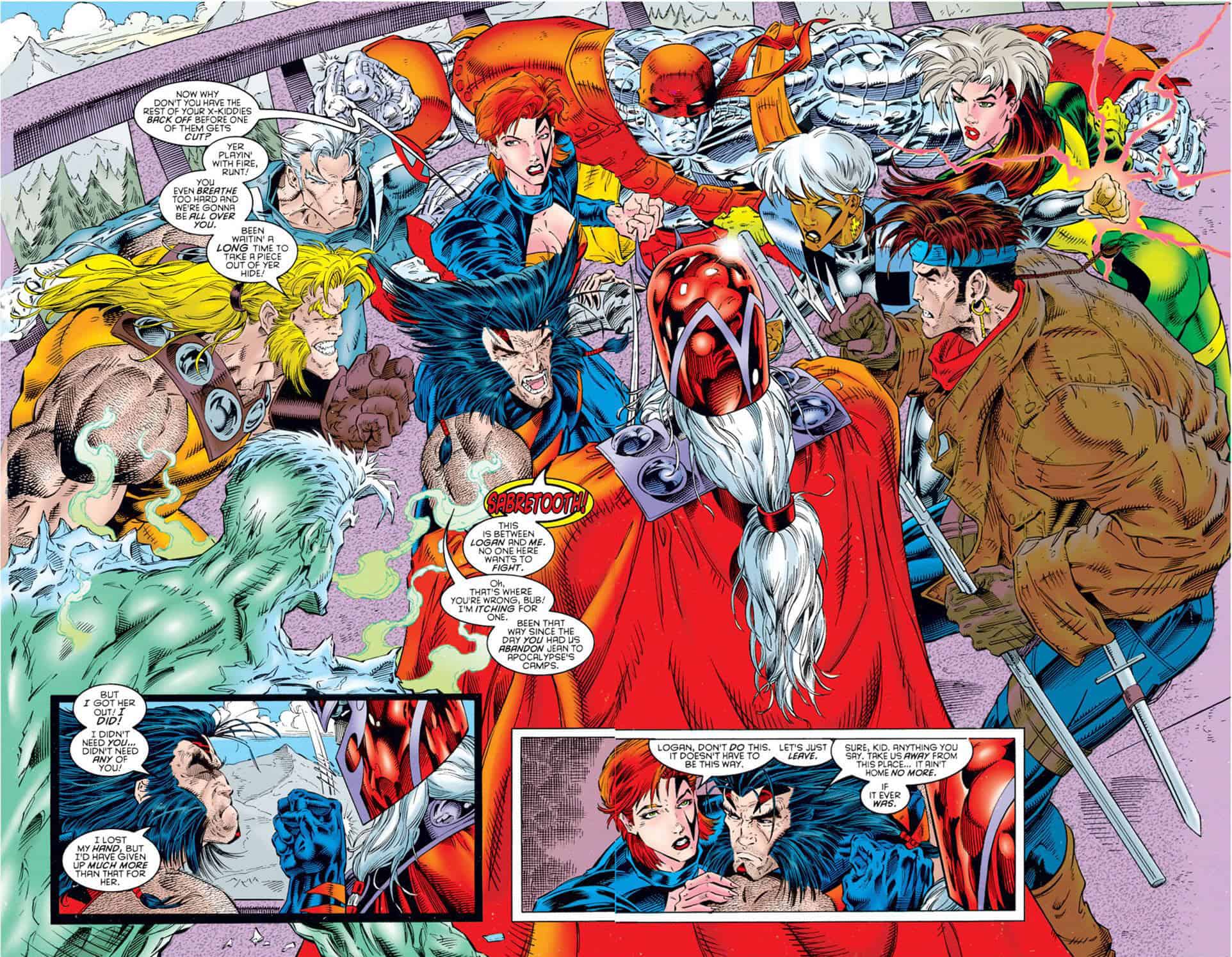
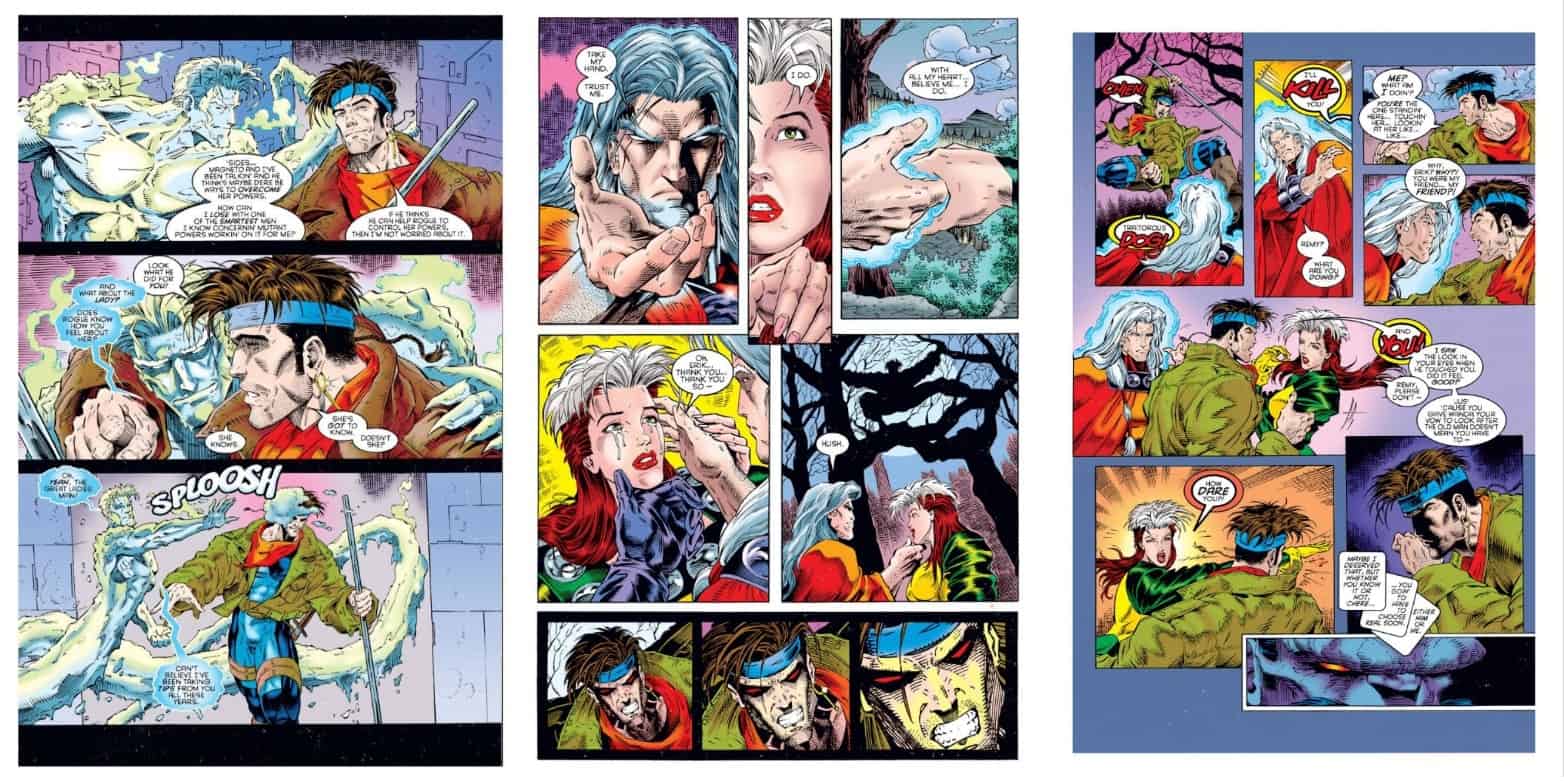 Churchill’s art is intense from first page to last. Action sequences are dynamic and he repeatedly fills larger panels with bigger than life characters–especially Wolverine whose size is emphasized And on several occasions characters extend past panel borders. The choice not only emphasizes size but helps the character in question pop off the page.
Facial detail is impressive as well. Characters show a wide range of emotion, especially in close ups where Churchill adds more emphasis to facial features.
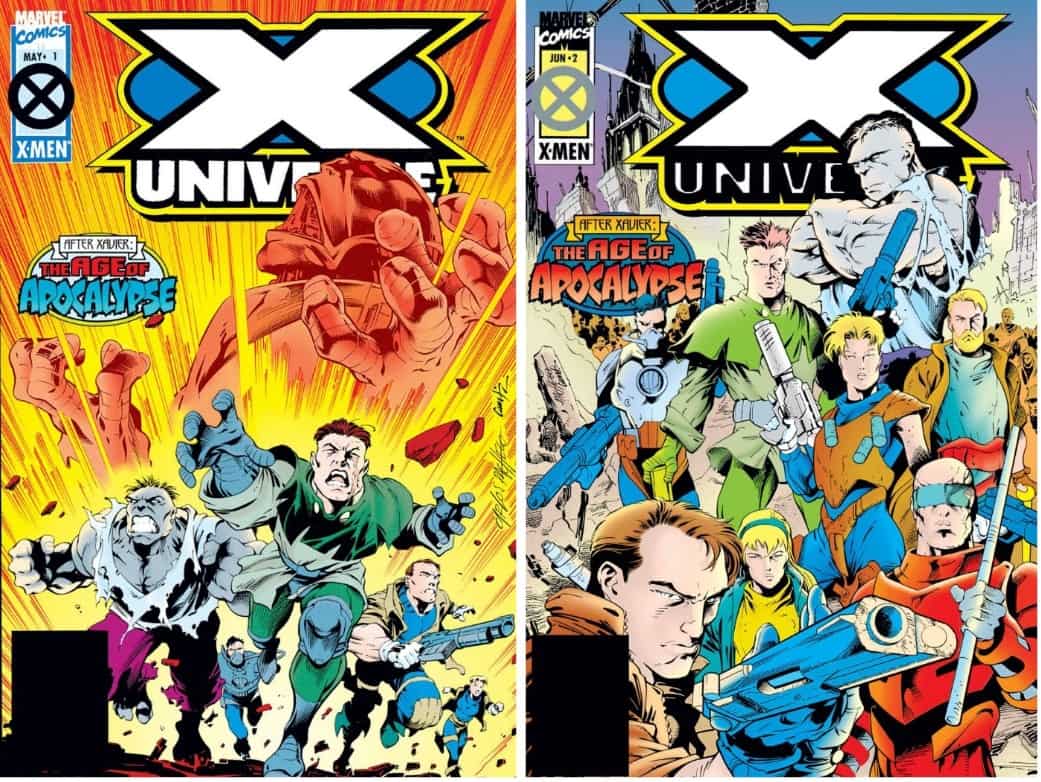 X-Universe #1 – 2
Story: Scott Lobdell | W: Terry Kavanagh | P: Carlos Pacheco; Carlos Pacheco & Terry Dodson | I: Cam Smith; Cam Smith & Robin Riggs | C: Kevin Somers & Electric Crayon; Kevin Tinsley & Electric Crayon | L: Richard Starkings & Comicraft
Gwen Stacy is in the ruins of Wakanda. She is a medic, providing what help she can to refugees in the area. She is attacked by a group of human freelancers that Apocalypse tolerates–Norman Osborn, Wilson Fisk, Arcade, and the Owl. Stacy is saved by the arrival of a giant mechanical spider piloted by Clint Barton and Tony Stark. The fighting over, Doctor Donald Blake approaches to greet Stark and Barton despite Stacy’s concern for his safety. Back in Europe, the fourth horseman of Apocalypse, Mikhail Rasputin, has arrived with a fleet of airships on a supposed mission of peace. Stacy, Stark, Barton, and Blake leave Africa and arrive in England. They meet up with Sue Storm and Ben Grimm. Victor Von Doom, head of Eurasian security greets Mikhail. The horseman speaks of a new nation safe from war, and the human crowds chant for unity. Mikhail invites Victor Von Doom (who brings all the assembled freedom fighters) on to his vessel. Mikhail quickly takes them prisoner, revealing that the captive mutant Empath is manipulating the nearby humans and will have them tearing at each other in desperation in a matter of days.
Mikhail promises ordinary homo sapiens the chance to be augmented into homo superior and thus survive in Apocalypse’s world. Empath continues to influence the human crowds to welcome Mikhail and scream for unity between the humans and Mikhail. Inside Mikhail’s ship, the delegation of humans who met with him earlier await either augmentation or organ harvesting. The augmentation programs kill 999 out of every 1000 subjects. When the process is started on Tony Stark, the technology built into him causes a feedback loop that frees everyone held on Mikhail’s ship. The freedom fighters begin evacuating Mikhail’s ship before setting out to free the Human High Council. Meanwhile, the augmented human Matt Murdock inadvertently touches Empath and samples part of his suffering. He kills Empath which sets free all the humans still enthralled by him. Elsewhere, Donald Blake takes on Mijhail, succeeding in killing him. With Mikhail dead, the Human High Council freed, and Empath’s influence gone, the human refugees are evacuated on the fleet of nearby airships. Rather than strike back against Apocalypse’s forces, the fleet heads out into space.
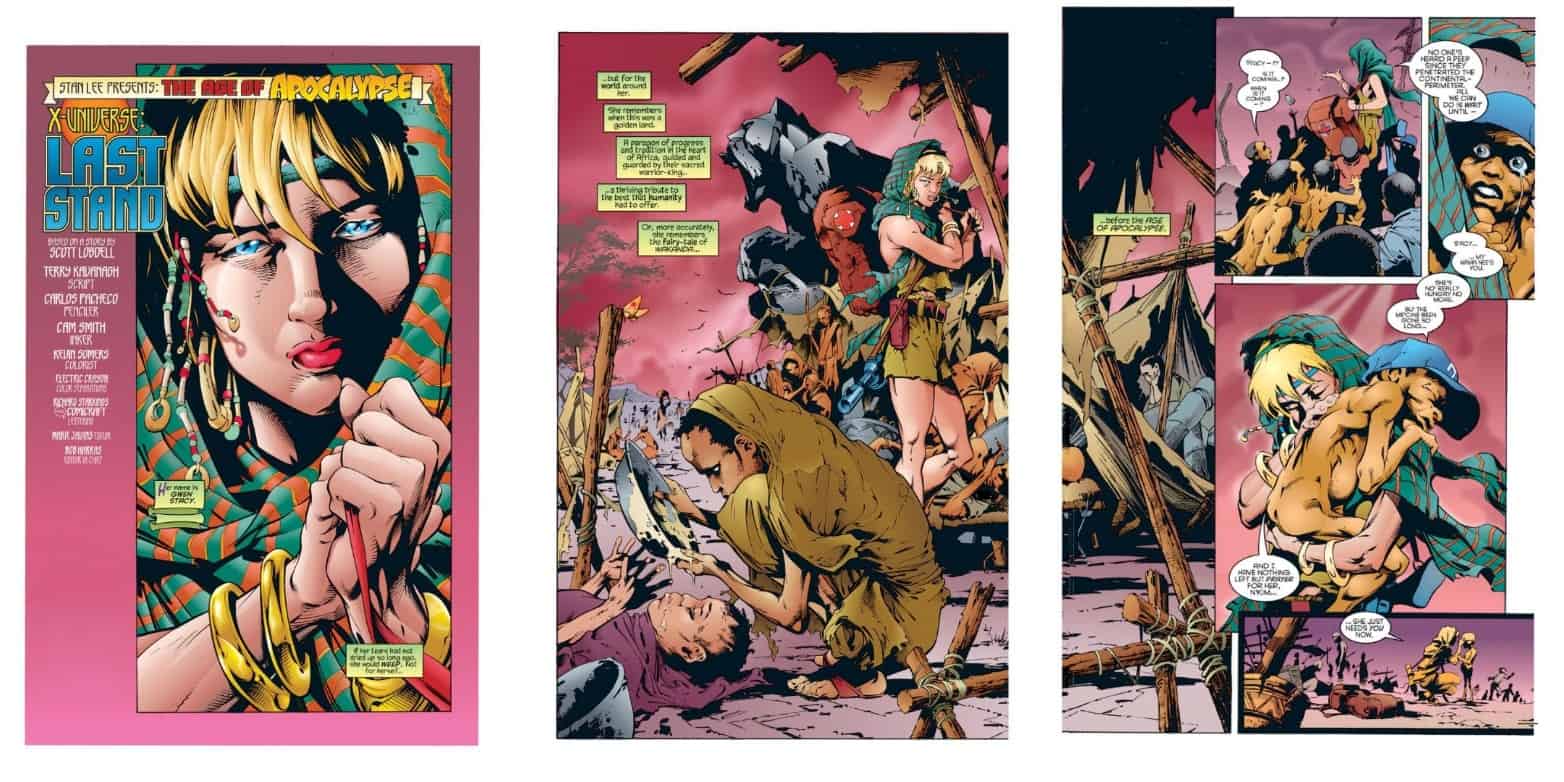 X-Universe is a very bizarre answer to the question of what happened to the human heroes in the Age of Apocalypse. It starts off well enough with the idea of people who offer aid and protection to refugees. Indeed, Gwen Stacy’s internal monologue about what happened to Wakanda is very intriguing. It’s an effective few pages.
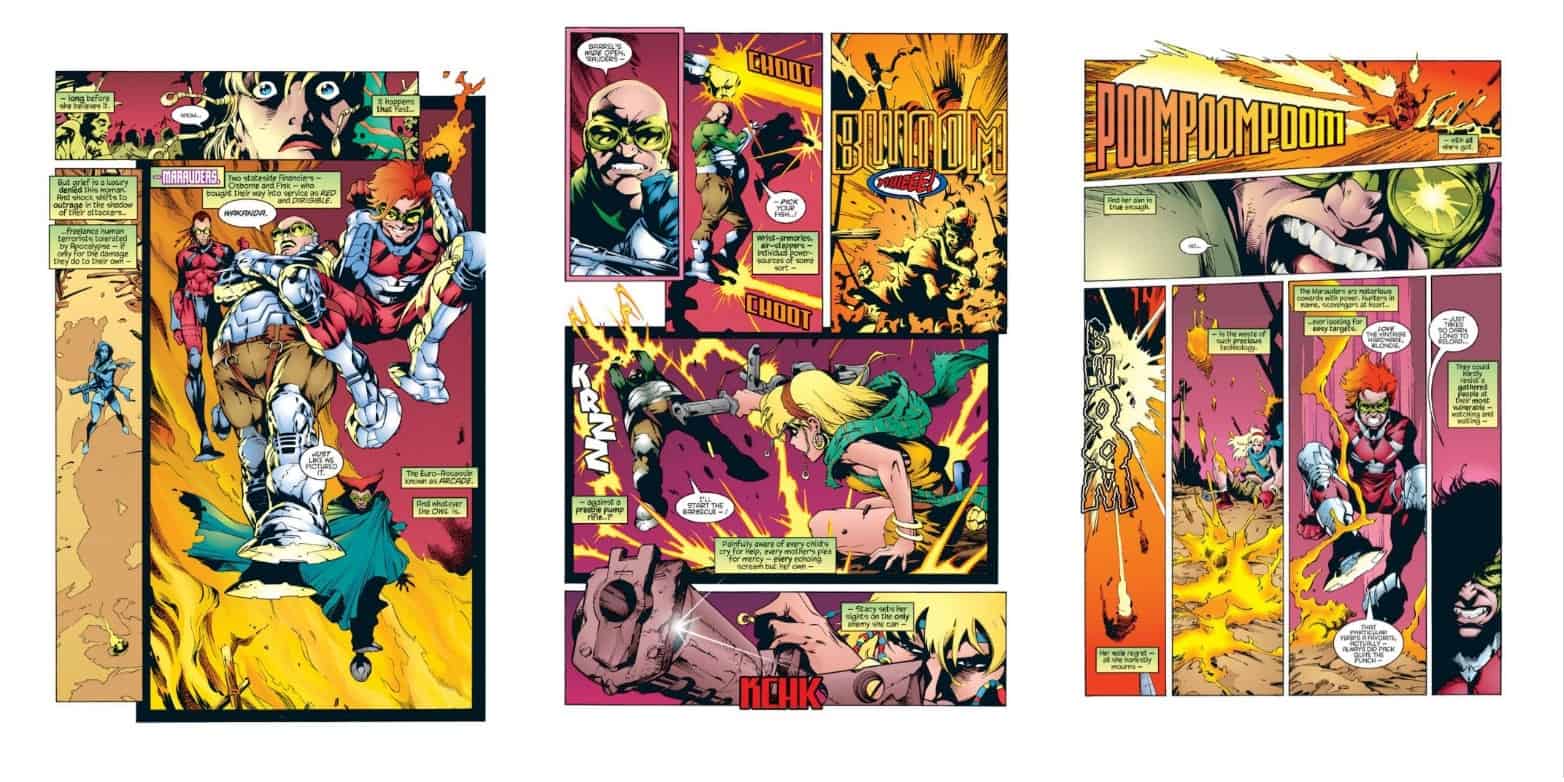 The Marauder attack that follows is interesting. Events in other Age of Apocalypse issues have begged the question of whether, even with all the cullings of humans, there is some tolerance for strong humans culling the weaker members of their species. Aside from a throwaway line in Stacy’s internal monologue, though, that idea isn’t addressed.
Mikhail Rasputin’s entrance is where the story goes seriously sideways. It largely ceases to be the freedom fighters’ story and becomes Mikhail’s. Rather than control events, everyone responds to Mikhail’s actions.
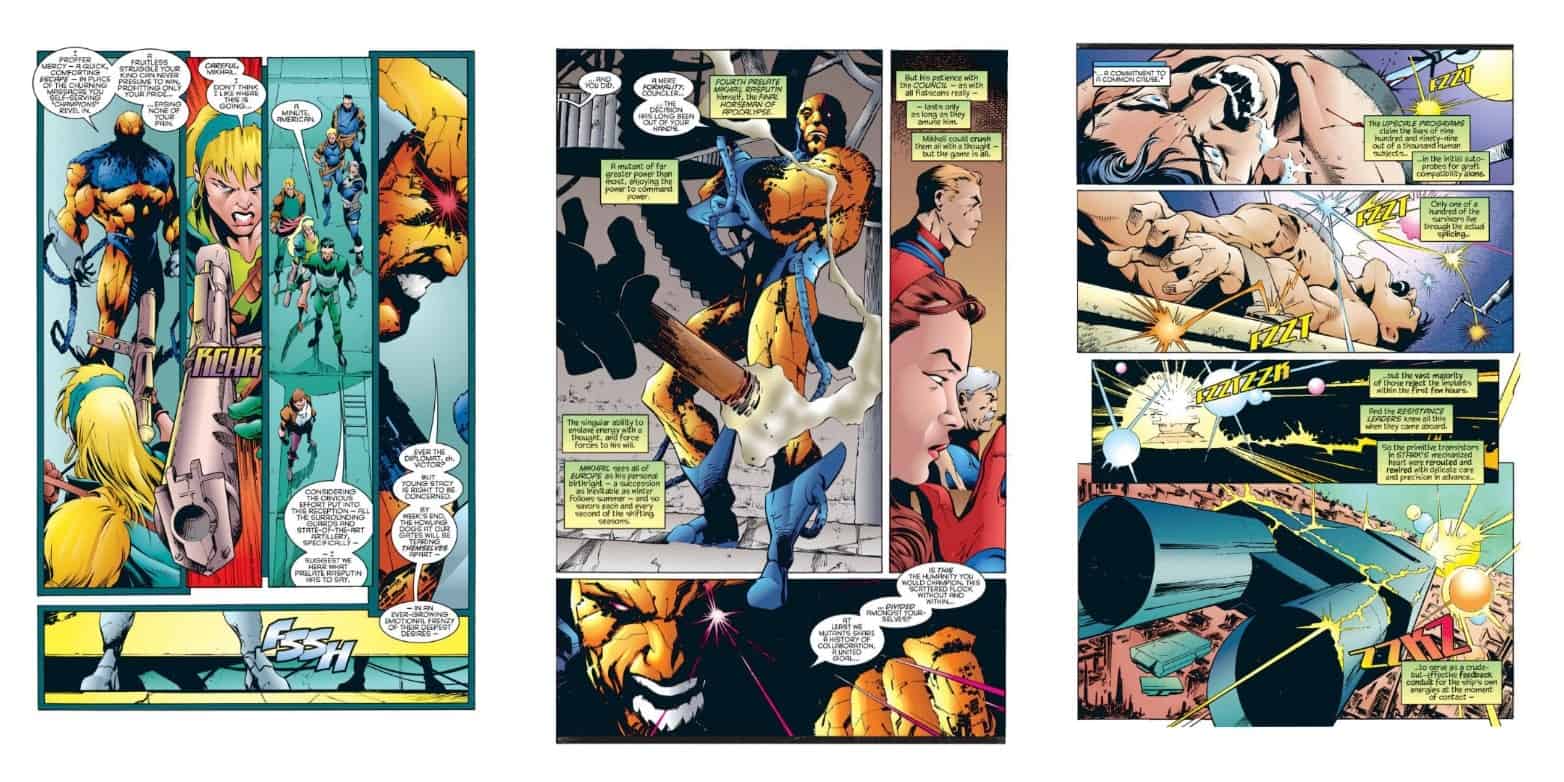 Unfortunately Mikhail’s motivation isn’t entirely clear. Is he using Empath to cause the humans to destroy themselves? Does he intend to kill as many humans as he can in his quest to augment a few? What are his intentions with the Human High Council and why does he keep them alive? His goals seem to change from the first issue to the second.
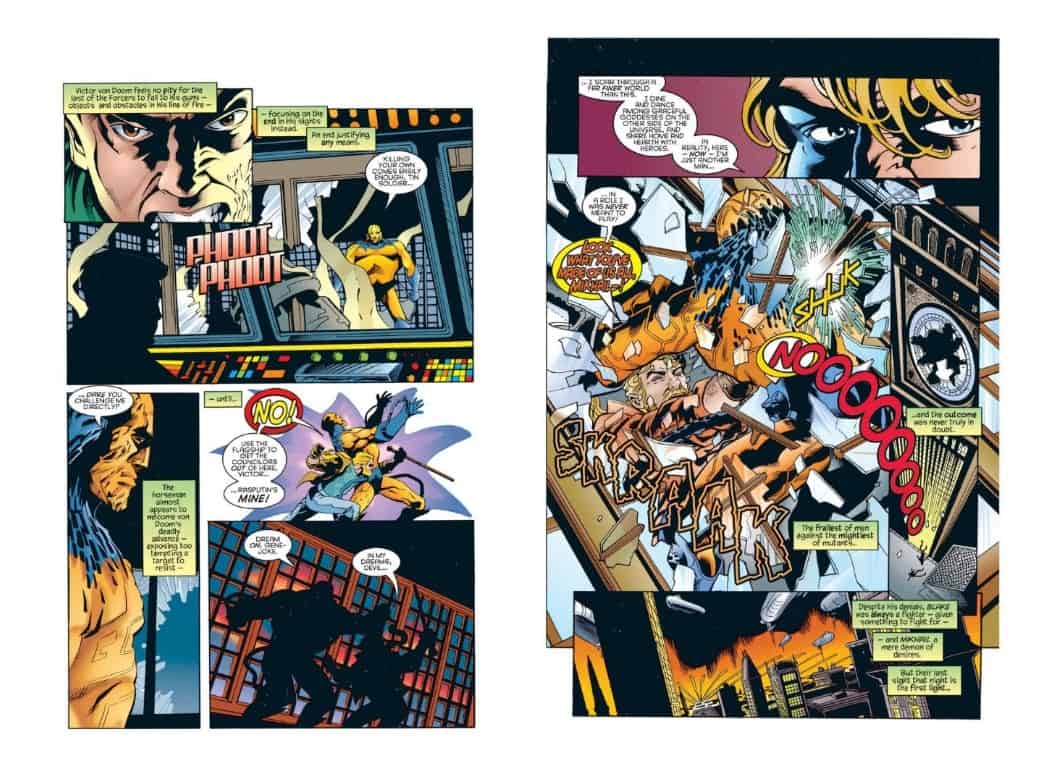 Kavanagh also sets Mikhail up as one of the most powerful mutants alive–only to have him killed by Donald Blake who stabs him with his cane and shoves him out a window in a fight where Mikhail never uses his powers.
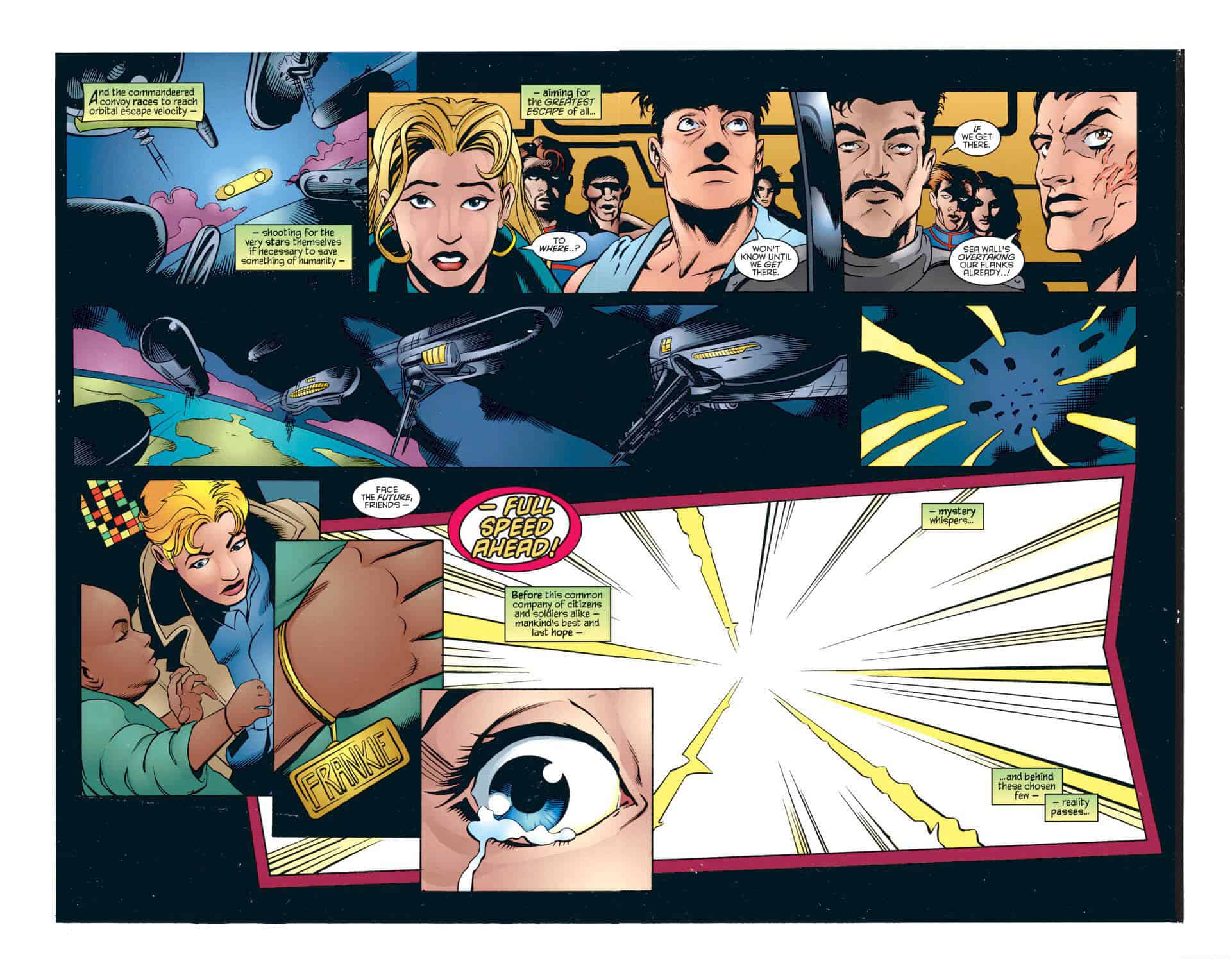 None of these strange moments and unanswered questions can possibly stand up to the final pages, though.
 Age of Apocalypse: The Chosen #1
Writer: Howard Mackie | Pencilers: Ian Churchill, Salvador Larocca, Steve Skroce, Val Semeiks, Tom Lyle & Tim Sale | Inkers: Scott Hanna, Sergio Melia, Bob Wiacek, Karl Kesel, Terry Austin, James Pascoe & Dan Panosian | Colorist: Ashley Underwood
Age of Apocalypse: The Chosen is a handbook style issue. It depicts a number of Age of Apocalypse characters with notes from Apocalypse and a designation of CHOSEN or FORGOTTEN.
 Save for an inclusion of Charles Xavier, every character appears at various points in other Age of Apocalypse series, and none of the insight about them seen here can’t be gleaned from the character development in those series.
 The bookend story is a Madri looking to see if the Madri order is chosen. For his arrogance in thinking that they are, the Madri is killed by Apocalypse who then lists them as forgotten. There aren’t any surprises here.
Next time…Sinister’s fate (and others’) in the first half of the #4s.