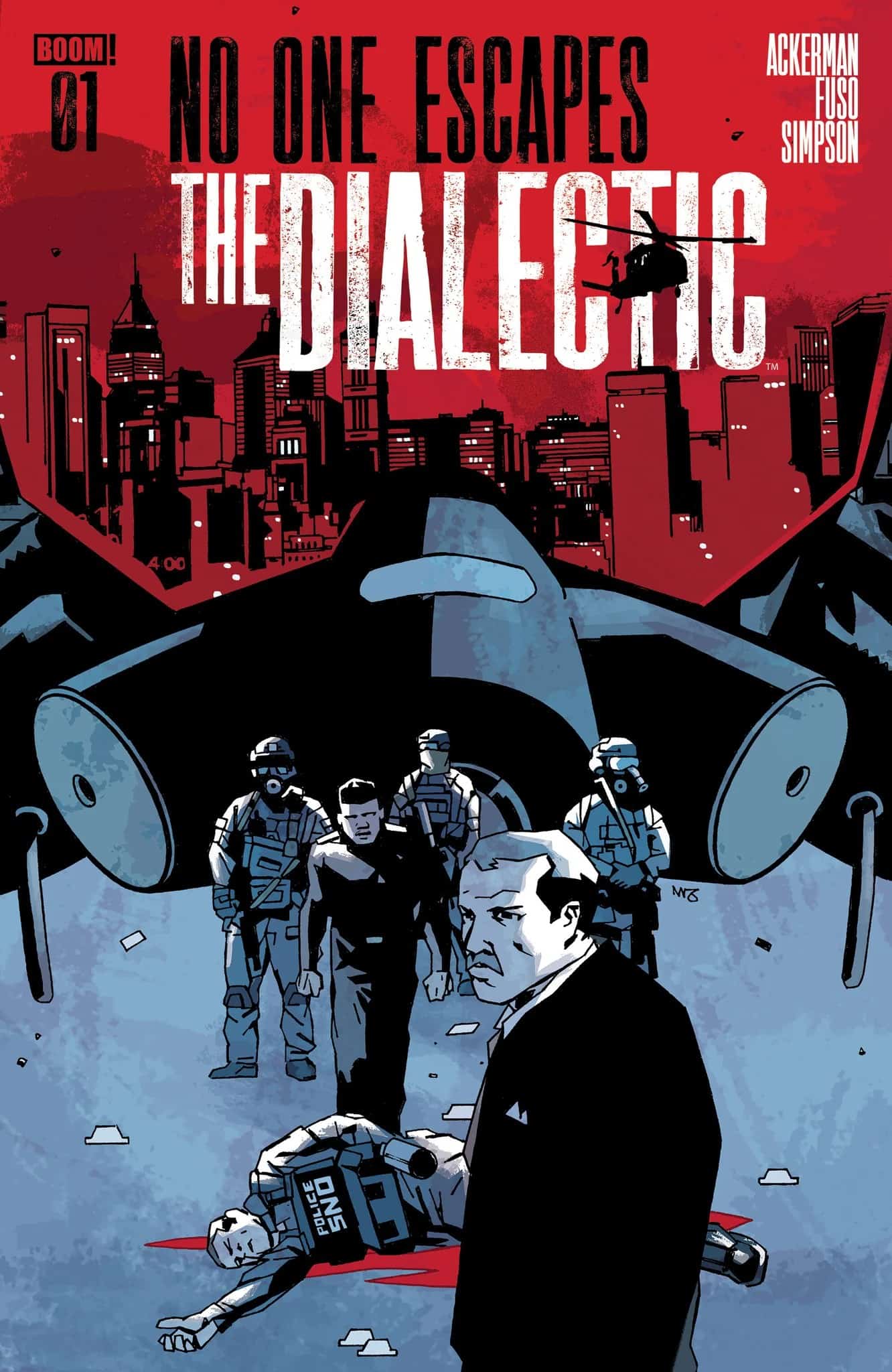
No One Escapes the Dialectic #1

Theron Couch
Recap
THE WORLD’S MOST DANGEROUS COMIC BOOK MAGAZINE!
From Pulitzer Prize and National Magazine Award-winning reporter Spencer Ackerman (Waller vs. WildStorm, Iron Man) comes the next generation of political radicalism in vigilante comics — unafraid to strike back at the deportation machine that threatens the foundations of American freedom!
When agents of the fearsome Special Naturalization Operations (SNO) become themselves hunted by a masked vigilante, a power struggle breaks out inside SNO between the Deep-State old guard and its death-squad vanguard, Gladio Unit!
Who is the masked vigilante calling themselves The Dialectic, posturing as a Marxist force of history? What is their relationship to their community’s liberation — and its violent suppression by SNO?
With powerful art by Italian superstar Antonio Fuso (House of Slaughter, G.I. Joe), No One Escapes the Dialectic is an unapologetic, provocative, and boundary-shattering new ongoing comic series for the age of permanent crisis.
Review
There is a murder mystery of sorts at the heart of No One Escapes the Dialectic #1. Who killed Officer Poole of SNO? Getting invested in that plot can be tricky, though, because this comic has a lot of complicated things to say that outweigh the nuts and bolts of what the opening pages set up.
Getting the most out of No One Escapes the Dialectic #1 requires understanding some of the political history Ackerman is pulling from as well as the thinly veiled metaphors Ackerman is employing. This first issue revolves around a security and immigration enforcement organization (abbreviated as SNO in a rather on the nose reference) that is slowly being “purged” of long standing, “deep state,” fairly innocuous bureaucrats and agents, in favor of a more militant operation.
These more militant agents belong to the Gladio unit. Gladio was the name of an operation that left “stay behind” units that were, according to the United States State Department, intended to resist a potential Soviet invasion of Western European countries during the Cold War. There is, however, evidence that the units instead cracked down on left wing parties in these countries and supported extreme right wing organizations and terrorists. This reference fits with the Gladios’ intentions in No One Escapes the DIalectic #1.
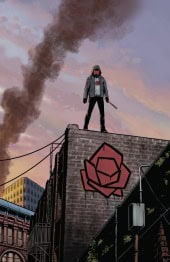
Officer Poole is murdered in the issue’s opening pages, killed by an unknown individual whose tunic features a red rose, a symbol associated with socialist and communist parties and revolution. This further feeds into the term “dialectic,” which Ackerman uses both as a name for the killer and a reference to the philosophical discussion of history advancing via thesis and anti-thesis–a process often associated in modern politics with communist thought.
The murderous Dialectic aside, Ackerman leans hard into a left wing over right wing moral and compassion superiority. A brief sequence in the issue shows community activists delivering food and supplies only to be brutally attacked by someone they believe is attached to the right wing elements in the government. The interaction between these activist characters, shown as chat room text messages rather than straight dialogue, is the only non-combative interaction in the entire issue. From a story point of view, this is the most interesting sequence.
 None of what Ackerman is doing here is subtle. He has a great deal to say about political thought and how it impacts modern behavior. But it heavily weighs down the narrative in this first issue. The murder that serves as an inciting incident is quickly buried under an overarching political struggle. There is virtually no character development here, and what there is is painted in extremely broad strokes. By the end of the issue, it’s become unclear exactly what Ackerman intends the long term plot to be. Yes, there was a murder, but will the series be about that or about the response? Indeed, it’s debatable whether the potential plot is important on its own or merely a soft foundation for a greater political discussion that is already clearly one-sided. Engaging with the minimal story that weaves through No One Escapes the Dialectic #1 requires a lot of patience. It is important to note, though, that despite the narrative’s deficiencies, the issue as a whole is very well written and engaging for readers willing to explore the depths of what Ackerman is presenting.
Fuso’s art doesn’t do much to improve on Ackerman’s very broad character presentation. The only expressions approaching a nuanced presentation belong to the older SNO employees who are being pushed out. They appear reasonable, especially in comparison to the members of the Gladio unit who radiate aggression without any kind of subtlety. As is the case with Ackerman’s writing for characters, Fuso’s work is overly broad. Ironically and unfortunately, No One Escapes the Dialectic #1’s most sympathetic characters whose presentation might give Fuso an opportunity to show off how he can visually develop sympathetic characters wear masks throughout their appearance.
Action sequences are considerably more successful that character depiction. This is surprising given that the issue doesn’t seem to be setting up an action forward series. Fuso relies more on small black patches as opposed to more subtle shading to develop a sense of dimension. It works well during the action sequences because that dimension on characters contributes to a sense of depth when multiple characters are in panel. This kind of dimension makes the action feel dynamic. This is especially the case in the opening pages when Dialectic attacks and kills Poole. He feels very much behind Poole as he appears. In subsequent panels Fuso does a good job of communicating Dialectic’s movement forward to come even with Poole, looking imposing over him as the attack continues, and receding to the background when the attack is over. The attack on Poole happens without dialogue, and Fuso’s art proves shocking and very effective.
Simpson uses a varied color palette throughout the issue. That said, there is a general theme to exterior background colors which constantly create a sense of late day and twilight. Simpson leans on darker yellows, blues, and purples. These choices create an oppressive feeling. No One Escapes the Dialectic #1 never has a sense of visual optimism, even during its most positive sequence with the community activists. Overall coloring, though, has a nice sense of contrast throughout. Simpson doesn’t lean too vivid, but everything on the page stands out from everything else.
No One Escapes the Dialectic #1 is a very text heavy comic at times which isn’t surprising given its subject matter. Troutman does a good job keeping dialogue bubbles organized and very easy to follow. There is never confusion in conversation about the order in which characters are speaking.
Final Thoughts
Story and character runs a distant second to political commentary in No One Escapes the Dialectic #1. This first issue’s very specific audience is readers who both have an interest in political commentary and who are eager (or at least willing) to engage with a specific viewpoint. The plot has some thriller potential, but for now it is very much in the background. The apparent use of the Dialectic as the villain opens the possibility for a more nuanced discussion in future issues, but that seems unlikely based on what Ackerman is doing here. When it comes to telling an actual story in going forward, No One Escapes the Dialectic #1 has potential as a thriller both in thought and action, but to get there readers may have to be very patient.
No One Escapes the Dialectic #1: Complicated Thought Over Story
- Writing - 6/106/10
- Storyline - 8/108/10
- Art - 8/108/10
- Color - 7/107/10
- Cover Art - 7.5/107.5/10