


Only The Savage Are Left #1

Recap
A strange virus has spread across the world, transforming its victims into monsters. The only cure is to kill another infected soul. When a nonviolent young man sets out from the safety of his settlement to find his missing true love, he must face the corrupted world of monsters and monster-killers. A dramatic survival adventure that dares to ask what we should stand for in the monster apocalypse.
Review
Humans turn into feral monsters thanks to a new disease in Only The Savage Are Left #1. The infected start showing physical changes, at first cosmetic, only a few days after contracting the disease. As they continue to change into more monstrous forms, their behavior also morphs into something akin to feral animals. Society was able to largely contain the problem for a time. That is, until a cure was discovered. The story ultimately focuses on a young man and woman, Ryder and Oaklynn.
Only The Savage Are Left #1 is technically a monster dystopia story, but it feels much more like a zombie story. The tropes are largely the same. The chief difference is the idea that a person can be infected but then treated such that they remain partly transformed physically but still completely rational. This doesn’t affect the story as it unfolds in the first issue, but there is the implication that survival in the wider world is made easier if one is partly transformed.
The most compelling idea here is actually the nature of the cure. Unlike most stories involving a disease that transforms humans in this way, Only The Savage Are Left #1 is set in a world that was on the verge of successfully containing the disease until the discovery of a cure–the bizarre nature of which led to humans embracing their baser, savage instincts in order to acquire. It was people’s attempt to cure themselves that ultimately tore society down. This idea sets the title up not just as a reference to the monsters but a comment on the kind of people that are surviving in this dystopian world.
Kaplan tells his story somewhat non-linearly. The plot, what little there is in Only The Savage Are Left #1, proceeds in a straightforward manner, beginning with backstory about the state of the world. Character moments are sprinkled throughout, dropped in out of order. These few scenes, delivered in this way, make Ryder and Oaklynn surprisingly compelling. More so than what little plot is established, it’s the connection with these characters that drives interest for the next issue.
Ryder and Oaklynn’s compelling nature is further enhanced by Raffaele’s art. Raffaele doesn’t go overboard on facial details, but a great deal of care is put into characters’ eyes. Most of the emotion the characters express is delivered there. Though Ryder and Oaklynn have a relationship stretching back well before the issue began, they have very different life experiences. The weight of that difference is communicated entirely via Raffaele’s art. Kaplan’s dialogue is effective, but the emotion is in the characters’ eyes–especially Ryder’s which are wider throughout the interactions and convey an innocence that Oaklynn lacks.
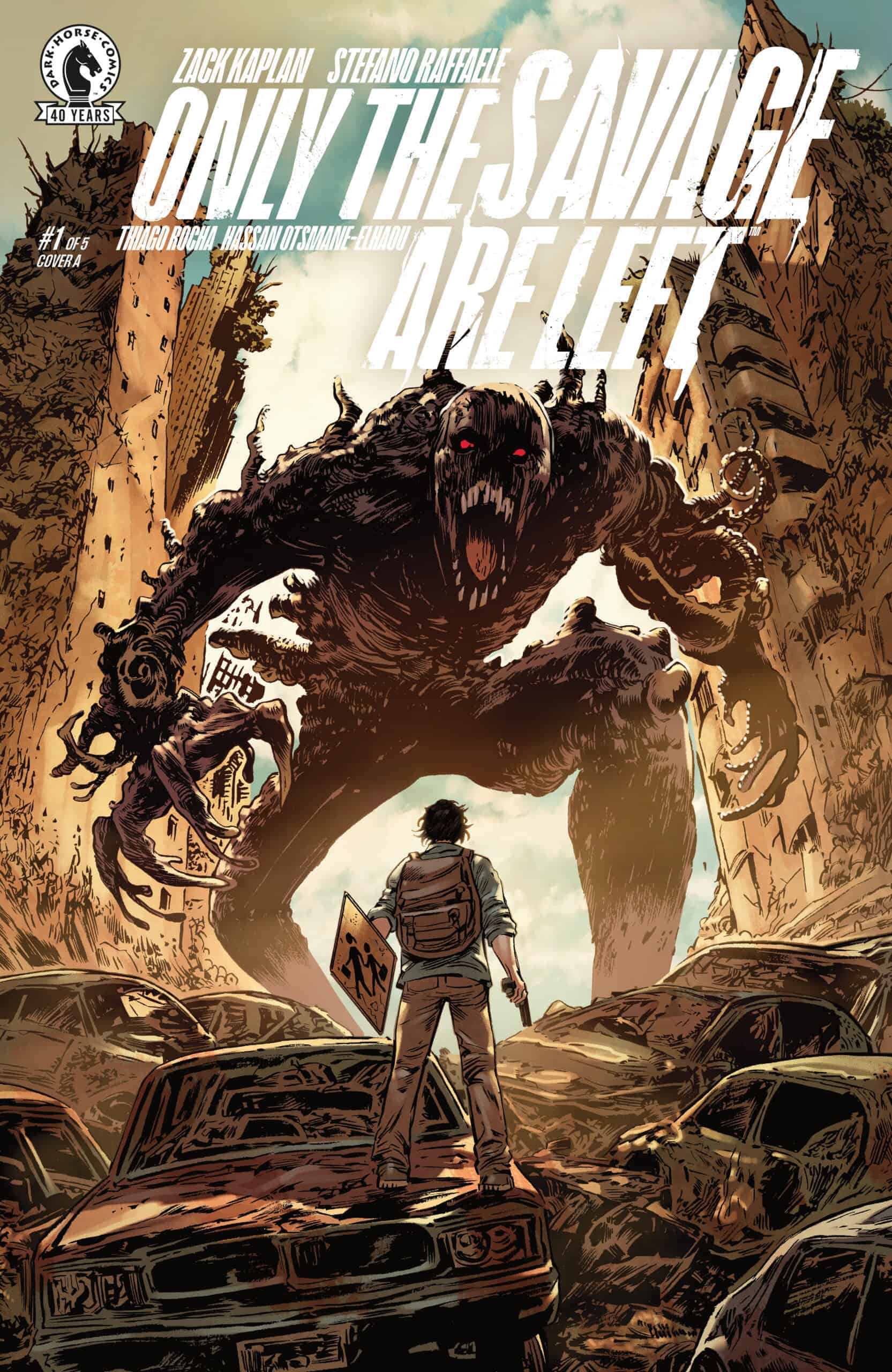
Settings and backgrounds in Only The Savage Are Left #1 are much more heavily lined than the characters. For the bulk of the issue, following the opening pages that lay out the backstory, the higher level of detail creates a rustic, somewhat uncivilized atmosphere. Buildings are run down. Abandoned cars look old and tarnished. Patches of weeds grow in worn down roads and bridges. Raffaele effectively captures the look this world demands.
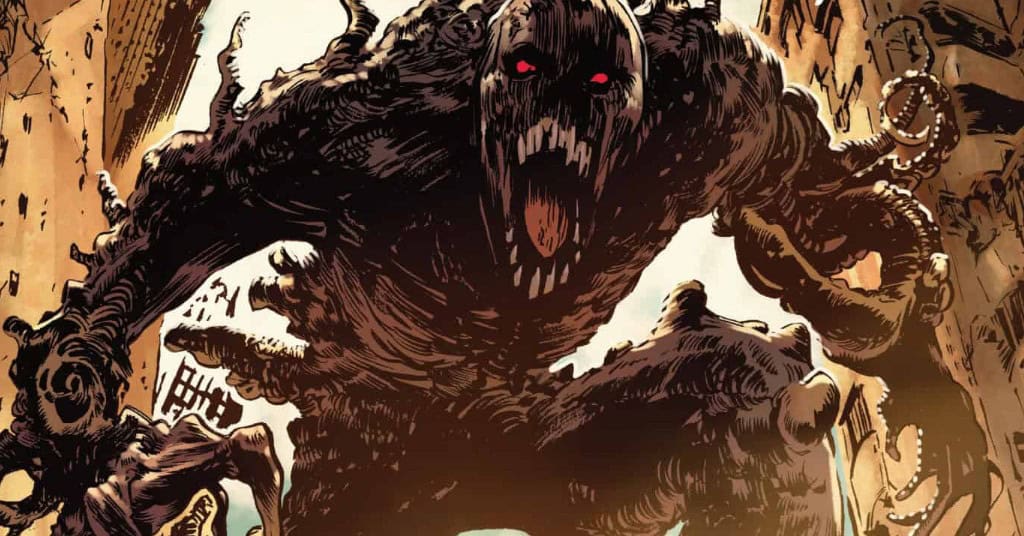
The monstrous figures that the infected humans turn into are also highly detailed. Layers of shading create depth and the appearance of uneven musculature and protruding rib cages. Though they are monsters, they still share some characteristics with humans.
Rocha’s coloring is restrained–not faded out but soft. There isn’t a lot of heavy contrast in the issue. The major exception is a page that sees Ryder and Oaklynn hiding from the death and destruction being dealt out by feral infected. Rocha gives the whole page a red tint, and it adds significant menace and a sense of trauma for both characters.
The issue’s sole narration is provided by Ryder’s internal monologue. Otsmane-Elhaou uses uneven, rugged edged caption boxes with a font that resembles handwriting. It’s a perfect accompaniment to the art and fits in nicely with the overall story.
Final Thoughts
Only The Savage Are Left #1 creates a world not unlike many other zombie and monster dystopian stories. The few differences do elevate the story somewhat, but what makes the story work here is the limited insight Kaplan provides on the main characters. Raffaele’s art is the real star here, though. It humanizes Ryder and Oaklynn considerably and fleshes out the world. Fans of horror dystopian stories, especially zombie and monster, should definitely give this series a look.
Only The Savage Are Left #1: It’s About the Characters
- Writing - 7.5/107.5/10
- Storyline - 7/107/10
- Art - 8.5/108.5/10
- Color - 7.5/107.5/10
- Cover Art - 8/108/10