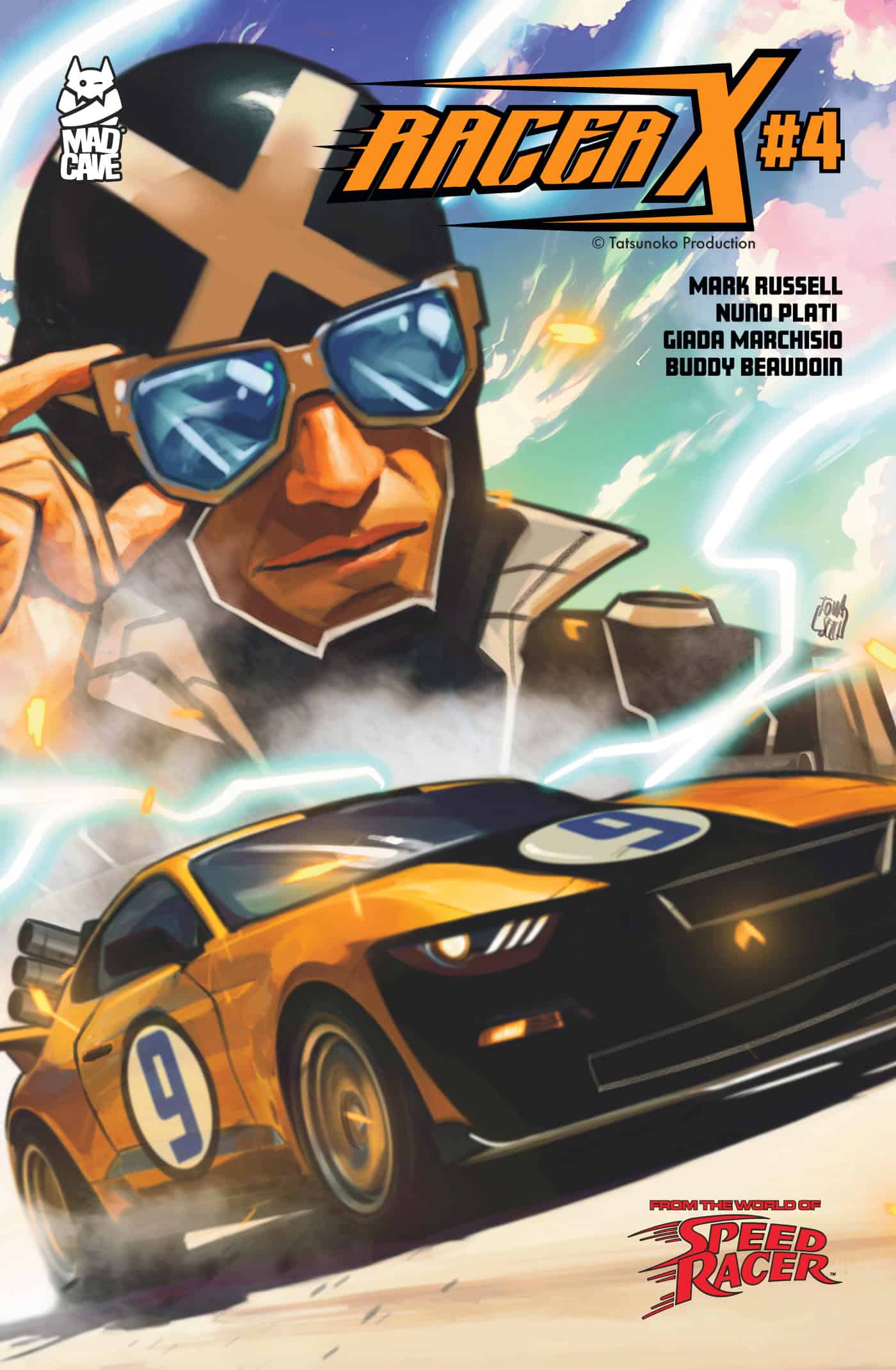
Racer X #4

Theron Couch
Recap
On the alpine track, Racer X faces his deadliest rival--Kim Jugger, the man who once betrayed Rex to the C.A.T. Team. As Jugger’s brutal tactics tear into the Wedge Car, Racer X relives the mob ties and blood-soaked betrayals that forged him…until Speed makes a last-second save that changes everything. The finish line delivers more than victory--it delivers redemption.
Review
Racer X’s relationship with his dad, Pops, factors heavily into Racer X #4. The series is built on the titular’s character introspection, his internal monologue not unlike that found in hardboiled or noir fiction. Russell doesn’t write Racer X with moral ambiguity, but there is a certain level of ambiguity about the world at large. In Racer X #4, that ambiguity factors into how Race X looks at his youth and relationship with his family.
The issue picks up almost immediately following the events of Racer X #3 and concurrent with Speed Racer #4. The Great Alpine Race is still in progress, and Speed’s Mach 5 has no brakes. Racer X’s attempts to save Speed are the catalyst by which Racer X examines his youth and the baggage that he feels he carries because of how he left home and the disagreement with his father that preceded his departure.
Russell complicates Racer X even more here when he puts the character in this position. Can Racer X ever find his way back to his family? Racer X #4 asks that question by having the titular character look at it from both perspectives. He believes that he needs to be unburdened by his past. But at the same time, Racer X finally looks past the contentious nature of his departure to the emotional bonds that still existed. It’s a big turn for the character.
Numerous flashbacks to Racer X’s youth as Rex once again showcase Plati’s style with ordinary people in ordinary environments. Plati’s art in flashbacks is staid relative to the action sequences in the present. This is most readily seen in how Rex is depicted: lean, ramrod straight, and largely devoid of emotion. The flashbacks overall don’t feel like active images so much as still-lifes. In an issue that is so devoted to Racer X’s struggle with his past and its influence on his present, this distinction in visual styles is particularly effective.
 The final stages of the Great Alpine Race look more intense than any racing sequence in Racer X so far. Most backgrounds are lost entirely to colors and lines indicating speed and force. These lines stretch across the panels as well as off the cars themselves. One splash page in particular features two cars on the road, two cars flying through the air, buzz saws, and fire. There is a real sense of kinetic energy as the vehicular insanity races diagonally toward the reader.
Marchisio’s color selections contribute nicely to the power of these racing sequences. The background colors are much softer than the racing cars and provide a high level of contrast. As a result, all of the car sequences jump off the page. None of this kind of contrast is visible during the flashback sequences. The overall softer color tones contribute to the still life quality of those sequences.
Beaudoin’s brighter yellow color for the captions containing Racer X’s internal monologue works very well, contrasting with Marchisio’s overall color style. It emphasizes everything Racer X is thinking relative to everything else on the page.
Final Thoughts
Racer X has consistently upped the stakes issue to issue. At the same time, Russell has never lost track of the character examination that makes the series as successful as it is. Racer X #4 is the best issue yet, combining high octane action with rich character development.
Racer X #4: Family Ties
- Writing - 8/108/10
- Storyline - 8/108/10
- Art - 8.5/108.5/10
- Color - 7/107/10
- Cover Art - 7/107/10