Rogue #2

Jamison Nilsson
Recap
During an airport catastrophe, the face of a bystander triggers new memories in Rogue that bring up unsavory questions about her dark past. After tracking down her mother, the once-malevolent mutant Mystique, Rogue hopes to get some answers.
More X-Men coverage from Comic Watch:
Review
Rogue #2 is economical with its pages. The pace doesn’t rapidly accelerate or suddenly slow down at any point. Instead, Erica Schultz keeps the issue moving at a steady rhythm while avoiding unnecessary exposition. What the dialogue doesn’t tell you, the characters do with their actions.
From the first page, Ariana Maher’s lettering gives way to narration early on in the issue. Mystique recounts her past verbally to Rogue as we see it play out on the page. It works well without stopping to clutter the scene and slow down the pacing with constant back and forth between the past and present. The issue hinges on that past, it’s the setup for Rogue’s actions that push the story forward. The effect that beginnings have on pacing cannot be overstated, as Rogue is sent hunting down an old and infamous acquaintance.
Mystique is excellent in this issue. She’s the same secretive super-spy she’s always been, even when it comes to her own daughter. Rogue is penned similarly well, just like in the last issue. Lately in Marvel’s X-titles, Rogue’s character has been given more of a spotlight. She’s being turned into a responsible leader to fulfill her role in Gail Simone’s Uncanny X-Men run. This change has turned Rogue from more of a punk rock defender of the weak into a loving wife and motivating leader. Even as she is barely escaping a firefight with her life in this issue, Rogue is already thinking about coming back to shut down an arms-selling ring.
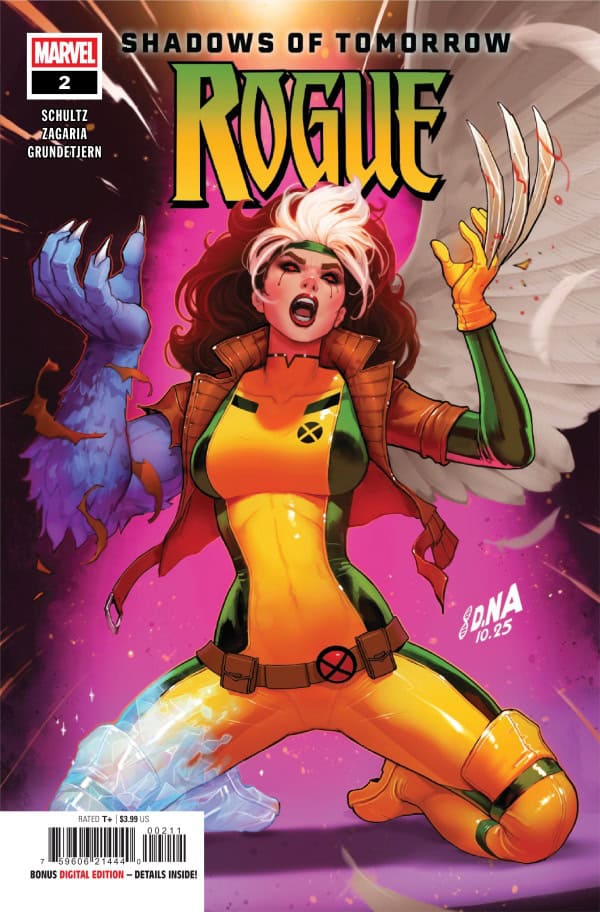
Luigi Zagaria has brought a very specific aesthetic to the series, and that style comes out in issue #2, such as the pages early in the issue where we see Rogue’s powers begin to go haywire, as seen on the issue’s cover. From erratically shapeshifting like her mother to mimicking mutant powers just like herself, Rogue becomes a slot machine of mutant superpowers in the issue. This leads into the action of the issue, which is framed through different panels split side by side or stacked together diagonally, which works well to show character movement without hindering storytelling.
How the writing and the art in Rogue #2 connect isn’t very subtle. Rogue’s malfunctioning powers reinforce the trauma of her misremembered past. This primarily serves as a way to quietly honor and call back to Rogue’s past, even as Schultz tells a story that sets up changes to Rogue’s character for future storylines.
Final Thoughts
Rogue’s solo story is setting up to be more than just a detour. As changes to both her powers and revelations about her past begin to surface slowly throughout the issue. Erica Schultz’s characterization of Rogue has been excellent, especially when combined with the artwork by Luigi Zagaria, which is able to capture the chaos of shapeshifting and power-stealing at the same time.
Rogue #2: Wardrobe Malfunction
- Writing - 8/108/10
- Storyline - 8.5/108.5/10
- Art - 8.5/108.5/10
- Color - 8/108/10
- Cover Art - 8/108/10