



Rogue #4

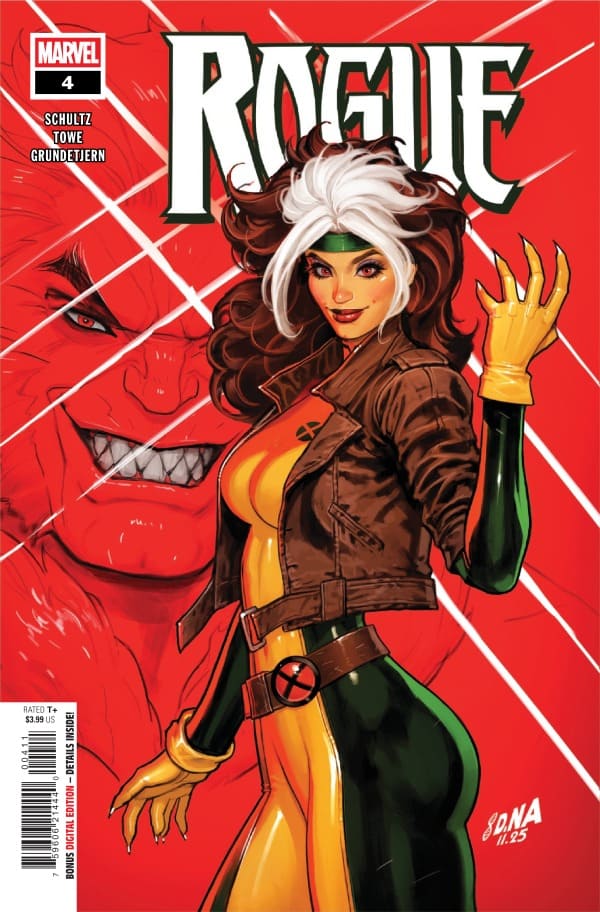
Recap
After receiving strange visions of a part of her past she barely remembers, Rogue has set out to find the truth about an encounter at Project P.E.G.A.S.U.S. Recently, she’s had little success on that end, aside from running into the Constrictor, an old teammate turned foe from long ago.
Review
Rogue’s characterization has been a focal point of the series so far, taking her away from her ongoing role as the leader of the Louisiana X-Men in Gail Simone’s Uncanny X-Men. However, that characterization has yet to meaningfully change or explore a part of Rogue left underdeveloped until now. The writing on this front comes across as “safe” to the reader. On the other hand, for a first-time reader or for a new reader’s first introduction to Rogue, Erica Schultz’s Rogue has been a decent introduction to the character herself.
This issue felt like Erica Schultz was stretching the story to last the length of its five-issue run. So far, the limited series has had plenty of interesting scenes and some solid artwork from Luigi Zagaria, but the series has yet to justify its run with meaningful changes or expansions to Rogue’s character. The story’s interesting hook, Rogue’s malfunction, and possibly changing powers have already been undone for the most part by issue #4.
One element of strong character writing worth pointing out is how Rogue’s reactivity is used as a character in the issue. Whether it’s a fight or a crashing helicopter she has to save in a pinch, Rogue is a hero through and through, and this stuff is light work for one of the X-Men’s most powerful heroes. Where Rogue struggles as a character is with her past as a villain; the weight of that past is what pressures her character into moving forward and acting proactively, which is the impetus for the story to move on across multiple issues.
A small editorial discrepancy in the writing of this issue is the placement of the word “flatscan,” a derogatory term used by mutants to refer to regular humans. The term first debuted in issue #1 of X-Men Vol. 2 in 1991. Mystique is the character who tosses out the word casually in a flashback sequence, which wouldn’t be out of place for Mystique herself. However, Rogue had already left the Brotherhood of Mutants and joined the X-Men back in Uncanny X-Men #171, which was released in 1983. It’s a small detail, and most wouldn’t notice it, especially as “flatscan” has made a rather recent comeback in Jed MacKay’s current ongoing X-Men title as the seemingly favorite word of Kid Omega.
Luigi Zagaria uses a varied panel structure and neat line art with one or two full or double-spread pages to provide certain scenes with extra flair. Depth and distance are two of Zagaria’s notable strengths, as they’re able to cram the entire interior of a living room into a single standard-size panel without crowding the panel or looking flat to the reader. The character’s move across the page is believable and clear to the reader, which keeps pacing tight.
Espen Grundetjern’s colors are immersive, with consistent lighting across panels and shaded characters that give Zagaria’s action scenes more punch. Multiple similar tones are able to exist on the page without overlapping or bleeding into one another, which enhances the overall look and feel of the issue.
Final Thoughts
Rogue #4 is an easy read and continues to develop the limited series’ storyline but does little to justify that storyline’s continually delayed plot points.
Rogue #4: The Past is Heavier Than a Helicopter
- Writing - 7/107/10
- Storyline - 7/107/10
- Art - 7.5/107.5/10
- Color - 8/108/10
- Cover Art - 7/107/10