Teenage Mutant Ninja Turtles #16

Anthony Bergamini
Recap
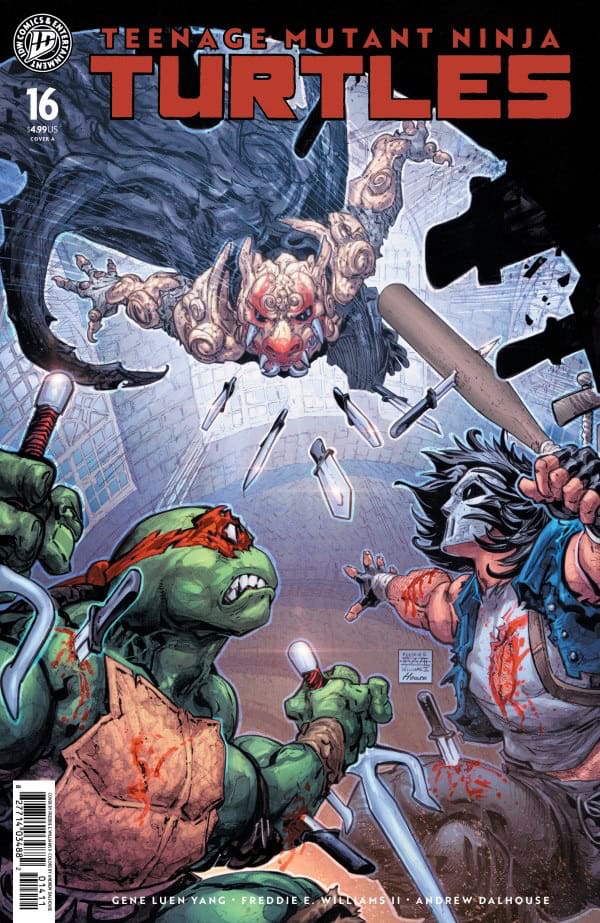
It’s Ujigami vs. Casey Jones, with Raphael caught in the middle! The Ujigami has vowed to protect the Turtles from their greatest enemies, so why is he attacking Casey? Meanwhile, Shinigami goes behind Karai’s back to make a power play of her own, involving a dangerous new ally. The first step in their plan requires blood from a very specific target... and in very large amounts!
Review
Teenage Mutant Ninja Turtles #16 picks up from the dramatic cliffhanger of the previous issue, with Master Splinter, disguised as Ujigami, confronting Casey Jones after witnessing a vision of a future in which Casey kills Raphael. What follows is a classic Turtles battle that highlights the strengths of each brother while also demonstrating how far their training has come as they face their own father. In a surprising twist, Splinter ultimately escapes, choosing instead to pursue a secondary quest to destroy Karai. This decision leads to major developments for both the Turtles and the ongoing machinations of Karai and Shinigami.
Artist Freddie E. Williams II does a fantastic job throughout the issue, beginning with the battle to protect Casey from Splinter. Williams infuses the conflict with a remarkable amount of pathos and character, giving the fight emotional weight rather than letting it devolve into a simple slugfest. His style emphasizes the high-energy action that has become synonymous with the franchise while still honoring the characters’ long history and emotional gravity, ensuring that every strike feels impactful.
The story takes an especially intriguing turn when Splinter escapes using a magical artifact that causes the Turtles to hallucinate, placing them in the setting that would bring each of them the greatest happiness. This sequence is arguably the standout section of the issue. It reveals that Michelangelo has the strongest connection to the Turtles’ Japanese roots, as his vision transports him back to a life before the Turtles were reincarnated. This moment is contrasted with the revelations surrounding Leonardo, Raphael, and Donatello, whose visions of happiness are very different and have little to do with their past lives. More than anything else, this sequence highlights a depth to Michelangelo’s character that is often overlooked in other interpretations, giving him an emotional weight he does not always receive. It also demonstrates that writer Gene Luen Yang has a deep understanding of the extensive lore built during the IDW era of Teenage Mutant Ninja Turtles and is genuinely interested in expanding upon it.
The final portion of the issue shifts its focus to Splinter’s new mission to confront Karai. This encounter is ultimately revealed to be a trap designed to remove the dragon spirit from her, another storyline that ties directly back to plot threads established by previous creative teams. One of the most compelling aspects of this development is the lack of clear finality surrounding it. While the Turtles have technically regained their father, there is no guarantee that he will remain with them permanently. If Karai’s plan succeeds, Splinter’s ultimate fate remains ambiguous, giving the arc a tense and climactic edge. This kind of storytelling is part of what has kept this franchise compelling for decades, and this creative team delivers on that legacy in a big way.
Final Thoughts
Teenage Mutant Ninja Turtles #16 exemplifies the action, pathos, and excellent character driven narrative that has made this franchise so long lasting.
Teenage Mutant Ninja Turtles #16: Reunited and it Hurts So Bad
- Writing - 10/1010/10
- Storyline - 10/1010/10
- Art - 10/1010/10
- Color - 10/1010/10
- Cover Art - 10/1010/10