


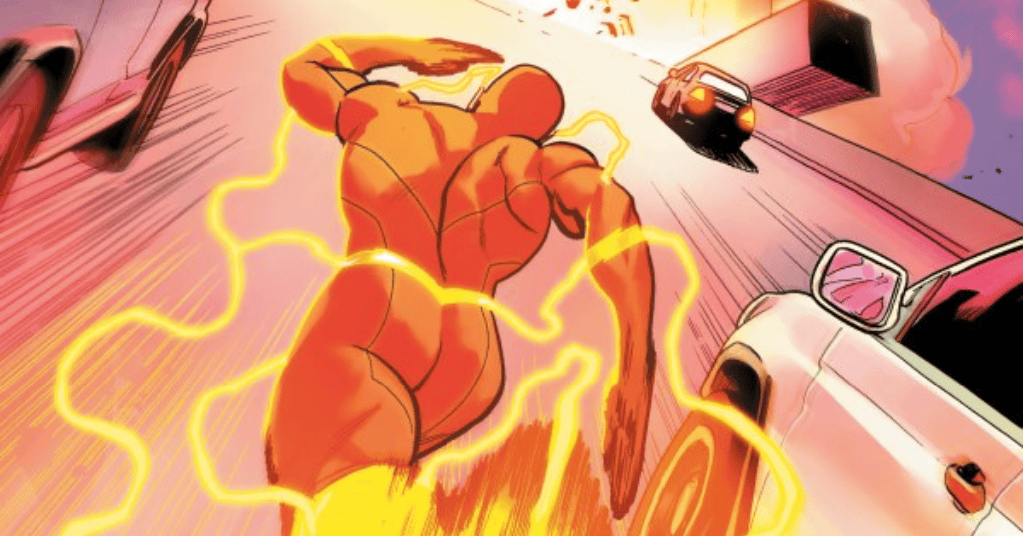
The Flash #38

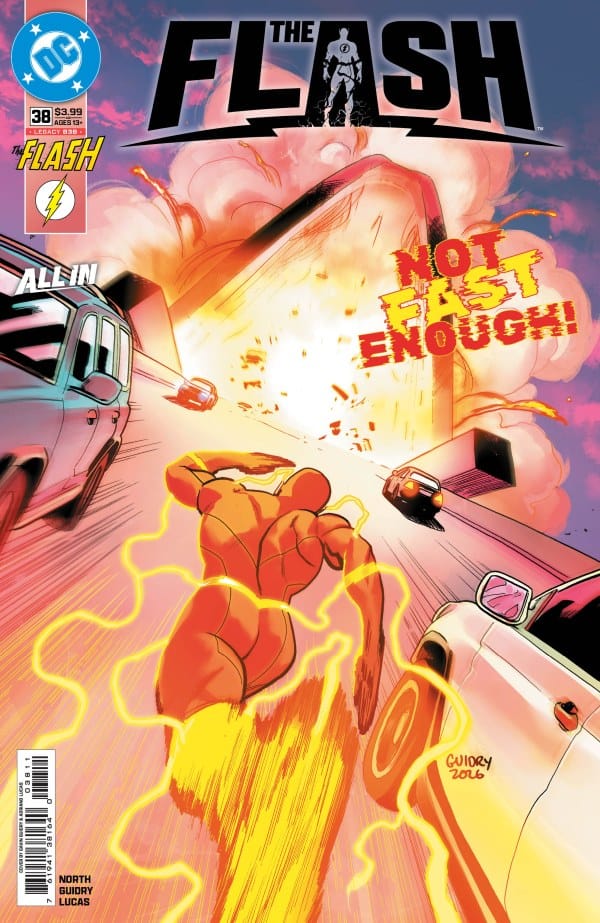
Recap
THE FUTURE COMPROMISED! Somehow, Wally West's visions of the future failed to foresee the destruction of three separate bridges in three separate cities, but he's determined not to let this interfere with the good work he's doing.
But the rest of the League is less interested in letting him experiment on such a scale, especially when the costs are so high and people are getting hurt. But the Flash still wants to do good and doesn't see a setback as a reason to abandon the entire thing. And besides, there's not much anyone can do to stop the Flash...
Review
The Flash #38 picks up with the destruction of the three bridges that Wally believed he had saved in the previous issue. As he struggles to understand how he failed to see this coming, the Justice League grows increasingly weary of his actions. This frustration is driven particularly by Green Arrow, who views Wally’s methods as a gross invasion of people’s privacy and a misguided attempt to deliver justice. On the flip side, Wally remains convinced that his way is the best way, refusing to acknowledge that his actions might be wrong, even as the evidence against him continues to mount.
The issue opens with Wally racing around, desperately trying to figure out how he missed something that ultimately led to the bridges’ destruction. It feels like a bit of a leap in logic for the League to turn against Wally so dramatically, especially after he demonstrated to several of its members that his methods could be effective. That being said, the fact that he spent the entirety of the previous issue investigating who planned to destroy the bridges and attempting to stop them before they could carry out their scheme, only for the destruction to happen anyway, suggests that something is clearly amiss. Artist Gavin Guidry subtly highlights a figure lurking in the background who is likely responsible for this confusion, adding another layer to the mystery. It is an effective way to build intrigue without detracting from the central conflict that is pushing Wally toward an inevitable confrontation with the League.
This adventure also leads to a fun interaction between Wally and one of his rogues, the Trickster, specifically the Axel Walker version. This exchange is one of the issue’s highlights, showcasing Wally’s unique connection with his villains and how it differs from the relationships other heroes have with their respective rogues’ galleries. Rather than simply treating his enemies as obstacles to overcome, Wally’s interactions with them reflect a more personal dynamic that makes his corner of the DC Universe particularly engaging. The scene also highlights Ryan North’s strengths as an intelligent yet lighthearted and comedic writer. Although the main storyline, which follows Wally testing the limits of his new powers and encountering the problems that come with them, is highly entertaining, moments like this emphasize what makes the character so compelling. They also offer a glimpse of what this series could become once the current story arc concludes and North has more room to explore Wally’s world.
Everything finally comes to a head when Wally confronts Green Arrow and the rest of the League, who have reached their breaking point with his antics. The confrontation also delivers a particularly poignant reveal about the effects Wally’s new powers are having on him, raising the stakes and suggesting that his current approach may come at a greater cost than he realizes. For a moment, everything seems to be unfolding exactly as the League wants, until Green Arrow opens his big mouth and gives Wally another reason to question everything. Some readers might interpret this exchange as an attempt to villainize Green Arrow, but his behavior feels consistent with the character. Oliver Queen has never been particularly good at keeping his opinions to himself, even when a little restraint might be the wiser choice. There is something refreshing about watching two heroes clash because of a genuine lack of trust rather than a contrived misunderstanding that could be resolved with a five-minute conversation. Here, the conflict stems from fundamentally different perspectives, compounded by one character’s inability to stop being an unintentional jerk when it matters most.
Ultimately, The Flash #38 continues to build an engaging story around Wally’s increasingly complicated relationship with his powers, his fellow heroes, and the people he believes he is trying to protect. North balances the larger mystery with character-driven humor and a growing sense of unease, while Guidry’s artwork helps reinforce the tension simmering beneath the surface. The League’s growing distrust of Wally may feel somewhat abrupt at times, but the underlying conflict is compelling enough to carry the story forward. More importantly, the issue hints that Wally’s greatest challenge may not be mastering his new abilities, but recognizing the consequences of using them without questioning his own judgment. With the mystery deepening and the rift between Wally and the League widening, this arc continues to move in an intriguing direction.
Final Thoughts
The Flash #38 balances Ryan North’s humor with a growing mystery and a compelling clash between Wally West and the Justice League, exploring what happens when a hero’s conviction in his own methods begins to undermine the trust of those around him.
The Flash #38: Behind the Surface
- Writing - 9/109/10
- Storyline - 9/109/10
- Art - 9.5/109.5/10
- Color - 9.5/109.5/10
- Cover Art - 9.5/109.5/10