


Transformers #38

Recap
WHO OR WHAT HAS EMERGED FROM MEGATRON'S COCOON? Sorry, Autobots. You're not gonna like it.
Review
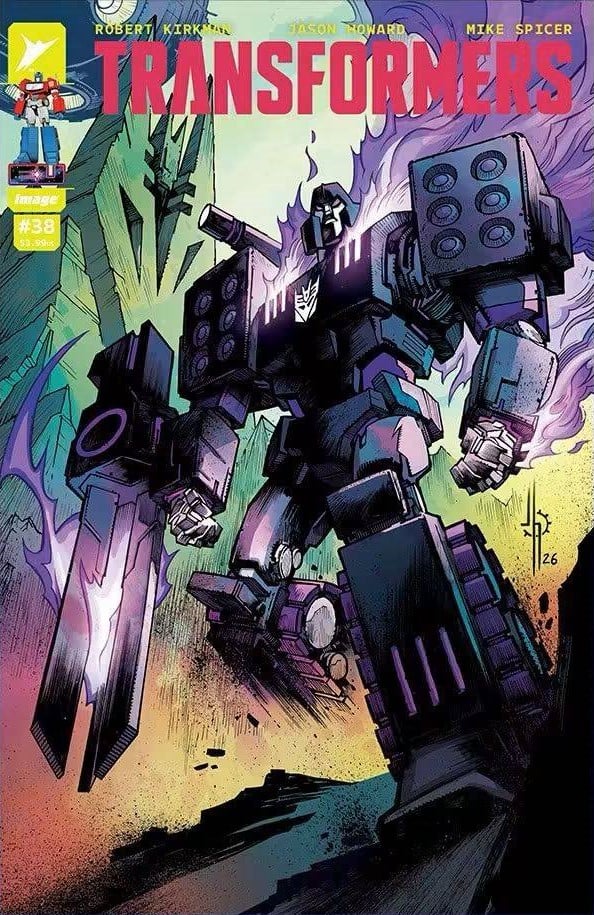
Transformers #38 launches a new story arc with a development that promises to reshape the series in consequential ways. As the cover suggests, Megatron emerges from his cocoon in a formidable new incarnation: Megatronus Rex. The transformation carries significant narrative weight because it grows directly out of events established earlier. After sustaining extensive damage, Megatron entered a dormant, cocoon-like state and encountered Megatronus Prime, who bestowed upon him the Matrix of Oppression. That sequence now reads not merely as a temporary detour, but as the foundation for a far more dangerous version of the character. Given Megatron’s famous transformation into Galvatron in the 1986 film Transformers: The Movie, many longtime readers may have expected the comic to pursue a familiar evolution. Writer Robert Kirkman instead moves in a less predictable direction, drawing on the franchise’s mythology without simply repeating it. By giving Megatron a distinct identity, visual language, and source of power, the story separates this transformation from earlier interpretations while positioning the Decepticons for a dramatic resurgence after their previous defeat.
Rather than easing readers into this new status quo, Transformers #38 opens with immediate conflict. Megatronus Rex and the Decepticons launch a full-scale assault on Earth’s Autobot faction, giving the issue a relentless pace from its earliest pages. In both structure and tone, the result resembles a more mature version of an episode from the 1980s animated series: the action remains the primary attraction, yet the violence carries greater force and lasting consequences. Campy, deliberately heightened dialogue reinforces that connection to the cartoon without reducing the confrontation to simple nostalgia. At times, the issue feels like the premiere of a new television season, familiar characters return, the central threat has escalated, and the balance of power shifts almost immediately. However, the spectacle also advances the larger narrative. The assault provides an effective showcase for Megatronus Rex’s expanded capabilities in both robot and vehicle modes, while the surprise appearance of a third configuration near the conclusion introduces another layer. Each reveal builds upon the last, allowing the issue to present the redesigned villain through action rather than exposition. The execution therefore accomplishes two goals at once: it establishes the magnitude of Megatron’s transformation and demonstrates why the Autobots are dangerously unprepared to confront him.
Amid the large-scale Decepticon offensive, the issue also introduces a device closely associated with the 1980s cartoon: the mech suit. Its earlier tease receives a substantial payoff when Carly takes control of the machinery and uses it to fight alongside her Autobot allies. More than a nostalgic reference, the sequence gives a human character a credible role in a battle otherwise dominated by towering combatants. Carly is no longer limited to observing the conflict or relying entirely on the Autobots for protection; equipped with the suit, she can respond directly and contribute on comparatively equal terms. The decision also revises expectations established by the animated series, in which Spike was more closely associated with this technology. Here, he does not receive a suit, although the story leaves open the possibility that he may eventually acquire one. That reversal keeps the homage recognizable while adapting it to the comic’s own character dynamics. Even so, the mech suit does not function as an easy solution to the Autobots’ crisis. The sheer brutality of the Decepticon attack makes Carly’s new hardware appear valuable but insufficient, emphasizing that individual courage and improved equipment may not be enough against Megatronus Rex’s overwhelming power.
As an opening chapter, Transformers #38 succeeds because it treats reinvention as more than a cosmetic change. Megatron’s new form supplies the immediate spectacle, but the issue’s real strength lies in how that transformation alters the conflict around him. The Autobots face an opponent whose abilities are not yet fully understood, the Decepticons regain a leader capable of restoring their momentum, and the human cast must search for increasingly dangerous ways to remain relevant on the battlefield. Meanwhile, references to earlier Transformers media lend the story a sense of continuity without dictating its direction. The combination of brisk pacing, forceful action, selective humor, and escalating stakes gives the installment the energy of a season premiere while preserving the consequences expected from a serialized comic. Although the emphasis on combat leaves some character threads only partially developed, that tradeoff feels purposeful rather than careless. By the final pages, the issue has clearly defined its central threat, demonstrated the inadequacy of the heroes’ current defenses, and created strong anticipation for the battles still to come.
Final Thoughts
Transformers #38 kicks off a new story arc with a bang, revealing Megatron’s new form.
Transformers #38: Megatron Rises
- Writing - 8.5/108.5/10
- Storyline - 8.5/108.5/10
- Art - 8.5/108.5/10
- Color - 8.5/108.5/10
- Cover Art - 8.5/108.5/10