


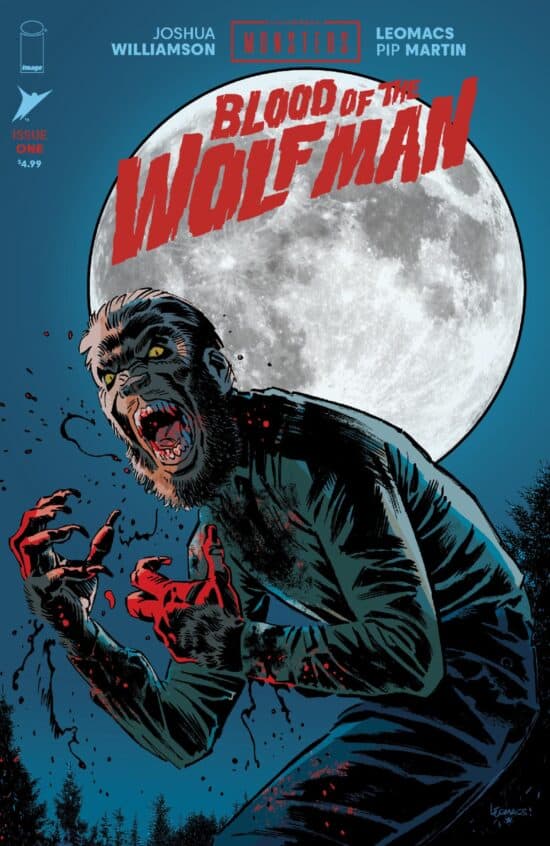
UNIVERSAL MONSTERS :BLOOD OF THE WOLF MAN #1

Recap
“Adam Jaeger thought he could become someone new at college... but not like this. One moment he was partying, the next he’s recovering from a massacre that left almost no survivors. The worst part? He might be responsible... As the monster within tries to claw loose, Adam will do anything he can to stop from becoming...THE WOLF MAN. The superstar team of JOSHUA WILLIAMSON and LEOMACS presents the next hit horror series of 2026!” - Image Comics
Review
The best Wolf Man reboot stories are always about more than just monsters, and this story understands that. The highlights of this book are the callbacks to the original 1941 Wolf Man movie; not literal callbacks, but thematic ones. This comic doesn’t attempt to reinvent the original story; rather, it honors what makes the film so enduring in the first place. Joshua Williamson, the author, reinterprets the themes of isolation and fate for a younger generation.
Brian Fanelli, a writer for 1428 Elm, points out that the creator of the original Wolf Man, Curt Siodmak, fled persecution in 1930s Germany. Siodmak channeled that feeling of being an outcast into the character of Larry. In the 1941 film, Larry is a pariah, disregarded and disrespected by the townsfolk. Larry lashes out against the town as the Wolf Man, killing Richardson and fleeing into the woods; a metaphor for how outcasts often feel anger toward the societies they reside in. Furthermore, the original film toys with the idea of fate. Larry retrieves the cane with the silver wolf’s head, inciting the plot of the film; it’s only because he grabbed this specific cane that he is able to kill the Bela. The pentagram appears in Jenny’s hand, signalling her death at the claws of the werewolf; the same symbol appears on Larry’s chest, sealing his fate. Siodmak wrote his life into this monster movie. In an interview with the Writers Guild Magazine and reported by Elaine Woo with the LA Times, he laments: “I am the Wolf Man… was forced into a fate I didn’t want: to be a Jew in Germany. I would not have chosen that as my fate.”
Williamson reimagines these themes throughout his reimagining of the cult-classic film. The main character, Adam, parallels Larry’s feelings of being an outcast. Adam is a compelling protagonist that readers will find relatable: especially younger comic readers. The inciting incident of the plot revolves around Adam’s isolation. Furthermore, subtle character moments brilliantly foreshadow the inevitable nature of Adam’s transformation. Adam’s fate is predetermined before readers even flip to the first page, with the description revealing his true nature. By framing the story in a way that the audience knows something that the characters don’t, readers feel that the Wolf Man’s rampage is inevitable, reinforcing the theme of fate. The writing’s greatest strength is what it implies, not what it shows.
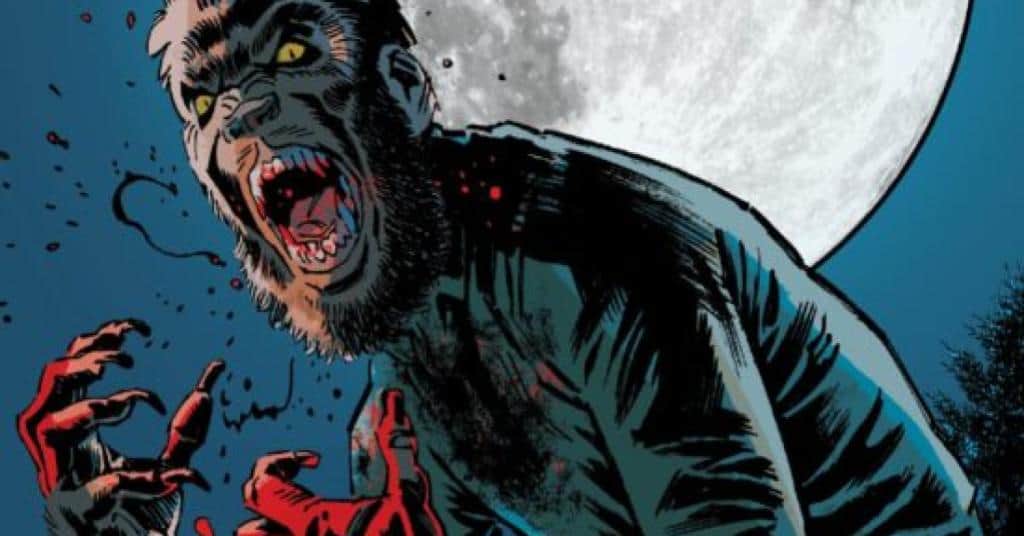
The art in this comic is lacking. The expressions look unintentionally exaggerated, almost cartoonish in their simplicity. Close-up shots of a character’s face look uncanny; something about their designs feels off. However, the art is entirely different when the story requires spectacle. Leomacs does a phenomenal job drawing the more fantastical elements of the story: the Wolf Man possesses striking amounts of detail; the action is electric and jumps off the page; the final page is striking and leaves the reader craving more. The art excels when it’s exciting; the art is lacking when it’s quieter.
Final Thoughts
Universal Monsters: Blood of the Wolf Man #1 is a faithful re-imagining of the classic Wolf Man story more fit for a modern audience. The book takes elements from the classic film and places them in a new setting. Williamson and Leomacs have laid a strong foundation; whether this momentum can be maintained remains to be seen.
Universal Monsters: Blood of the Wolf Man #1: A Faithful, Subtle Reimagining
- Writing - 8/108/10
- Storyline - 8/108/10
- Art - 6/106/10
- Color - 7/107/10
- Cover Art - 8/108/10