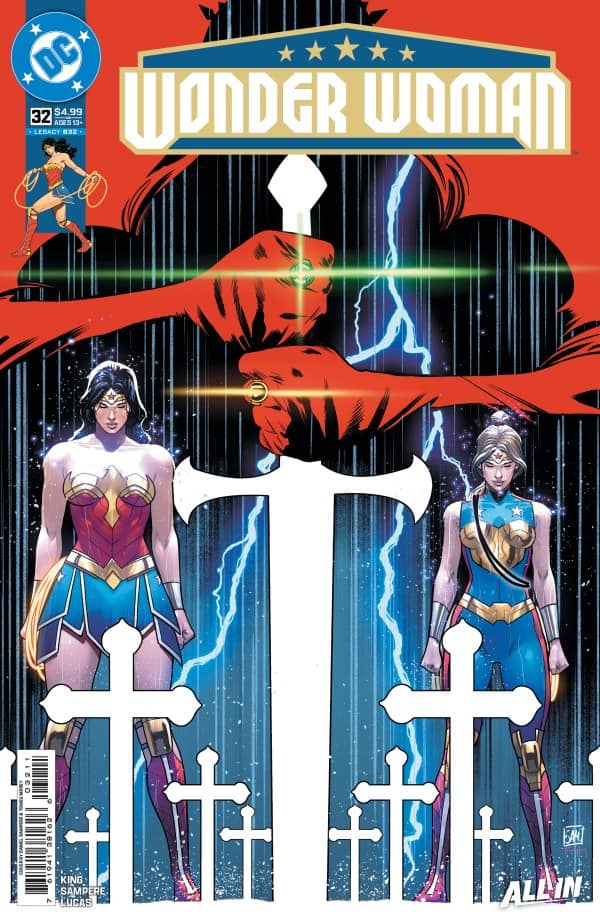
Wonder Woman #32

Anthony Bergamini
Recap
THE WONDER WAR CONTINUES! ALL HAIL THE MATRIARCH! After a disastrous attempt at stopping the Matriarch, she has risen more powerful than ever. Now it's up to Trinity, who finds herself alone as her allies fall one by one, to stop her childhood companion. Can the daughter of Wonder Woman finally live up to the name and all the pressures that come with it?
Review
Wonder Woman #32 continues the epic “Wonder War” storyline, which feels like the definitive culmination of everything that has come before. While the previous issue further introduced the dystopian future in which this story takes place, this installment digs deeper into its specifics, leading to several reveals that may leave readers scratching their heads. By the final pages, the arc increasingly resembles writer Tom King and artist Daniel Sampere’s swan song, laying the groundwork for the beginning of the end for many of the run’s lingering plot threads.
Over the course of the previous arc and the last issue, King and Sampere have carefully established that the Matriarch is every bit as powerful and unstoppable as she claims, demonstrating her dominance through multiple instances of her killing some of DC’s greatest heroes. With that foundation in place, this issue pulls back to explore a key question: why did Lyssa become the Matriarch? While it never fully answers that question, it does reveal the identity of her father and suggests how that connection may have shaped her worldview. However, the reveal is presented as if it were already common knowledge, creating the impression that one or two additional story arcs were originally intended but ultimately scrapped. As a result, what should have been a jaw-dropping moment instead lands awkwardly.
Even with that misstep, the issue still showcases classic Tom King storytelling in all the right ways. Regardless of one’s opinion on his run, it’s hard to deny his ability to structure a single issue so that it conveys everything essential about a character. This is especially evident in the way the narrative shifts between the Matriarch’s press interview and Wonder Woman and Trinity’s siege of Themyscira. The juxtaposition offers pointed commentary on how public figures manipulate events to suit their image, something that mirrors how Diana herself has been portrayed throughout the series. In many ways, this ties back to the book’s central thesis: highlighting what sets Wonder Woman apart while placing her on equal footing with Batman and Superman. Ultimately, it is her honesty and compassion in the face of overwhelming destruction that define her, especially when the odds are so heavily stacked against her.
From a thematic standpoint, this arc succeeds in bringing together many of the ideas the creative team has been building toward, positioning the story for a meaningful conclusion. Unfortunately, those thematic strengths are occasionally undercut by abrupt narrative leaps that make the plot feel rushed, particularly when it comes to moments that should have carried far greater weight as major revelations.
Final Thoughts
Wonder Woman #32 is a great issue in a vacuum that unfortunately suffers from a rushed narrative that makes it feel like parts are missing.
Wonder Woman #32: Political Irony
- Writing - 9/109/10
- Storyline - 6.5/106.5/10
- Art - 9/109/10
- Color - 9/109/10
- Cover Art - 9/109/10