


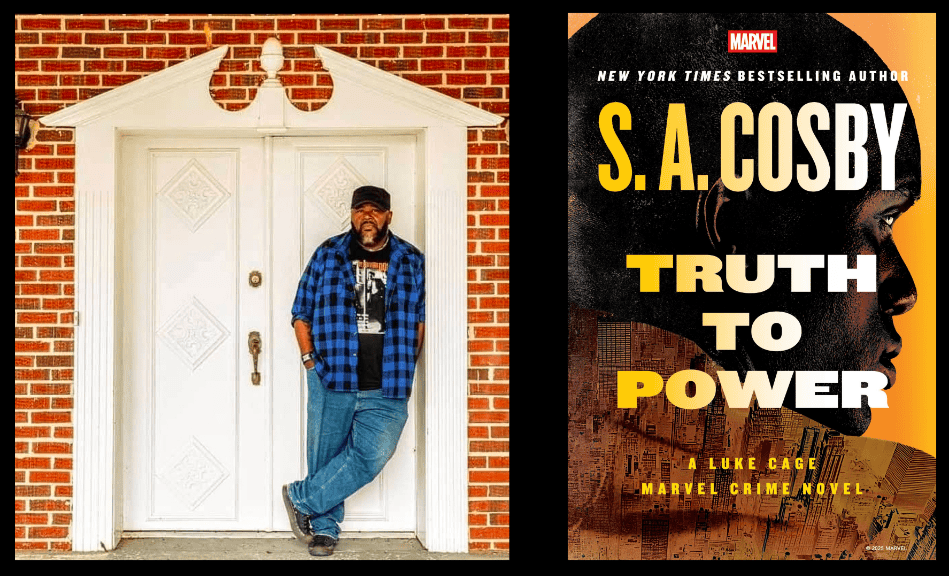
As New York Comic Con 2026 raged on, Tyler Davis, one of Comic Watch’s press correspondents at the show found some time to sit down and chat with author S.A. Cosby about his new novel, Luke Cage: Truth to Power, and the writing process that went into bringing Marvel’s iconic hero to the world of written prose.
Comic Watch NYCC 2026 Coverage:
- New York Comic Con 2026: Harvey Award Winners
- New York Comic Con 2026: Pizza, TMNT, & Matthew Rosenberg
- New York Comic Con 2026: Marvel Midnight Press Room Interviews
- New York Comic Con 2026: The Mighty Marvel Comics Press Room: Ryan North, Charles Soule, Ashley Allen, Joe Kelly
_ _ _
Tyler Davis (TD) – All right, so we’re here in New York Comic Con 2026, sitting with S.A Cosby. Prolific author of Razorblade Tears, All the Sinners Bleed, and many more great books. We’re here to talk about his new novel, Luke Cage Truth to Power.
So, the hook of this book, I know for a lot of comics readers going into it, is that you’re taking an iconic Harlem hero and dropping them into Virginia, a setting you are no stranger too as far as your other work goes. Is that something that Marvel came to you specifically for, or did you actively seek out bringinh your storytelling sensibilities to this character?
S.A. Cosby (SC) – It was more like I wanted to bring my sensibilities to the character. I love old movies and I’m a big fan of a movie called Walking Tall, which is about a vigilante Sheriff who just goes around busting people’s heads. I thought it’d be cool to have Luke Cage come out of New York and come to the South and just beat up rednecks for 300 pages, whilst also exploring a sort of the fish out of water story with him.
Luke is known as Harlem’s Hero. He’s an iconic New York character, but I thought it’d be interesting for him as a superhero, but also as a black man to come down the South and see how the ghosts of the Civil War, the ghosts of the South, haunt everybody everywhere across the country and how he would deal with that.
I thought that would be really interesting. When I first got word that they wanted me to do a Luke Cage book, and I write sort of cinematically, I saw images in my head. The first image that came to my mind was a good old boy cracking Luke over the head with a pool cue and nothing happening. I was, like, oh man, that’d be so much fun. So, the story sort of went from there, and to Marvel’s credit, they were super okay with it. They let me just take a story where I wanted to take it.
TD – It’s an interesting point you make about that imagery. The book opens with a quote from James Baldwin about the nature of hate. Was that something you had in your head, maybe not that quote specifically, but kind of the meaning of it going into the writing of this book or was that something you discovered as you were writing?
SC – It’s kind of the idea ahead going into it. I think it’s interesting, to quote another great Marvel character, ‘ with great power comes great responsibility’, this idea that Luke as a superpowered person, can lift 500 tons, has unbreakable skin, making it very easy for him to go around and bully people.
It would be very easy for him to just beat the hell out of people when he feels like it, and I liked taking Luke and creating this situation where he has to temper himself. He knows how strong he is. He knows how powerful he is. He doesn’t really necessarily want to hurt people unless they deserve it.
I thought it’d be cool to take that and give him in a situation where it challenges his ability to calm himself. It challenges his ability to restrain his strength, you know. In the book, he is asked by Matt Murdock, Daredevil, to investigate this prosthetic plant in the South near where he has some relatives. He asked his cousin to take a look at things before he comes down, and his cousin is found murdered.
The sheriff there tries to say it’s an accident, and so Luke has a lot of rage. Luke is a rageful character. He’s been through so many things: The experiment that gave him his powers in prison, the loss of his family. The fact of his father turned his back on him.
You know, all these things have happened to him, and so I wanted to show how he’s able to process that rage, how someone is able to hold it in and not let it consume them. That’s the main point of the book. Everything else in the middle is just the gravy and fun parts.
TD – That’s what I found so interesting about the quote was how it, you know, contextualizes people’s hate as a way to bury their pain.
You have Luke going up against Polar Bear Man in the opening chapter. It’s classical comic fun, but the book transitions into something that’s really important for a lot of people historically, culturally, and emotionally, similar to the route your other work has taken.
That route has a far more serious tone, so, coming into a project like this, did you struggle to kind of balance those things out?
SC – Yeah, it was weird. At first, I didn’t have a problem with getting too serious or feeling like the book was too heavy. I knew I needed a little bit of a lighter hand than say my other crime novels, but I did struggle with grasping where Luke fits powers-wise in the pantheon.
There are certain things that Marvel was like, ‘I don’t think he can do that’, but I was like ‘I think he can’.
That was the biggest struggle, but the tone was never really a struggle because I knew that Luke always had a sense of humor.
If you read the comics, Luke is a bit of a smart aleck. I like using that humor to sort of diffuse situations sometimes.
But as I said, he’s a character who deals with rage and he deals with injustice. I don’t like bullies, and I felt like Luke wouldn’t like bullies either, and so being able to use him almost as an avatar to explore that.
There are times where you wish you could just pluck somebody with your finger and send them flipping head over heels. You don’t want to kill them, but sometimes the only thing people understand is a good ass whooping and using Luke in that sort of way was really interesting.
I wanted him to really work on letting go of his hate. Letting go of his anger, his rage. Making the rage a righteous thing instead of just a visceral thing.
TD – So, we’re taking him out of Harlem, but Jessica Jones still has a role in this novel, as does Matt. As a long-time commentator, I can’t really remember the last time Marvel really explored traditional Southern American culture in a big way outside of Gail Simone’s current X-Men book being based in Louisiana.
How was it for you getting this pocket of the universe to flesh out in your own way?
SC – It was great. Luke is one of the great African-American comic book characters of all time.
To me, you put him on Mount Rushmore with Black Panther and Falcon. If you go into the distinguished competition, you have some really good characters in the Milestone books too in addition to the characters like Black Lightning.
So for me, it was really cool to take Luke and sort of show through him how the ghosts of the Civil War, the ghosts of the South, and everything that entails sort of haunts every one of us across the country, no matter where are you from.
Taking the guy from New York, who’s from that incredible sort of milieu and mix of culture, the excitement and intention, and taking him down Southwest life is a little bit slower, but a little bit more difficult sometimes. Getting to show him how that part of the country still affects him, even though he lives in New York as Harlem’s hero.
For me, it was really fascinating to try and showcase that, for all the problems that the south has, there’s some beautiful parts down there. As grotesque as it can be, it can also be beautiful, and you know, historically, I wanted to show that these ghosts still haunt us all.
TD – We’ve seen so many different versions of Luke, from his early 70s blaxploitation era to the 2000s when he was on The New Avengers, and even most recently as Mayor Luke. For you, since you’re writing outside of comics continuity, where do you find your Luke Cage?
Is it in the things you may have grown up reading or is it a facsimile of all these different things curtailed to what you love best about the character?
SC – It’s sort of an amalgamation of those things. In the book he’s not yet Mayor Luke, but he’s definitely not ‘Power Man’, blaxploitation with the open collar shirt down to the naval.
For me, he’s sort of that 90s Luke, where he stopped going by Power Man. When he started going by Luke Cage, wearing clothes like a leather jacket that was treated with the same process that gave him his powers, so it’s indestructible.
He’s this hero for hire, private detective, and like that version of him the best, in my opinion.
So in my mind, that’s where he was when writing. In the book, you know, I mentioned that he’s still friends with Danny Rand, Iron Fist. Danny’s one of his best friends. That’s another thing that was fun for me. Giving Luke that sense of strength and curated family, right?
Danny Rand is the brother that he lost. He loves Jessica Jones. That’s his partner, his woman. Having Matt Murdock as his really good friend and showing that he has this sense of support around him.
But for me, Luke is the best, in my opinion, when he’s this private eye with superpowers. I was talking to someone earlier about Walter Mosey and his character, Easy Rollins, and in my mind, that’s what Luke was like, especially in the 90s.
He was easy Rollins with unbreakable skin, and what that entails, I thought it was really cool to set him in that sort of pocket in the world that I was creating.
It was really special to show him putting clues together and not just using his brawn and his strength, but also using his brain and his intellect, you know, I thought that was really, really cool.
But he’s also got funny moments in the book. There’s a moment where he’s fighting some security guards, and he lets one of them go, and the security guy asks him, ‘you’re just gonna let me go?’ He responds with a sort of, ‘Well, do you want me to make it hurt?’
He has a sense of humor that, I think, was really evident in his earlier books that maybe doesn’t come through as much, especially like in the TV show, which I understand is a totally different medium.
So for me, I like that sort of wisecracking P.I., but just one that’s got bulletproof skin.
TD – You mentioned the loss of a cousin as a plot point like that kicks off the conflict in this book alongside the weapons situation in Harlem, bringing him down to Virginia.
What inspired you to set off his journey to Virginia that way?
SC – This series of crime novels from Marvel are a passing of the baton. Lisa Jewell did the Jessica Jones novel, and she passed the baton to Alex Segura for his Daredevil novel, and so of course, he passed the baton to me.
I thought it’d be cool to sort of take Luke out of his comfort zone. You know he’s always protecting New York. protecting Harlem, but I also thought it’d be cool to create a situation where he’s protecting the whole country.
I don’t want to give anything away, but once he gets into the meat of the story, you realize that what’s going on with these weapons is bigger than once thought. For those that haven’t read Alex’s Daredevil novel, [Matt] passes this case to Luke that started while he was fighting the hand. Some of the people he was fighting had cybernetic and enhanced prosthetic limbs that he traced down to Virginia.
He asked Luke to go down there and check it out because he has other things he’s got going on. Once Luke gets down there, he finds out that these guys are not just processing cybernetic prosthetics, but using multiple medical devices to control people.
It was really interesting for Luke to realize this could happen anywhere in the country. One of the detective things he does is he discovers that there are plants all over the country that are owned by this company. You can have these enhanced people who are mind controlled anywhere in the country. It made the story less about Harlem and New York, but about the whole country. At the end of the day, Luke’s a hero, and he’s got the broad shoulders to carry the weight. He does what heroes do.
Luke is considered a street level character, and I agree with that. I understand that, but just because this is a street level character doesn’t mean the stakes can’t be really high. I really wanted to make the stakes as high and as personal for him as possible for him.
TD – That’s a great point, because sometimes the stakes on the streets are just as high as they are with a giant laser beam in the sky. You make an interesting point about the story transcending Luke to being a protector of the entire nation that starts out of something intimate with the ‘ghosts of the south’. With how dark our country’s origins are and its politically fractured personality, when you’re writing within an IP, and you have these kinds of ideas that are socially relevant, but also very thematically relevant, and enrich Luke, do you ever find yourself struggling to walk the line between the story being both entertainment and socially meaningful?
SC – Yeah, I think I’ve always struggled with that, whether it’s in Luke Cage, or my crime novels. There’s a great quote from Stephen King where he says that nobody wants a 300 page sermon, You can talk about whatever you want to talk about as long as the story is good. and exciting. I like to say that, when you come to my books, you come for the wood chipper and stay for the existential drama.
With Luke, there’s a lot of fun stuff in the book. There’s this scene where he and his surviving cousin go to a honky talk bar, and he beats up some rednecks. There’s another scene where a security guard tries to shoot him and the bullets bounce off. He doesn’t want to punch the guy because he might kill him. So, these scenes where you see Luke using his power, measuring it, and trying not to hurt people are fun scenes. There’s a scene where he gets jumped by whole gang of people and he’s working hard not to break these people’s necks. Those action elements are there, but underneath the action is this unfortunate social dynamic.
Being a big black dude in a small town with white people, you learn to watch where you walk. You learn to watch what you say, you learn to be aware of your surroundings, and even though Luke has superpowers, that’s still a part of the way he sees the world. He can’t help it.
There’s a scene in the book where he has to go knock on somebody’s door and ask to look at their ring camera because he thinks it might have recorded some evidence, and even though he’s bulletproof, he still hesitates a little bit.
He still steps way back, so he’s seen as non-threatening. I think that’s something, unfortunately, you learn as African-American man in America, especially if you’re a man over six feet. So, for me, the line is always, am I doing this in service to the story?
As long as I’m not preaching or proselytizing, I think it’s okay. Once you start you slip into a sermon, then you’re gonna lose people because nobody’s gonna listen, no matter what you have to say. No matter how intelligent it is, they won’t listen if they feel like you’re attacking them.
The story is paramount, but within using a story, you can slip something greater in. The story, the action and the drama is the candy, and then the social commentary is the medicine.
TD – Well, it sounds like it’s all coming from the character, which makes the themes feel even more real and even more honest. I remember my first interaction with Tony Morrison’s work in high school and loving how much Beloved read like a horror novel whilst also being this other thing that, after digging beneath the surface, had me realizing just how much I still had to learn about the world.
SC – I read a novel years ago called A Thousand Acres by James Smiley. It’s about three sisters who are trying to be the one that inherits a farm from their father, and for me as a man, there’s seeds in that book that had me going oh, this why women go to the bathroom in groups and things of that nature.
So, to me, using this book to sort of talk about those issues while still, again, making it fun, making it exciting, and keeping it action packed. There’s a scene in the book where Luke just picks up a forklift and throws it at a guy, and I think we’ve felt the need to do that.
_ _ _
Luke Cage: Truth to Power is available now wherever the best books are sold. You can find more of S.A. Cosby over on Bluesky and discover more of his work here on his official author’s page on Goodreads.