Fallout

Henry Davis
Recap
With big irons on their hips, our intrepid group of wastelanders find themselves on a new journey filled with intrigue and unfamiliar locations, drawn into an ever-unraveling conspiracy of destruction as they begin to uncover what appears to be an unending war with them at the center.
Review
The first season of Amazon’s Fallout was a shocking critical success, further proving that the true home for video game adaptations in the motion video landscape is the small screen. Expectations were understandably high going into the second season, which boldly chose to venture into the sacred halls of Fallout: New Vegas, a game almost universally regarded as the series’ best. It’s a daring move, especially considering the show had only just completed its inaugural season, which in itself felt like a Hail Mary attempt to translate such a vast and intricate franchise into a new medium.

After the credits rolled on the season finale, I was left feeling oddly conflicted. While this season elevates several of the elements that made its predecessor so compelling, its execution is far more uneven. The standout remains Cooper Howard, with Walton Goggins continuing to deliver one of the most captivating genre performances on television. Beyond his arc, however, much of the cast feels stuck in a sluggish state of character progression, weighed down by the sheer number of competing plotlines running wild this season. Lucy and Maximus’ journeys are still integral to the broader narrative, but the season’s pacing services them so inconsistently that their stories are often shuffled aside before they can truly gain momentum.
It’s ultimately the performances that kept me invested. Goggins, as mentioned, pours everything into Howard, crafting one of the most engaging protagonists the genre has seen in years. Ella Purnell convincingly portrays Lucy’s growing maturity, but the slow-burn approach to her arc feels less deliberate than it should. Her development is largely put on hold as the story waits for her long-anticipated reunion with her father, undercutting the steady changes the early episodes so carefully set up. While those initial chapters do an excellent job establishing her conflict with the Ghoul and the brutal rules of the Wasteland, that momentum stalls as the season repeatedly diverts its attention to other narrative threads in an effort to escalate the larger conflict.

Maximus fares similarly. Despite being granted one of the season’s most triumphant moments, Aaron Moten’s character often gets lost in the dense lore and internal politics of the Brotherhood. The season’s overreliance on plot mechanics, rather than character-driven decision-making, leaves it feeling defined more by what it establishes on a macro level than by the sharp satirical cynicism that allowed the first season’s character writing to soar. That said, there are still moments that genuinely surprised me and elicited an emotional response, largely stemming from the haunting past of Cooper Howard that swirls around every story this season. The return of a familiar face from the previous season also became a consistent source of laughs, growing more effective the longer it lingered. On top of that, several inspired casting choices are sure to delight fans of both the games and film alike.

Even so, I’m deeply intrigued by the tangled web of tension this season leaves behind. Warring factions, morally fraught decisions, and consequences that echo far beyond a single choice are at the heart of Fallout at its best. In that regard, this season sets the table for one of the most ambitious power struggles the franchise has explored in Bethesda’s nuclear wasteland. The lack of immediate resolution ultimately works in its favor, allowing the writers to lay the groundwork for a layered, interconnected conflict that firmly positions New Vegas at the center of an escalating battle for the future of America.
One of my biggest fears going into the season was that New Vegas would serve as little more than nostalgic window dressing, and for a time, that concern felt justified. With the narrative spread so thin across multiple characters, Lucy’s time in the capital of sin is frequently undercut, never quite allowing the city to emerge as a character in its own right. Historically, Fallout has excelled at imbuing its settings with a distinct identity—from the Capital Wasteland to the sprawling wilds of West Virginia—and that sense of place is intrinsic to the franchise’s post-apocalyptic storytelling. The season’s first half struggles to capture that magic. Fortunately, as the latter episodes weave their disparate threads into a chaotic yet compelling convergence, New Vegas finally begins to breathe, coming alive in the way I had hoped from the start.
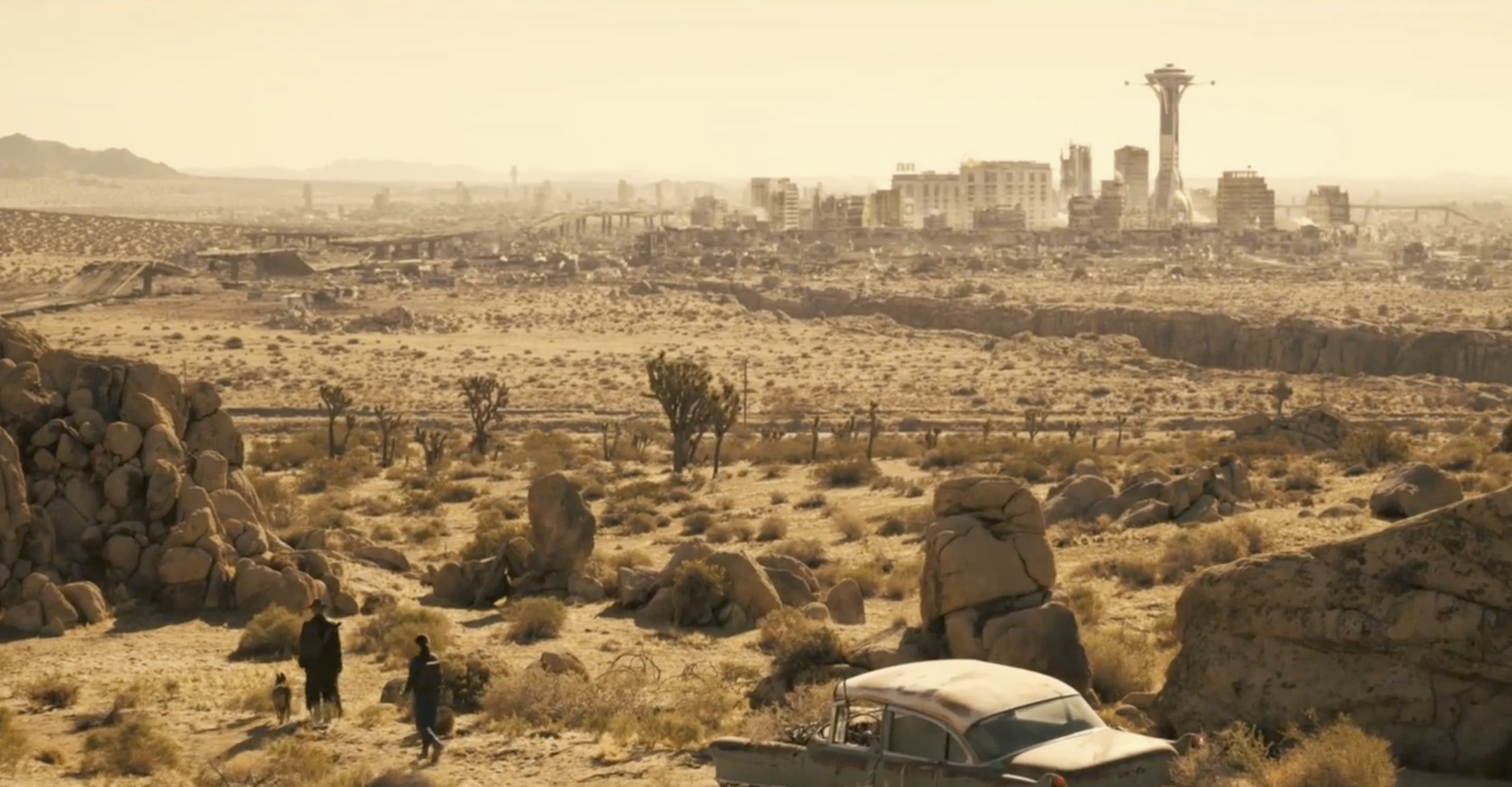
From a craft perspective, the season is as strong as ever. The attention to detail on display makes it clear how deeply the creative team understands and loves the Fallout universe. Several creature designs are genuinely jaw-dropping, the realization of New Vegas and its many inhabitants is exquisite, and the expanded range of environments introduced alongside a new overarching threat helps broaden the scope of the world without losing sight of its grime-soaked roots. It’s a technically impressive season, even when its storytelling ambitions occasionally outpace its ability to fully realize them. Especially in the practicality of its design and crafty uses of CGI that manage to envelope the viewer in an unrelenting grip of escapist atmosphere.
Final Thoughts
With the season now complete, it’s clear that the purpose of these episodes was to patiently weave together a massive climax—one poised to crack open the very soul of the series as it heads into its third season. While the season is filled with strong setup and a devotion to expanding the scope of its plotting, this decisions the risk of falling flat when so few of the character arcs introduced at the outset are given satisfying resolutions.
Fallout Season 2: What Happens in Vegas
- Writing - 6/106/10
- Storyline - 7/107/10
- Acting - 8/108/10
- Music - 9/109/10
- Production - 8.5/108.5/10