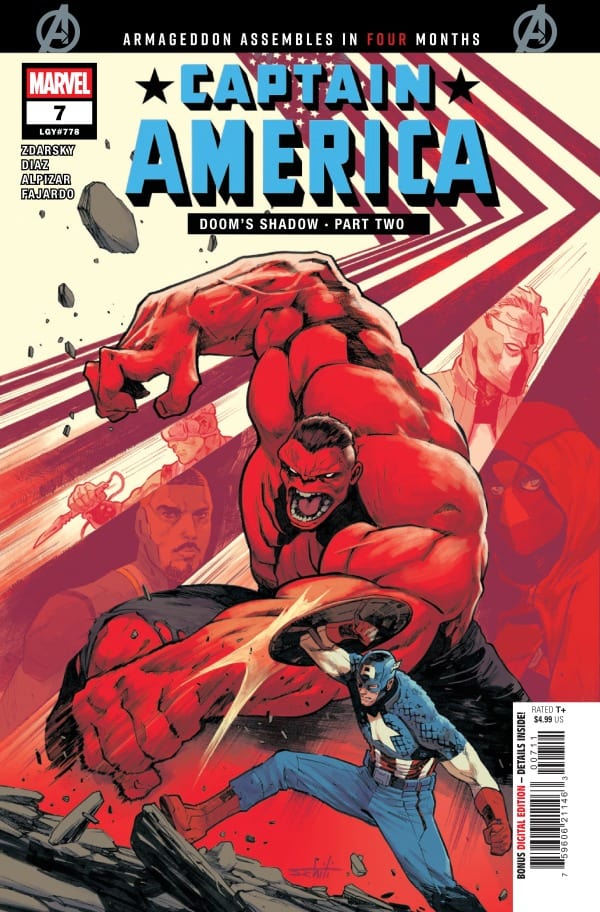
Captain America #7

Henry Davis
Recap
A CAPTAIN'S CRUSADE! Red Hulk's fear of a second Doctor Doom rising from the ashes of Latveria spurs him into taking drastic action, just as Captain America discovers there are those within the war-torn country who see a path to a brighter future. Can Captain America bring their dream within reach, or are there too many forces stacked against him?
More Marvel heroes coverage from Comic Watch:
Alien vs. Captain America #4: D-Day
Marc Spector: Moon Knight #1: Caging the Moon
Planet of the Apes vs. Fantastic Four #1: We're Not on Yancy Street Anymore...
Review
Politics and their role in comic books has become white noise in the background of popular media discussions, with books as politically potent as Captain America criticized for daring to reflect the societies of the world today. Without lecture or ignorance, Chip Zdarsky has continuously approached this title with political writing that runs deeper than the surface, and there may not be an issue as poignantly representative of this as Captain America #7. Alongside a rather brilliant art team, this book continues to sing with a cohesive and emotionally rich sense of storytelling that has been missing not just from this character, but from the company as a whole in the last decade. That may sound hyperbolic, but in a world where political comics only seem interested in corpo-approved rebellion, reading an issue as multi-layered in its commentary feels blissful.
Starting with the art, the work here is genuinely jaw-dropping. Both Delio Diaz & Frank Alpizar knocked their pages out of the park this month with work that both elevates the script and stands tall on its own accord. Their take on Red Hulk is both menacing yet detestably insecure, his red-blooded bravado the mask of a man deeply brutalized by the same kind of foreign policy failures he himself continues to weaponize. Their use of shadows and lighting allows for in-panel positioning that feels cinematic, but doesn’t ever forget the nature of its own medium. Their representation of Latveria continues to be incredibly thoughtful in its use of rustic, Eastern European influences, feeling as though it’s a place brimming with historic culture but unafraid of elevating the humanity of its citizens with intelligence and modern design sensibilities.
On the writing itself, with all the setup out of the way in the last issue, Chip hits the ground running here as we begin to layer out the faction-based conflict that is running wild throughout Latveria. Seeing Steve navigate this by divorcing himself from the political operations of S.H.I.E.L.D. and the dynamics of said groups themselves, and instead venturing into the streets of Latveria, brought about a whole new perspective of depth that allows him to think with his head and heart equally, avoiding the kind of militant excuses both his allies and enemies have begun making for themselves. There is a brilliant character return from the first arc that layers this exploration of political systems and the supposed necessity for violence.
Every major antagonist in this title thus far has subtle differences that separate them from their shared goal of societal control. Safety and the cost of freedom have been loud conversations in society over the last two days, but Zdarsky is cutting through that noise with Steve, who sees true freedom as the cure for those societal strifes. He isn’t being played as the “both sides” wrong centrist that so many writers peg him as to avoid having to say anything bold themselves. This Steve offers a new way forward in his fight for humanity that hopes to break the shackles of convention that men with money and ego have enslaved the world with.
That being said, there is a particular “Marvel” moment in this issue that does have me nervous that the intricate design of this run so far might be short-lived. It might be more trope fatigue than anything else, but, and spoilers be warned, the secret relative of a major Marvel evil actually being good is a trope I am exhausted by. Now, if this is used to layer its themes of closed-circuit politics, then it might be one of the best versions of this trope in modernity, but only time will tell.
Final Thoughts
Captain America #7 continues marching slowly towards Armageddon with an intricately layered and political dynamic exploration of a country left swirling in a post-fascist state, Steve Rogers the only point of authority interested in the human beings under threat of gluttonous power structures. This book continues to be one of Marvel's best.
Captain America #7: A Captain’s Crusade
- Writing - 8.5/108.5/10
- Storyline - 8.5/108.5/10
- Art - 10/1010/10
- Color - 10/1010/10
- Cover Art - 7.5/107.5/10