Terrorbytes #6

Theron Couch
Recap
Lost inside a fully immersive alien VR recovered from the Roswell UFO crash, Dr. Asher wanders a dying world of bone fields, glass forests, and firefall oceans—unaware that pulling the plug would kill him in the real one. As time fractures and the inhabitants finally reach out, TERRORBYTES #6: Witch House delivers a haunting sci-fi descent into isolation, exploration, and the terrifying cost of going too far.
Review
Terrorbytes #6 is more theme oriented than plot oriented. The plot is still a dark manifestation of technology, but it’s not as much a disaster created solely by humans’ technological development.
Shocking no one who has been reading Terrorbytes, something goes terribly wrong when the human scientists attempt to use alien technology in Terrorbytes #6. A test subject is left in a kind of catatonic state and the argument that develops is whether or not to kill him. The test subject’s fellow scientist doesn’t have the authority to unhook him which could be fatal or the budget to keep him alive indefinitely. London is not playing this dynamic for humor, but it’s hard to not to chuckle at the bureaucratic dilemma.
This argument kicks off the big thematic discussion In Terrorbytes #6. The person the scientist goes to for help with the problem doesn’t understand why the problem developed in the first place–how the scientists could proceed with such a dangerous venture. The scientist explains the simple truth that mankind are explorers. Throughout history, humans have routinely used new technology that they haven’t fully understood.
London hits on an interesting idea here whether he meant to or not. Indeed, it’s one that justifies every horrible thing that has happened in the series. Humanity routinely leaps before it looks. The thing that makes Terrorbytes so compelling is that every leap has gone horribly wrong on some level.
The purely plot oriented framing story, that of the robot Nate Culver trying to find out what happened to humanity, takes a big step forward here. There is not a shift in focus from the one off anthology stories that Terrorbytes tells to this longer framing story, but the latter is gaining in importance. Presumably the two types of stories are headed for some kind of collision course. In any event, the framing story has grown more compelling.
Doe’s art is largely minimalist when it comes to characters. What little lines he uses are just enough to shore up a feature or two–along a character’s mouth when they’re angry, firming up a cheekbone when they’re in semi-profile, etc. The limited expressiveness comes through characters’ eyes, and even that is minimal. It works for the most part. There are only three characters of any consequence in Terrorbytes #6, and they largely have a default emotional state through the series. In a strange way, The art and the narrative are strongly suited for each other.
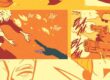
Backgrounds follow this style for the most part as well. The major exception are the sequences that take place in a very exotic location. It’s almost as if Doe saved on detail elsewhere so he could bring a higher level of work to these exotic places. Backgrounds, creatures, inhabitants–everything is much more detailed here than anywhere else in the issue. This is relatively speaking, though. The art isn’t suddenly overloaded with fine lines and nuanced shading, but it is enough to set the location apart.
Doe’s coloring is a natural extension of his art style. There is little nuance in color transitions here. An example is that characters and backgrounds don’t show darkened hues suggesting they are ever in shadow relative to light sources. The palette itself is fairly limited. The aforementioned exotic locations have the widest range with primarily blue and green. The more familiar locations are based on burnt orange with little range beyond that. Everything feels slightly muted–even the richer exotic locations with their wider color palette. These sequences are brighter by comparison but nothing is so vivid it truly jumps off the page.
Mangual does his usual good job keeping dialogue out of the way of the issue’s art. There aren’t very many text heavy sequences, but in those cases he fits them in between characters or off to the side, always letting the important visual elements shine through. In most panels, where there are only two or three dialogue bubbles, Mangual will sometimes use long tails linking them to the character so as to keep the bubbles as far as possible from the character and visuals immediately around them.
Final Thoughts
New technology continues to go horribly wrong in Terrorbytes. This issue’s problems don’t hit quite as close to home as many others. The big success here is the discussion on why humanity might get themselves into these problems in the first place. As a dystopic technology gone wrong story, this is a fairly light issue. That said, Terrorbytes #6 is the smartest issue the series has put out yet.
Terrorbytes #6: Leaping Before Looking
- Writing - 9/109/10
- Storyline - 8/108/10
- Art - 7.5/107.5/10
- Color - 8.5/108.5/10
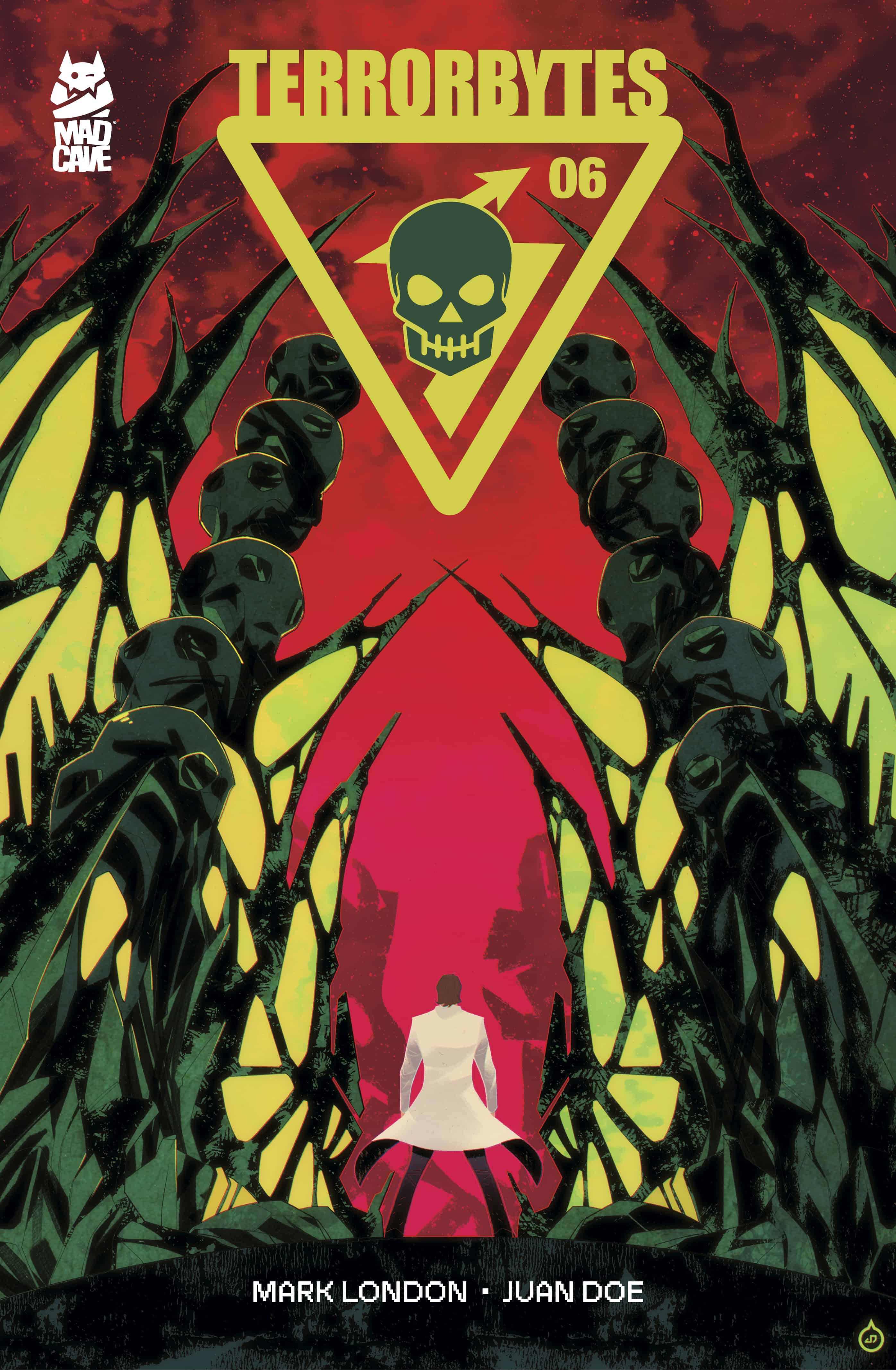
- Cover Art - 7/107/10