The Flash #31

Anthony Bergamini
Recap
Wally West: father, husband, and fastest man alive. And now with DC K.O. in the rearview mirror, Wally can finally relax and live his best life. Or can he? Because an awful lot of people are suddenly relying on the Flash to save them — and intentionally putting themselves in danger to ensure that he does! Something sinister is happening behind the scenes... and Wally is right in the crosshairs.
More Flash coverage from Comic Watch:
Flash #28: Talkin' 'Bout My Generation
Review
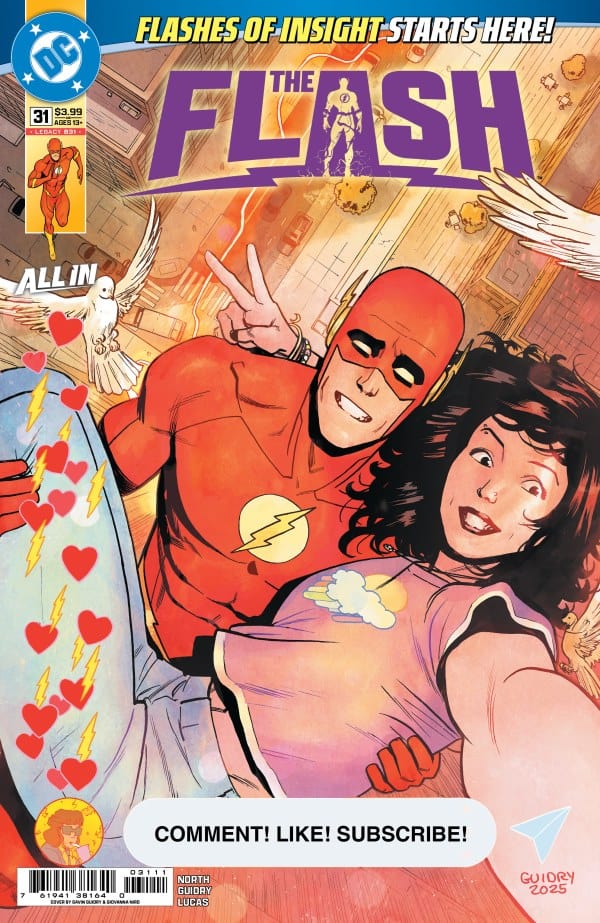
The Flash #31 kicks off not only a brand-new story arc, but also a fresh direction for the character. Over the past few years, the series has undergone several shifts, taking Wally West and his family through dense, high-concept science fiction stories. While ambitious, many of those arcs felt ethereal and somewhat disconnected from what fans consider the core of a Flash title.
That approach ultimately gave way to the most recent storyline, which acted as a palate cleanser for readers who didn’t quite connect with Simon Spurrier and Vasco Georgiev’s earlier work. At the same time, it functioned as a tie-in to the recently concluded DC KO event. Now, with Ryan North and Gavin Guidry at the helm, the book appears to be moving in the opposite direction, one that many readers will likely view as a return to basics.
From the outset, this issue establishes three key ideas:
- Wally is a devoted family man who still embraces his signature humor.
- Gavin Guidry’s love for the character shines through, particularly in the return of Wally’s classic costume.
- Central City feels as vital and alive as any member of the supporting cast.
Together, these elements create a strong opening that recalls the era when Wally first won fans over after taking up the mantle from Barry Allen. Guidry’s enthusiasm is matched by North’s writing, which clearly draws inspiration from Jeremy Adams’ run. Wally’s family, Linda, Irey, Jai, and Wade, remains central to the story, giving the book an immediate warmth and grounding. This focus reinforces Wally’s growth over time, offering a sense of progression that many long-running characters often lack.
Although the issue isn’t packed with classic villains, it uses its limited roster effectively to highlight Wally’s relationships with them. After laying its foundation, the story introduces Tar Pit, a lower-tier rogue who accidentally creates a tornado using the Weather Wizard’s wand. Instead of defaulting to a fight, Wally talks him down, uncovers the misunderstanding, and resolves the situation peacefully. It’s a refreshing approach, one that echoes memorable moments from the Justice League animated series, where Wally’s rapport with his rogues was a defining trait. This brief interaction encapsulates the essence of the Flash just as effectively as the opening pages establish Wally’s identity as a family man.
As the story unfolds, the larger arc begins to take shape with the reveal that Wally has developed a new ability: glimpses into the future. In the wake of DC KO, several characters have gained new powers, serving as a catalyst for fresh jumping-on points across the line. For Wally, this addition feels particularly fitting, given his history of racing to prevent possible futures. It’s an intriguing twist that adds psychological depth, even if its long-term implications remain unclear.
The central conflict revolves around a disturbing “game” orchestrated by an unseen figure. Citizens of Central City are encouraged to put themselves in danger, jumping from buildings or stepping in front of trains, with the promise of a cash reward if the Flash saves them and they manage to snap a selfie with him. This premise introduces a layer of social commentary, drawing a clear parallel to real-world viral trends that often lead to self-harm or reckless behavior. As a result, the stakes feel grounded and uncomfortably relevant, presenting Wally with the impossible task of being everywhere at once.
What makes this storyline especially compelling is its intimacy. By focusing on Central City and its people, the narrative shifts away from the universe-spanning threats of previous arcs. The smaller, more personal stakes suit the character remarkably well, reinforcing this new direction as both refreshing and deeply fitting.
Final Thoughts
The Flash #31 kicks off a wonderful new direction for the character, establishing a close, intimate feel with this character that has been heavily missed.
The Flash #31: Race Back to Basics
- Writing - 9.5/109.5/10
- Storyline - 9.5/109.5/10
- Art - 9.5/109.5/10
- Color - 9.5/109.5/10
- Cover Art - 9.5/109.5/10