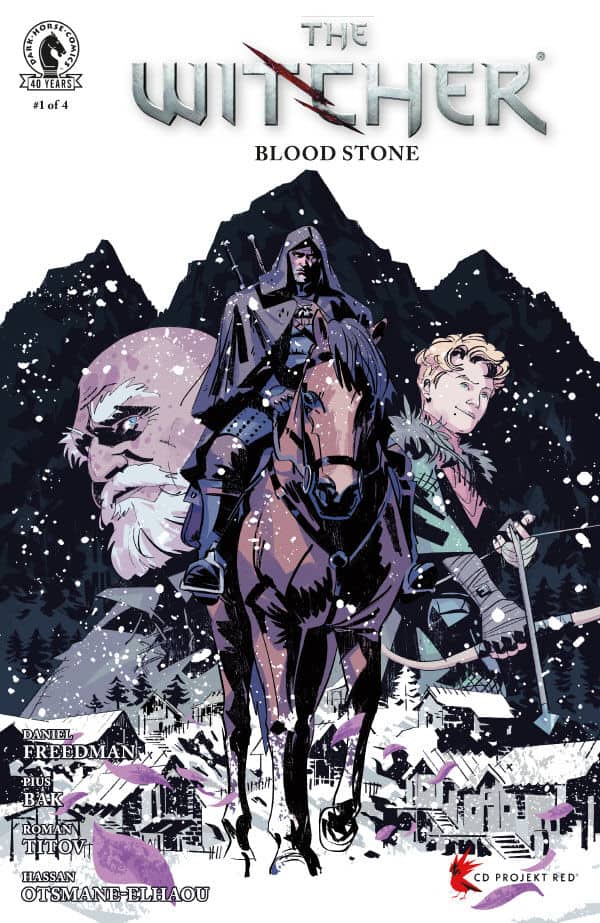
The Witcher: Blood Stone #1

Jamison Nilsson
Recap
On his travels northward, Geralt of Rivia stops in a small town called Plinth. For as long as anyone can remember, the town has been plagued by the deaths of travelers who come to the town in search of treasure said to be hidden in the mountains and the abandoned mines, according to legend. With time to kill and a bit of coin to be made, the white wolf settles in for a short four-issue story.
Review
The Witcher: Blood Stone #1 opens with a rather simple setup. Geralt’s services have been hired by a simple baker who wishes to stop the cycle of bloodshed in his small and otherwise peaceful countryside village. The baker and the people of the town of Plinth are introduced to us quickly with simple and easy-to-remember names that match each of their professions. These characters are, for the most part, stock for the background and the story that will unfold over the story’s four-issue run.
Geralt in particular is portrayed well. The white wolf’s no-nonsense demeanor and ruthless professionalism are balanced in a way that feels closer to the video games from CD Projekt Red than the original books by Andrzej Sapkowski. That said, fans of the books who are unfamiliar with the games will still feel at home here, as the story doesn’t dwell much on Geralt; instead, it focuses on the mystery at hand. Rather than revealing any dark secrets about the village itself or any of its inhabitants, the mystery is deeply tied to the dwarven mines in the mountain that treasure hunters regularly seek out but never return from. While I won’t spoil what Geralt finds inside the mines or the conclusions he draws from it, I will say that it’s classic Witcher. The issue ends in a way that sets up the story rather well and makes the vast expanse of the northern countryside feel like a small place to hide when everyone you meet is a suspect, and if that’s not a beloved Witcher tradition, then I don’t know what is.
Pius Bak’s artwork captures the dreamy embrace of a cold northern countryside without forgetting the subtle dread of any good Witcher comic. A lot of this comes down to Roman Titov’s colors, which add to the atmosphere of the issue, placing bright tones against simpler and darker shades to draw attention to important pieces of the page and to set the tone for the reader. The artwork also strengthens the storytelling, such as Geralt’s Wolf School Medallion, which is used as a means to convey clues to the reader, such as when magic is nearby, and is an important piece of the story for knowing when the pacing is about to change. This kind of telegraphing only works because mystery and subtlety are two of The Witcher’s greatest strengths as a series.
Final Thoughts
The Witcher: Blood Stone #1 is an excellent introduction to a short four-part story and is set up as strong “further reading” for fans of the Witcher universe. Both the story and the art seem to understand the world and its most famous character, Geralt of Rivia, who is portrayed well despite only playing a small role in the actual events of the issue itself. My recommendation: perfect for pre-existing fans of The Witcher, perhaps a bit confusing for first-time readers that aren’t already familiar with the character or world.
The Witcher: Blood Stone #1: Greed vs. Peace
- Writing - 8/108/10
- Storyline - 8.5/108.5/10
- Art - 8.5/108.5/10
- Color - 9/109/10
- Cover Art - 8/108/10