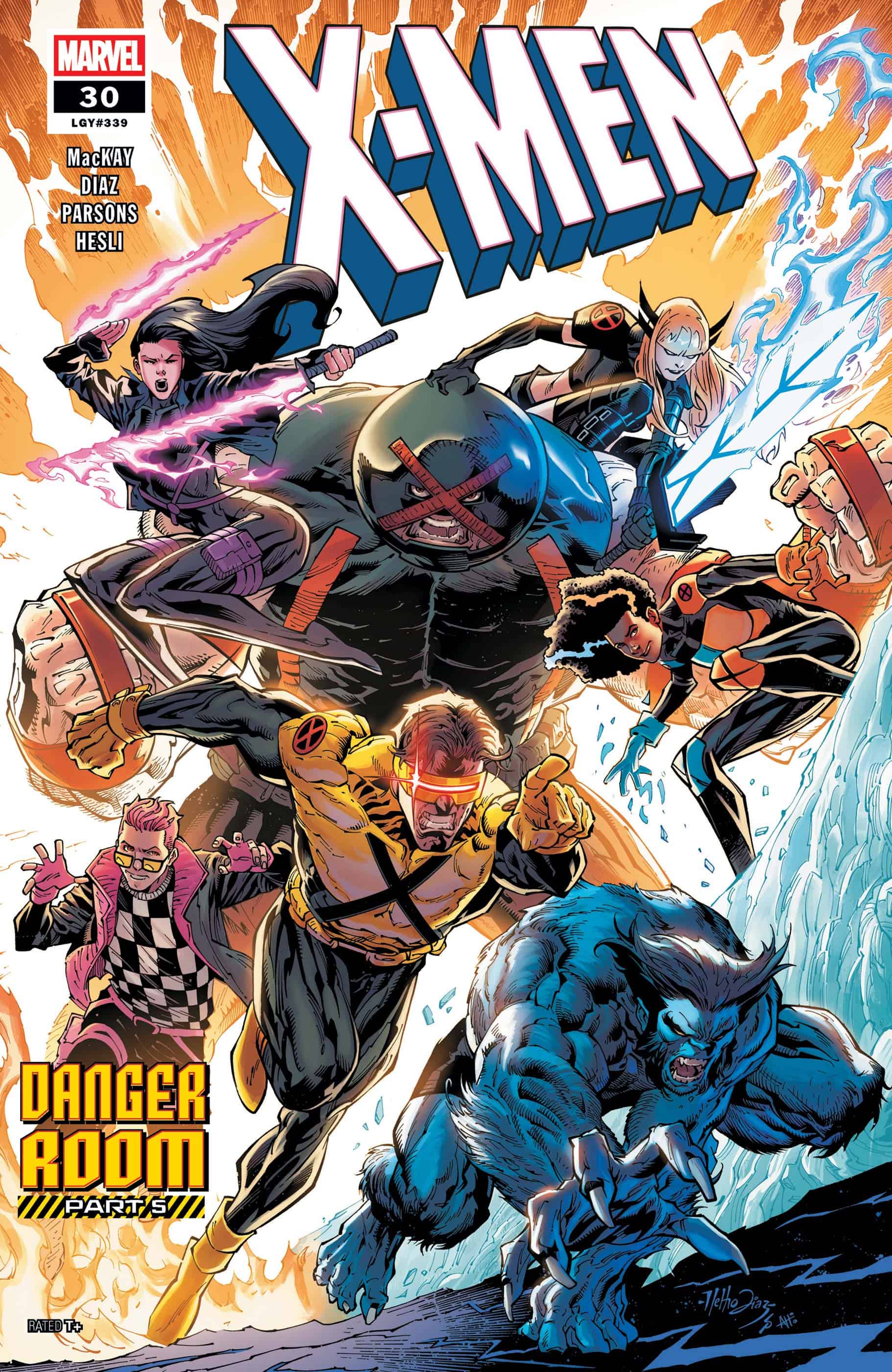
X-Men #30

Jamison Nilsson
Recap
The X-Men have been divided and attacked by the Danger Room, a new group funded by the Beyond Corporation to eliminate the X-Men once and for all.
Review
X-Men #30 should have been a milestone issue. It brings an end to one of the longest story arcs in the book’s run yet doesn’t hit that iconic status. Aside from the numerous other problems with the Danger Room story arc, X-Men #30 in particular is extremely condescending to its readers.
The characters themselves are where this sense of the author writing down to their readers becomes the most prevalent. All of the characters speak with this far too self-aware tone that’s somehow emotionally healthy and deeply dysfunctional at the same time, such as Psylocke calling herself the “world’s greatest psychic-ninja assassin” or Cyclops suddenly taking credit for Beast/Hank’s plot armor and labeling it his strategy. The problem with it is it doesn’t really come across as realistic even by comic book standards, which are already loose to begin with.
Take Hank McCoy, for instance, aka Beast, who is probably the worst example of this kind of over-characterization. He has been left to fight a battle of wits with the bio-weapon that previously took out the rest of the X-Men’s A-team. He convinces this “weapon” that it is actually, by his definition, a “person” and able to make its own choices free from the Danger Room’s control. Although this somewhat invalidates Hank’s point since he is subtly manipulating the weapon to some extent himself. In other words, Hank literally talks down an enemy that has him and nearly everyone else on the ropes. It’s the definition of plot armor that has been written to seem more intelligent than it is.
Then we have our villains, a group of underwritten psychopaths without clear motivations or distinct personalities who have been presented to us as evil for several issues without sufficient explanation beyond “they’re the bad guys, okay?” All of these new Danger Room “characters” who are in league with Beyond Corporation are exactly the kind of characters that will never return once another writer takes over the X-Men title. Not because there isn’t grounds for a storyline with them, but for the reason that they are forgettable archetypes rather than distinct figures.
Netho Diaz and Sean Parsons’ art is filled with inconsistent spacing, with rooms that seem cramped but suddenly become large enough to fit a different kind of panel or angle, which throws the pacing of the already questionable storyline further off track. However, the artists do bring an impressive level of finer details to several of the scenes, such as the detailed screens in the danger room or the characters themselves, who are each well drawn.
Arthur Hesli’s colors are a standout in this issue, bringing a vibrant coat of paint to Psylocke’s sword, enhancing character designs, and providing atmospheric lighting to numerous scenes. Whether it be the Alaskan town of Merle late at night, which is lit in hues of yellow and orange by streetlights and window reflections, or the cooler blues of the danger room’s technological interiors. A colorist’s job is to top off the artwork and to enhance the tone, not to carry that tone almost single-handedly. In X-Men #30, the color does both.
Final Thoughts
X-Men #30 is a poorly written issue that finishes an overly dramatic story arc that has failed to change anything about the X-Men’s status quo or establish interesting new characters.
X-Men #30: Thirty Long
- Writing - 5.5/105.5/10
- Storyline - 5/105/10
- Art - 7/107/10
- Color - 8.5/108.5/10
- Cover Art - 8/108/10